
Daily protein intake and strength training over 40

Tofu with wholegrain pasta, lentils with bread and yogurt with oats all contribute protein without a scoop of powder. For adults aged 19 to under 65, the German Nutrition Society (DGE) gives a general reference value of 0.8 grams per kilogram of body weight per day. Turning 40 does not introduce a separate age category. For strength training, the useful distinction is between this general reference and guidance for demanding sports training.
Daily protein: how age and training affect the guidance
The German Nutrition Society (DGE) gives a reference value of 0.8 grams of protein per kilogram of body weight per day for adults aged 19 to under 65. From age 65, it gives an estimated adequate intake of 1.0 gram. There is no additional age category starting at 40 in this table.1
These are DGE reference values, not a statement of current US dietary guidance.
| Context of the DGE figure | Protein per kilogram of body weight per day | Scope |
|---|---|---|
| Adults aged 19 to under 65 | 0.8 g | General reference value, not a specific strength-training target |
| Adults aged 65 and over | 1.0 g | Estimated adequate intake |
| Demanding sports training from five hours per week | 1.2 to 2.0 g | Sports context; training volume, intensity and goals matter |
The sports position paper discusses this range from five training hours per week. Training intensity and goals also matter. Reaching a particular number of hours does not by itself mark a biological threshold for protein needs.3 Two short workouts do not automatically put you at the upper end of the sports range.
The unit describes the whole day’s protein intake, not powder to add on top of meals. The weight used in the calculation matters too: the general DGE reference values relate to normal weight. They should not simply be multiplied by current body weight to create individual advice when weight falls outside that scope.1
The daily total includes protein from every ingredient that provides it. Bread, pasta and oats count alongside tofu, eggs and yogurt.
Protein and amino acids: what is behind the gram count?
Proteins are made of amino acids. The body uses these building blocks to make its own proteins, including structures in muscle, transport proteins in the blood and enzymes that enable metabolic reactions. Protein therefore matters beyond the training day. Indispensable amino acids, also called essential amino acids, cannot be supplied in sufficient amounts by the body itself and must come from food.2
The protein amount on a label tells you how much protein a food provides, but not its amino acid composition. Availability to the body also differs between sources and preparation methods. When choosing foods, variety therefore matters alongside quantity. Grains contain relatively little lysine, for example. Pulses such as lentils provide more lysine but are lower in sulphur-containing amino acids such as methionine. Lentils and bread can therefore complement each other’s amino acid composition.2
You can see this in the example day: oats in the morning, tofu with wholegrain pasta at lunch, and lentils with bread at dinner bring different sources together. You can spread that variety across the day without following a rigid pairing formula for every plant-based meal.3
Glycine and creatine: how they connect explores how amino acids also take part in making other compounds.
Which everyday foods provide protein?
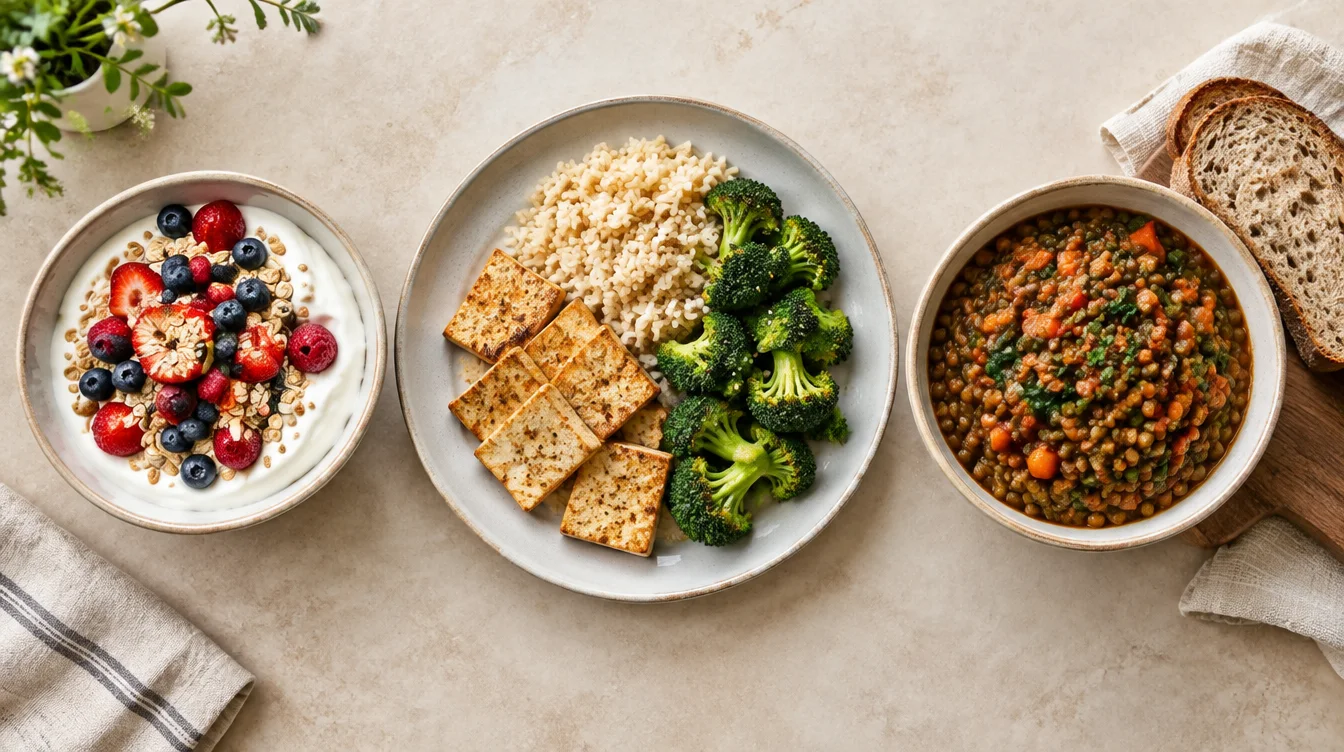
You can start with ordinary ingredients. Dairy foods and eggs are possible sources, as are tofu, pulses and grains. Bread and pasta contribute to the day’s total too. Counting only tofu or eggs overlooks part of the meal.
These comparison values come from the DGE food table. Varieties and individual products can differ. For pasta, lentils, vegetables and tofu, the figures here refer to the cooked food.2
| Food | Protein per 100 g | An example serving | Protein in that serving, calculated |
|---|---|---|---|
| Tofu, cooked | 16 g | 100 g | 16 g |
| Lentils, cooked | 9 g | 120 g | 10.8 g |
| Wholegrain pasta, cooked | 6 g | 200 g | 12 g |
| Wholegrain bread | 7 g | 100 g | 7 g |
| Oats | 13 g | 60 g | 7.8 g |
| Walnuts | 16 g | 25 g | 4 g |
| Yogurt, 1.5% fat | 3 g | 150 g | 4.5 g |
| Egg, boiled, without shell | 12 g | 60 g | 7.2 g |
| Button mushrooms, cooked | 4 g | 100 g | 4 g |
| Green beans, cooked | 3 g | 150 g | 4.5 g |
Identical weights do not make foods interchangeable. Walnuts, bread and tofu serve different purposes in cooking. Use the table for arithmetic rather than sorting foods into good and bad categories. A plant-based yogurt alternative does not automatically have the same values as dairy yogurt either.
To calculate a serving: protein per 100 g × grams eaten ÷ 100. For 120 g of cooked lentils, that is 9 × 120 ÷ 100 = 10.8 g of protein. If you weigh dry lentils, use an entry for dry lentils instead. Water absorbed during cooking makes a fixed conversion unreliable without a measured cooking yield. The guide to nutrition values and portions explains this distinction.
An example day with protein calculated for each meal
Here is one way to divide the ingredients between breakfast, lunch and dinner. All protein values are calculated from the same DGE table. This is a quantity example for three meals, not a complete dietary plan or daily target. Energy, other nutrients and drinks have not been assessed.
| Meal | Ingredients and edible amounts | Protein calculation | Total |
|---|---|---|---|
| Breakfast: yogurt and oats | 60 g oats, 150 g yogurt with 1.5% fat, 25 g walnuts | 7.8 + 4.5 + 4 | 16.3 g |
| Lunch: wholegrain pasta with tofu and button mushrooms | 200 g cooked wholegrain pasta, 100 g cooked tofu, 100 g cooked button mushrooms | 12 + 16 + 4 | 32 g |
| Dinner: lentils and beans with egg and bread | 120 g cooked lentils, 150 g cooked green beans, 60 g boiled egg without shell, 100 g wholegrain bread | 10.8 + 4.5 + 7.2 + 7 | 29.5 g |
| Combined | The listed ingredients across all three meals | 16.3 + 32 + 29.5 | 77.8 g |
For breakfast, mix the yogurt and oats and add the chopped walnuts. For lunch, prepare the pasta, tofu and button mushrooms according to their preparation instructions and weigh the cooked components. At dinner, use fully cooked lentils and beans, boiled egg and bread. Follow the preparation instructions for each ingredient.
The quantities in the calculation are ready-to-eat amounts, not a shopping list for dry pulses or pasta. Sauce, oil, additional sides and other additions are not included. If you add them, record their own product values. The decimal places come from arithmetic using rounded source values, not a laboratory analysis of your meal.
Spread meals through the day without watching a countdown
For sports training, the DGE position paper discusses three to four eating occasions across the day. You can use that to plan meals without starting a countdown after a workout. Protein amounts can vary between meals, and the paper does not prescribe one gram count for every person and every meal.3
For a workday or an evening workout, start with when you can comfortably fit in a meal. That might mean a prepared lunch or a breakfast with a protein source you enjoy. The example day has different amounts at different meals. Build around your opportunities to eat rather than trying to make every meal reach the same number.
For specific meals with amounts and calculations, see the high-protein breakfast without powder, the high-protein snacks for work and the after-work dinners.
The same flexibility applies to plant foods: different sources can be eaten across the day rather than all in one meal.3
The portrait Bryan Johnson: how he organises his Blueprint day shows how meals and movement fit together in a published biohacking schedule. It describes his personal practice alongside his commercial product range, rather than providing a protein requirements table.
For a different way of organising meals, see Andrew Huberman: What he eats. The portrait separates his food choices and personal reasons from human study findings on protein and meal timing.
When might a shake be convenient?
| Your situation | A practical next step |
|---|---|
| You have not yet looked at your usual meals | Start with the ingredients and servings from an ordinary day |
| Ordinary foods fit your routine | Do not buy powder solely because you work out |
| A meal is difficult to fit in when travelling | Compare a portable meal with a shake for preparation effort, tolerance and product information |
| A large number on the packaging looks convincing | Separate grams of powder, grams of protein, the reference amount and the ingredient list |
A shake can be convenient when fitting in food on the go is difficult. Compare it with a portable meal: which works better for preparation effort, tolerance and your day? The DGE prioritises ordinary foods and does not treat supplements as a basic requirement.3
Record the portions you actually eat
Want to see how protein from your own meals adds up? Find the matching foods in The 8 Protocol or use the barcode on the package, then enter the amounts you ate. Pay particular attention to raw versus cooked food and your share of a dish. The diary and data export are available without a subscription. Plus is optional.4
Start with a meal you already make. That connects a number to an actual plate rather than asking you to copy the example day unchanged. View The 8 Protocol on the App Store.
Frequently asked questions
Do I automatically need more protein after 40?
The general DGE table has no additional threshold at 40. Training volume and individual circumstances need to be distinguished from age alone.12
Does protein from plant foods count?
Yes. Tofu, lentils, grains and other plant foods contribute. Use the appropriate preparation state and the amount actually eaten in the calculation.2
How much protein belongs in a single meal?
The sources used here do not set one protein amount for every meal. The sports position paper discusses several eating occasions throughout the day. The portions above show how to calculate what each meal contributes.3
Must I have a shake immediately after training?
A shake immediately after training is not a general requirement in the DGE position paper. Start with meals you can fit into your day.3
Why does a product label differ from the table?
The table contains general food values. Your product’s recipe, water content and preparation may differ. For a packaged food, use its applicable nutrition information and reference amount.
Bringing the numbers back to your meals
Choose a meal you regularly eat and work out how much protein its ingredients contribute. The portions and example day show the arithmetic, not a personal dietary plan. Energy, other nutrients and drinks have not been assessed. Seek qualified advice for individual targets or dietary changes involving an existing medical condition.
Sources
- DGE: protein reference values. General reference values and estimated adequate intakes with age and weight scope. Not a specific training target for people over 40 or a statement of current US guidance.
- DGE: questions and answers about protein and indispensable amino acids. Reference values, sport and foods; Table 1 attributes its values to DGExpert/Monica-Mengenliste. The serving values above were recalculated from the listed per-100-g figures.
- König and colleagues, 2020: DGE position on protein intake in sports. Expert position paper covering training context, sources, distribution and supplements.
- The 8 Protocol on the App Store. Product source for the listed input methods and free basic features.