Gymnastic rings training: choose your exercises
During a ring row, your feet stay on the floor as you pull your chest towards the handles. Changing your body angle changes the task without adding a weight plate. A pair of rings can provide pushing, pulling and selected leg and trunk exercises. Start with a suitable set-up and variations whose movement you can control.1
Strength and movement control are useful goals when thinking about ageing well. Getting out of a low seat, lifting a bag and pushing something away call on different abilities. Rings provide bodyweight strength tasks, while a kettlebell can add external load and different movement patterns. For the broader foundations, see Calisthenics and kettlebells: strength without a gym.
Easy to carry, with a suitable place to train
Rings and straps fit in a rucksack and can be packed away after training. That makes them practical at home or when travelling. Whether you can use them at a particular location depends on the suspension point as well as the time you have available.
Use an attachment point suitable for your specific ring system and its intended use. The rings, straps, fastenings and supporting structure must work together. Pulling firmly on an unfamiliar ceiling hook, branch or frame does not verify it as a training point. Permanent fixings depend on both the mounting product and the load-bearing material. Have their suitability assessed by a competent professional if you are unsure, and follow the relevant manufacturer’s instructions.23
Before each use, check the rings, straps, stitching and fastenings. Damaged parts, slipping straps and abrasive or sharp contact surfaces are reasons not to use the set-up. Allow clear space for the movement and a surface where your feet can maintain their footing during assisted exercises. Another ring model’s manual can illustrate what needs checking, but cannot replace the instructions for your own system.2
What changes when you use rings?
A push-up moves your body away from the handles, while a row brings it towards them. In these set-ups, ring height and foot position change your body angle. This gives you ways to choose a more manageable task within the same movement family.1
Leg exercises use the rings in several distinct ways. Suspending a foot changes a split squat, hand assistance supports a pistol squat, and a hamstring curl brings the heels towards the body. Hyperextensions also belong in the exercise selection for the back of the body, but require suitable purpose-built equipment here. The differences are explained below.
Keep a useful selection for each location
Record the equipment each exercise needs. At home, you might have ring rows and a kettlebell hip hinge you have already learnt. Elsewhere, a pull-up station or parallel bars may be available. Floor push-ups and bar dips are separate equipment alternatives, rather than the same exercise with the rings locked in place.
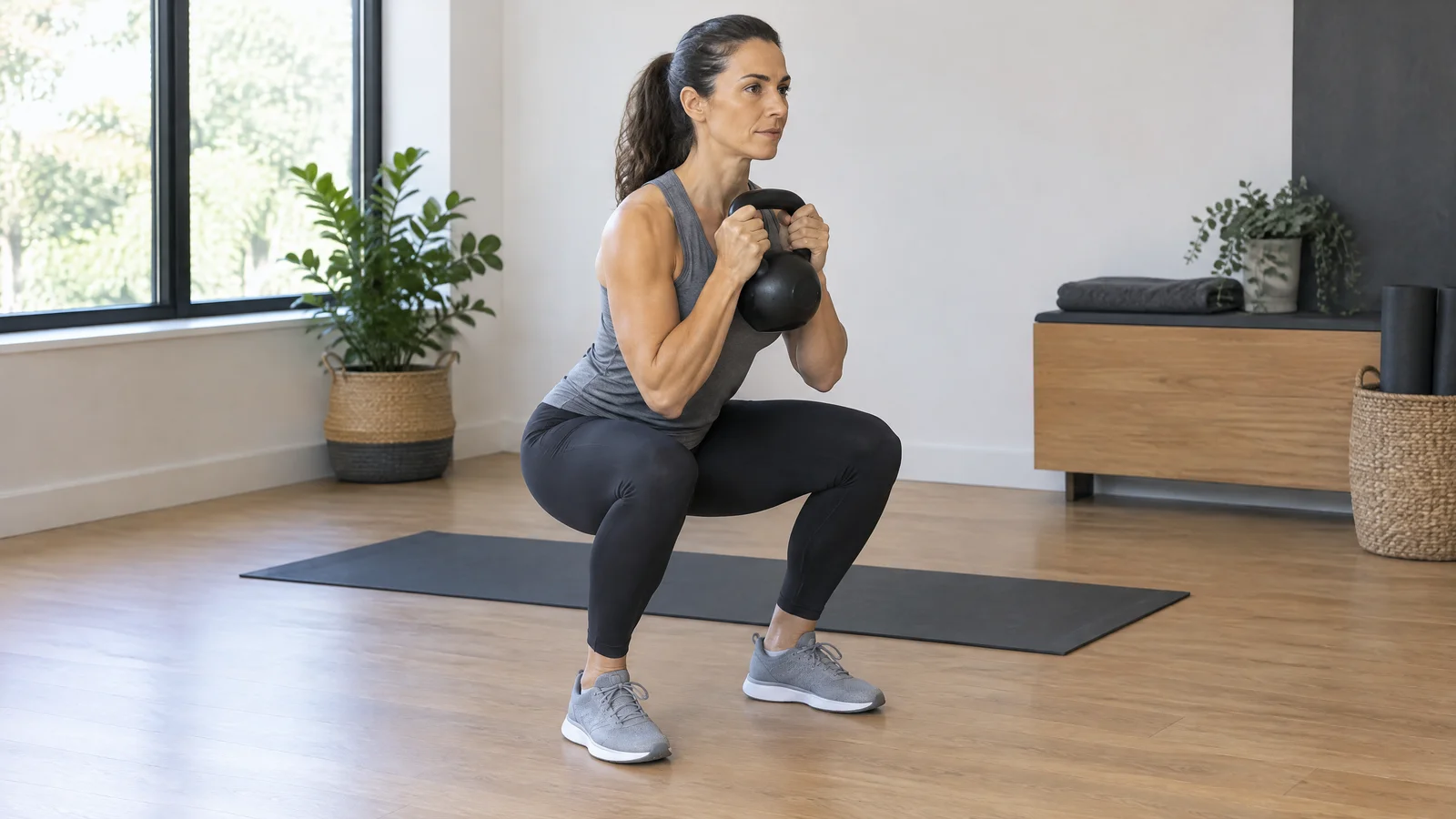
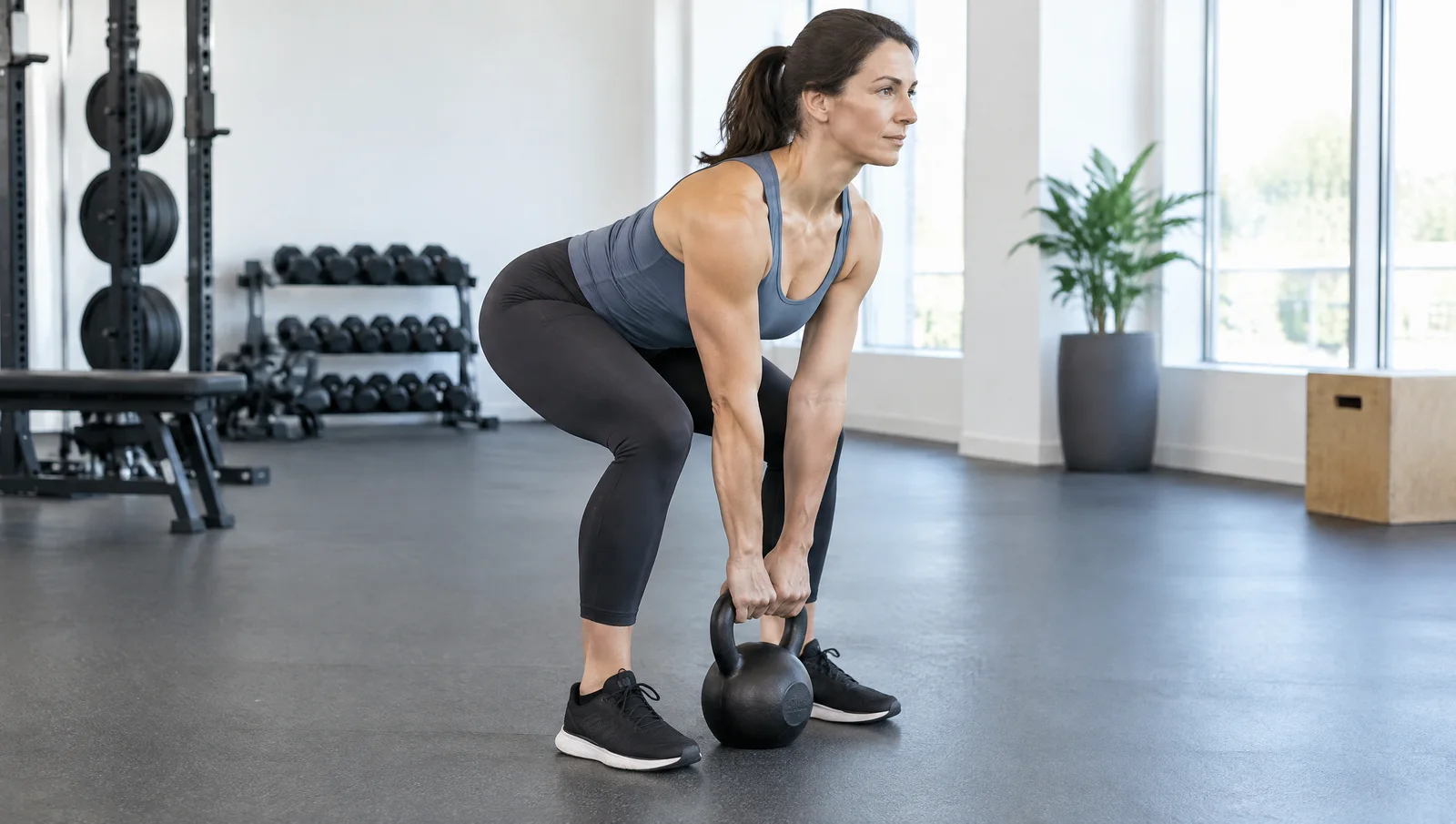
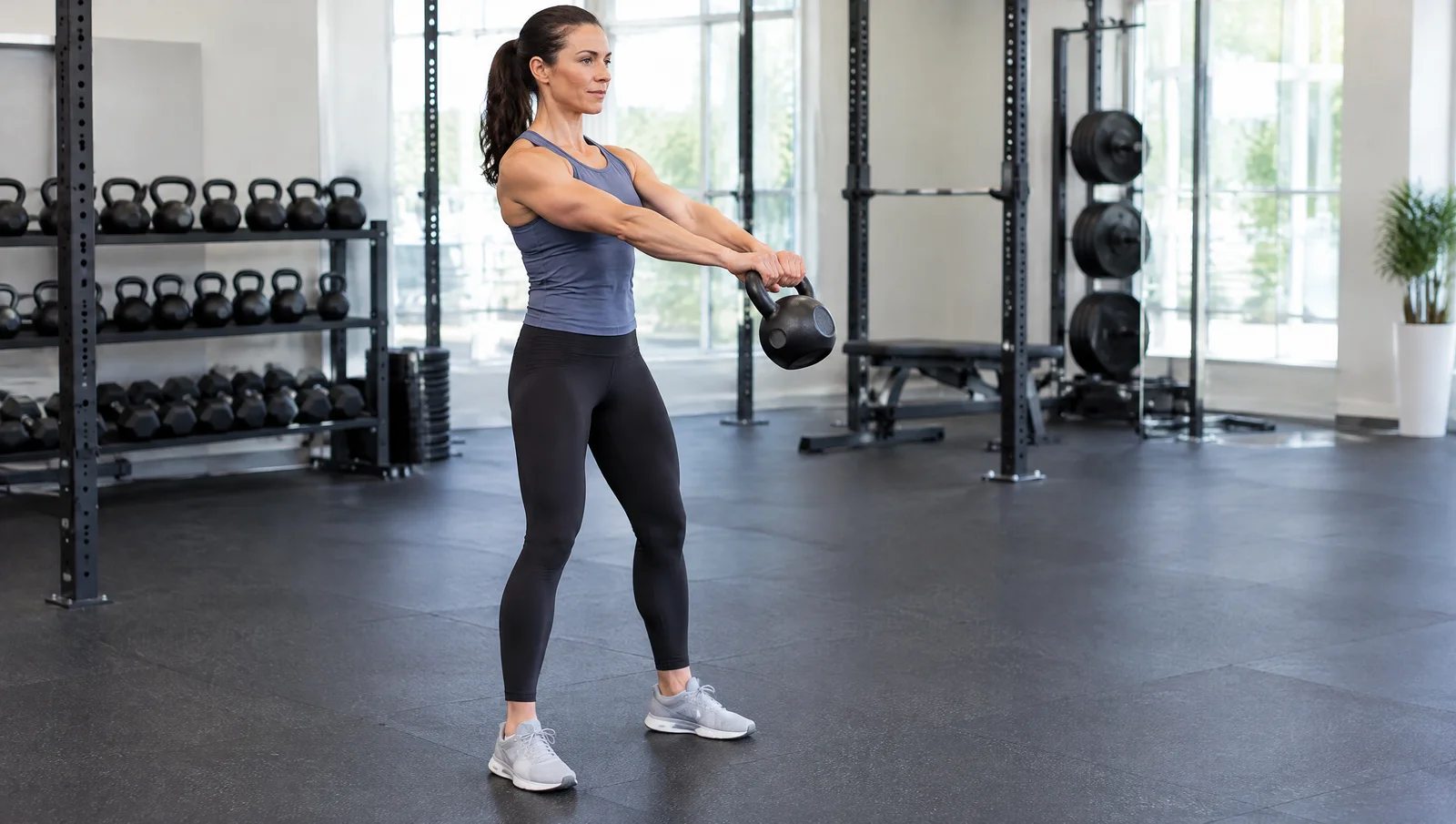
A kettlebell complements rings when you want to move an external load deliberately. In a goblet squat you hold it in front of your chest. In a deadlift you lift it from the floor using a practised hip hinge. A swing, learnt later, adds a dynamic hip drive. Those are different tasks from a ring curl or a hamstring curl. Heavy squats and deadlifts also retain a place where they suit your goals, skills and equipment. For technique and exercise choices, see Kettlebell training over 40: four exercises for your routine.
A location-based exercise list answers the question of what is available today. The A and B sessions below organise different exercises into two training days. You can combine the two ideas without inventing an entirely new programme for every location.
Chest, shoulders and triceps
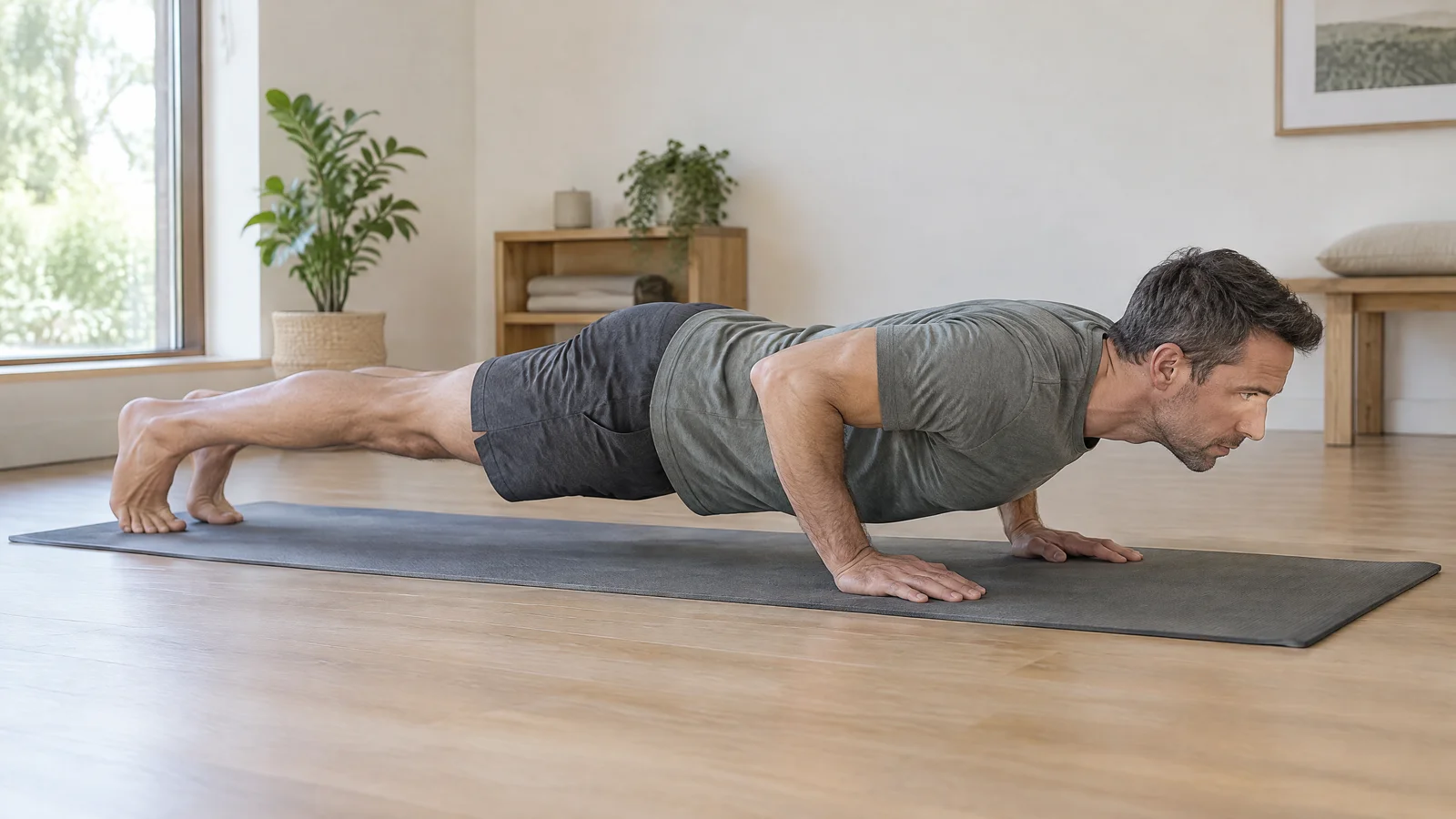
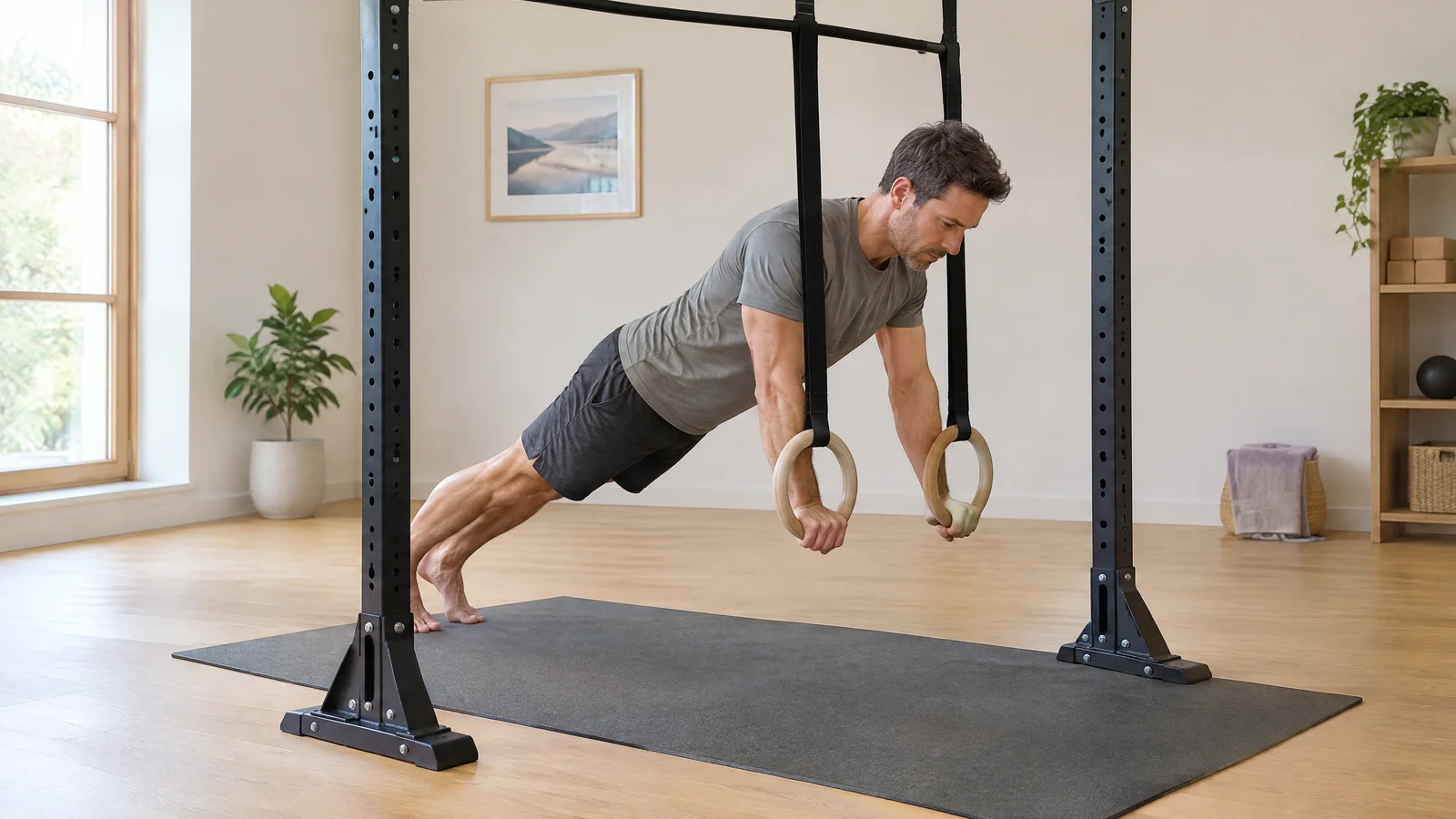
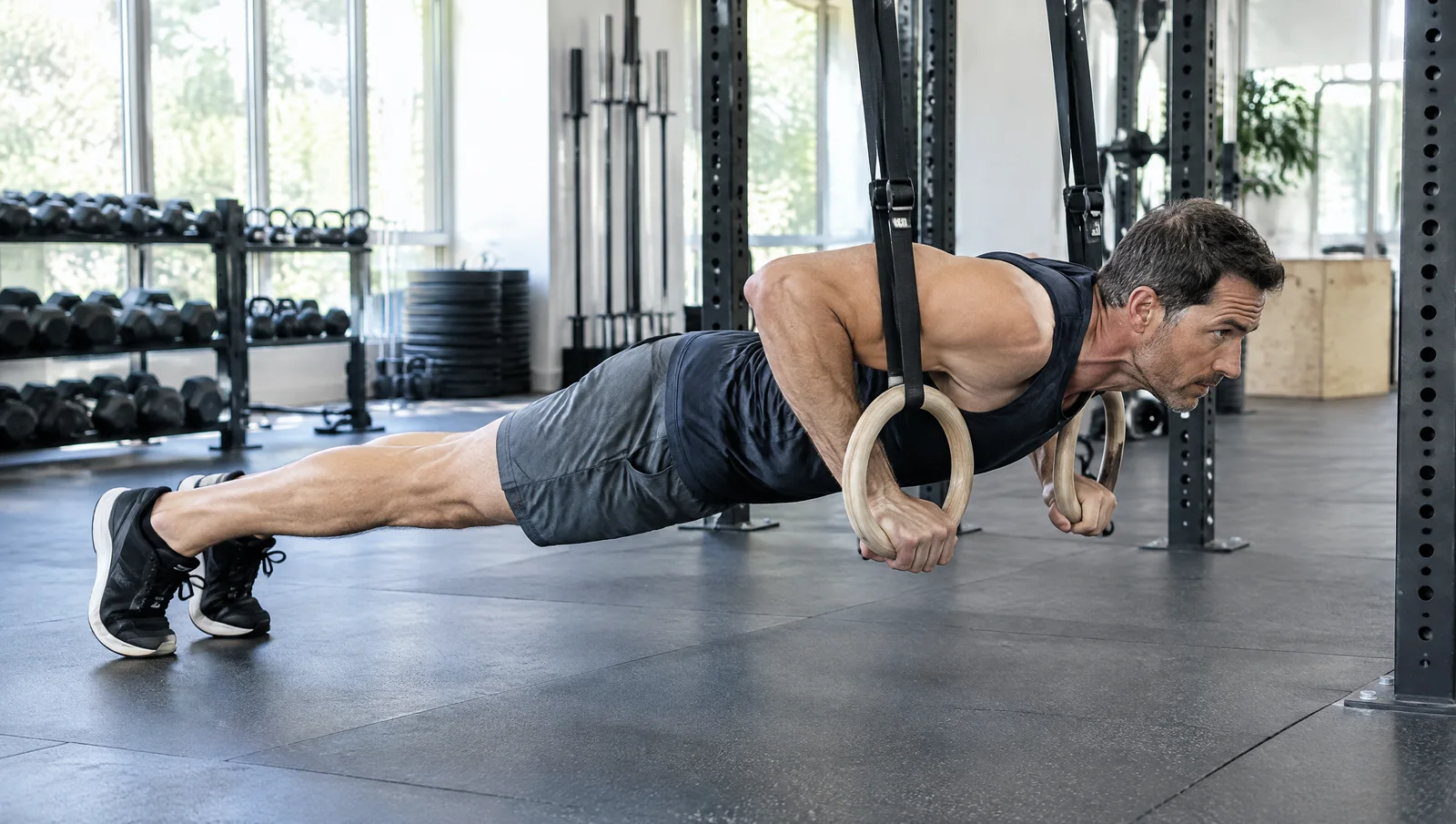
Ring push-up: guide the handles as you press
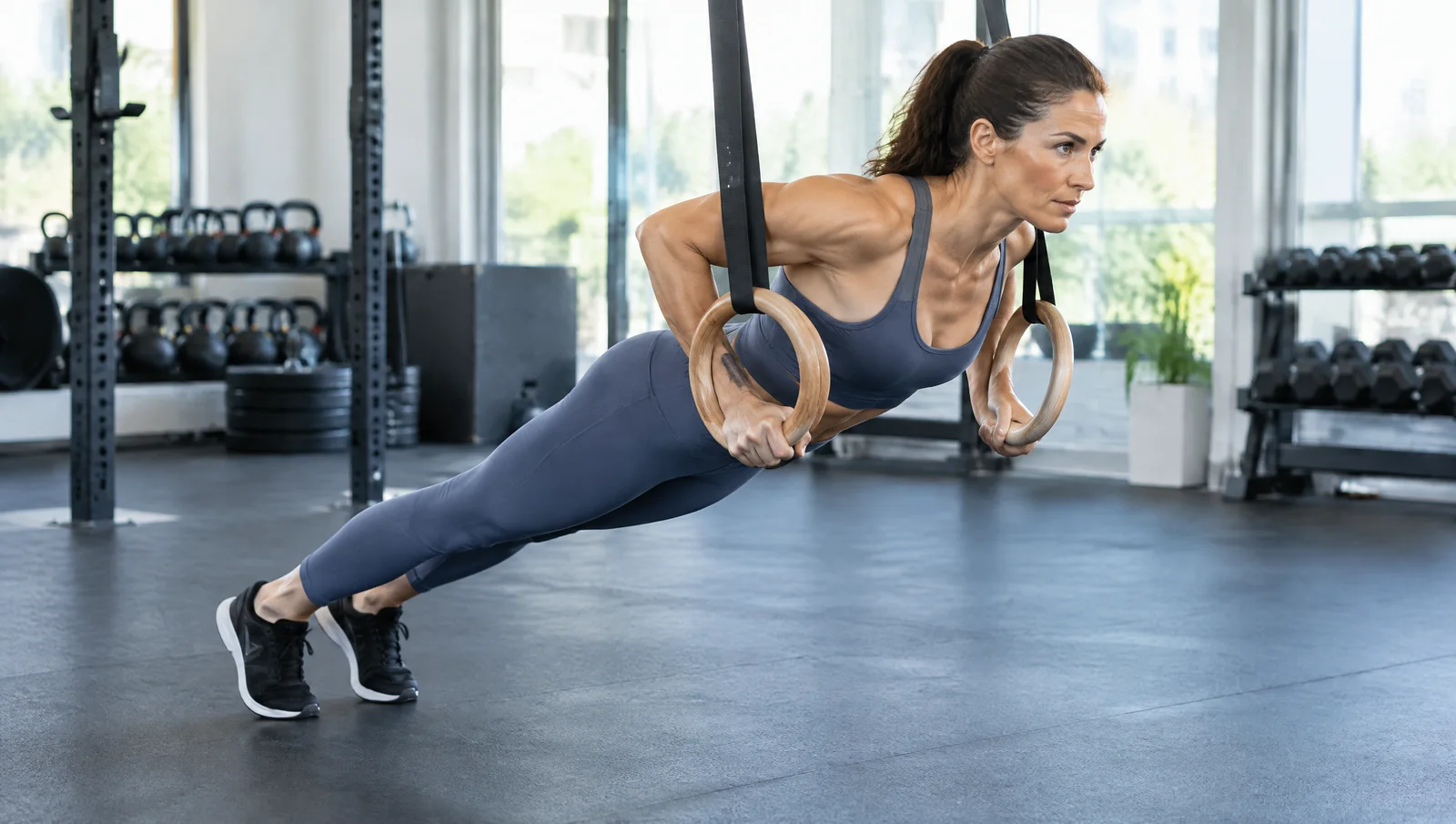
Hold the rings in front of you and begin with a more upright body angle. Bend your elbows, bring your chest towards the handles and press back. Keep your trunk and pelvis in a controlled line while preventing the rings from drifting apart. Once you can control a low-ring variation, its starting position resembles a floor push-up, but with your hands on moving handles.1
Ring spacing changes the position of your arms. Choose a distance that suits a controlled movement rather than spreading the rings as widely as possible or forcing a strong stretch. Keep spacing and movement range consistent initially so that progression is easier to follow.
Ring dip: control the support position first
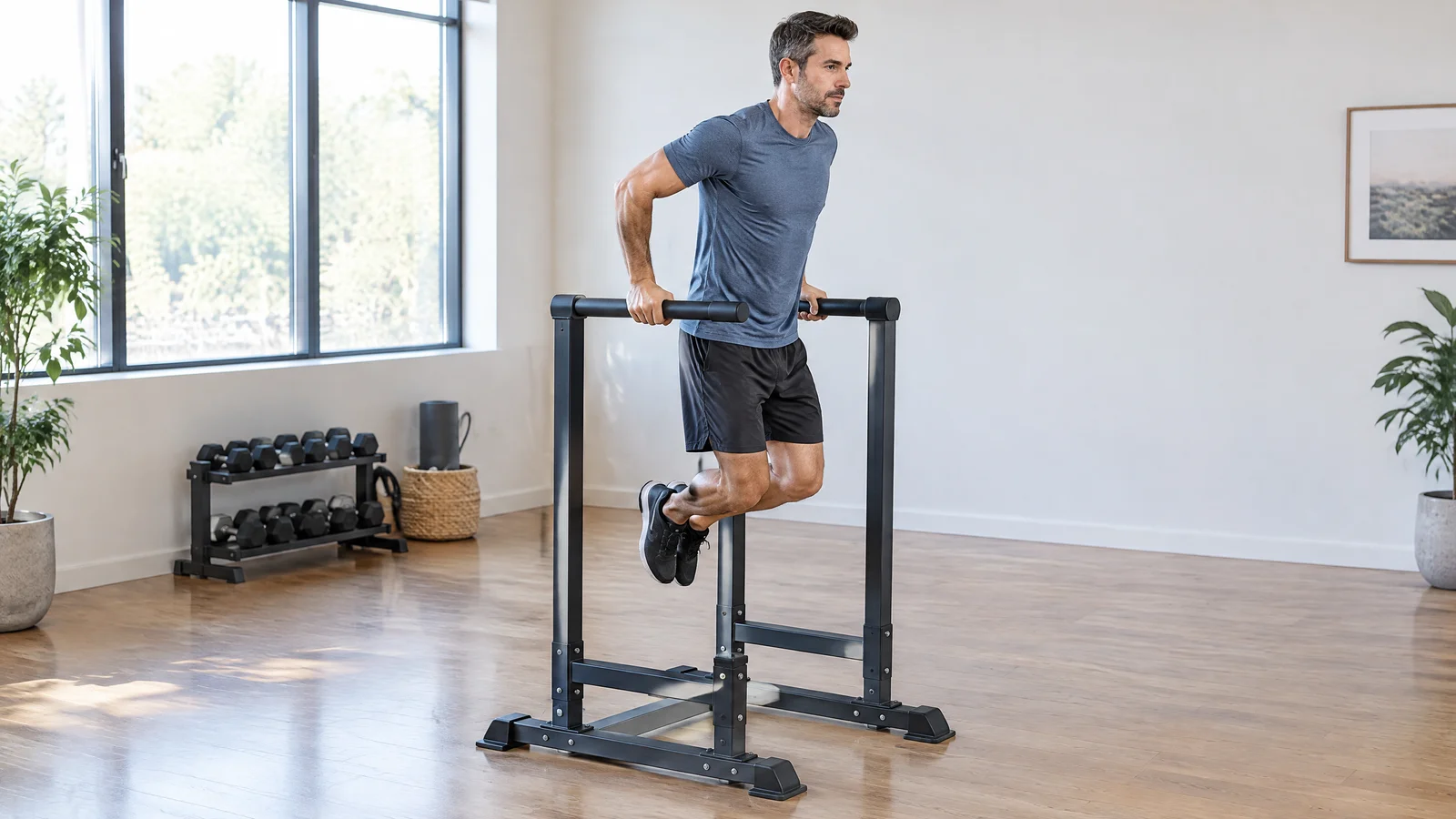
A dip supports your body between the rings. From a steady top position, bend your elbows, lower yourself and press back up. Keep the rings close to your sides. You need a controlled ring support position first, which is more demanding than supporting yourself on fixed parallel bars. Foot assistance can reduce the task when the set-up and movement allow it. Use a depth your shoulders can control and stop the movement if you feel sharp pain.1
Ring fly and push-up-to-fly combination
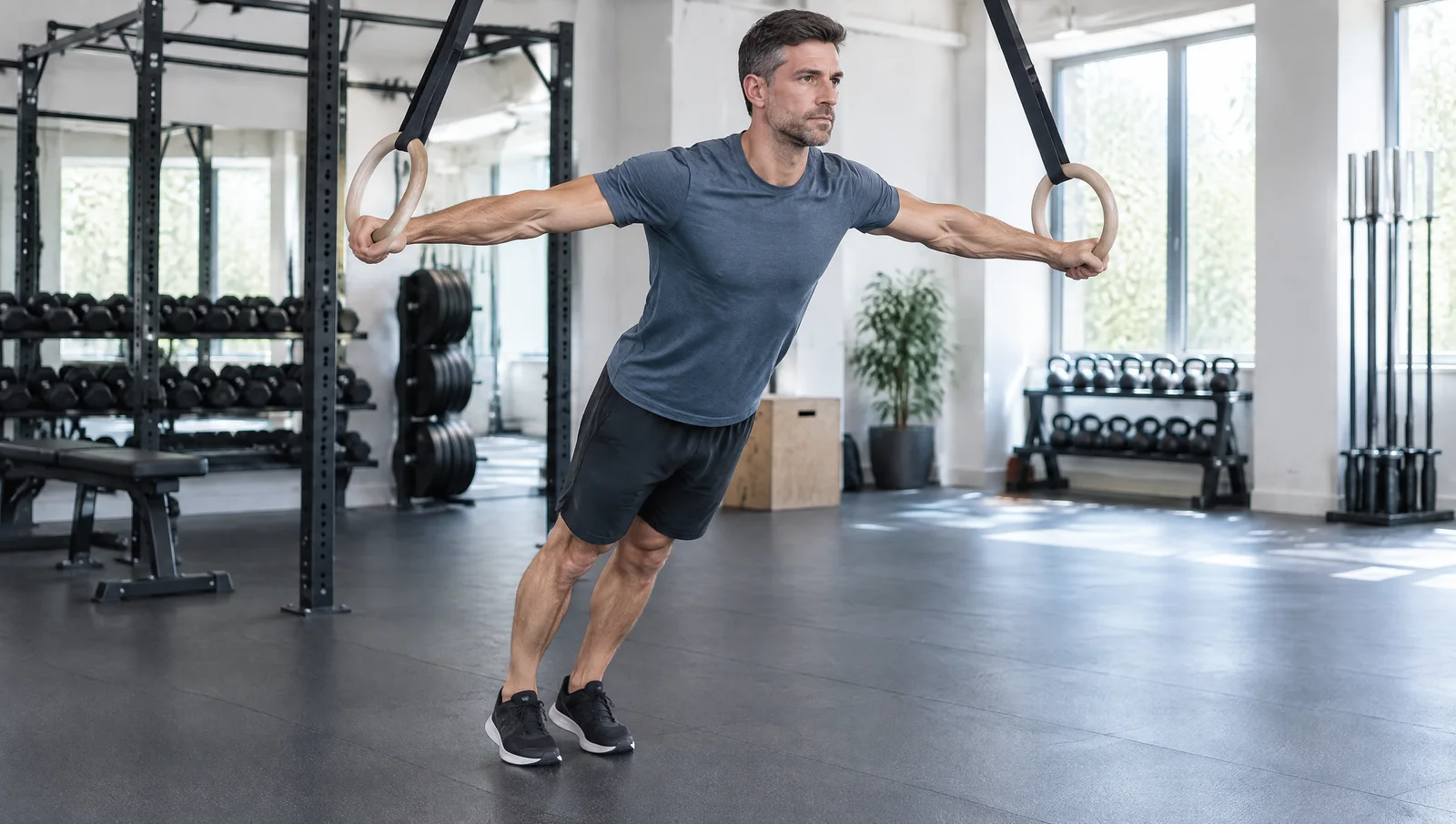
In a ring fly, the arms open out to the sides before bringing the handles together in front of the body. Elbow extension plays less of a role than in a push-up. The long arm lever makes control demanding. It is an additional chest exercise for suitably experienced trainees, rather than a necessary starting point. Maximum opening or a particularly deep stretch is not the goal.5
A push-up-to-fly combination links pressing and bringing the arms together within one movement. It requires control of both elements and is a separate combination, not an easier version of a push-up. Learn the individual movements with suitable instruction before combining them. The A/B outline only needs the ring push-up.
Back exercises and grip choices
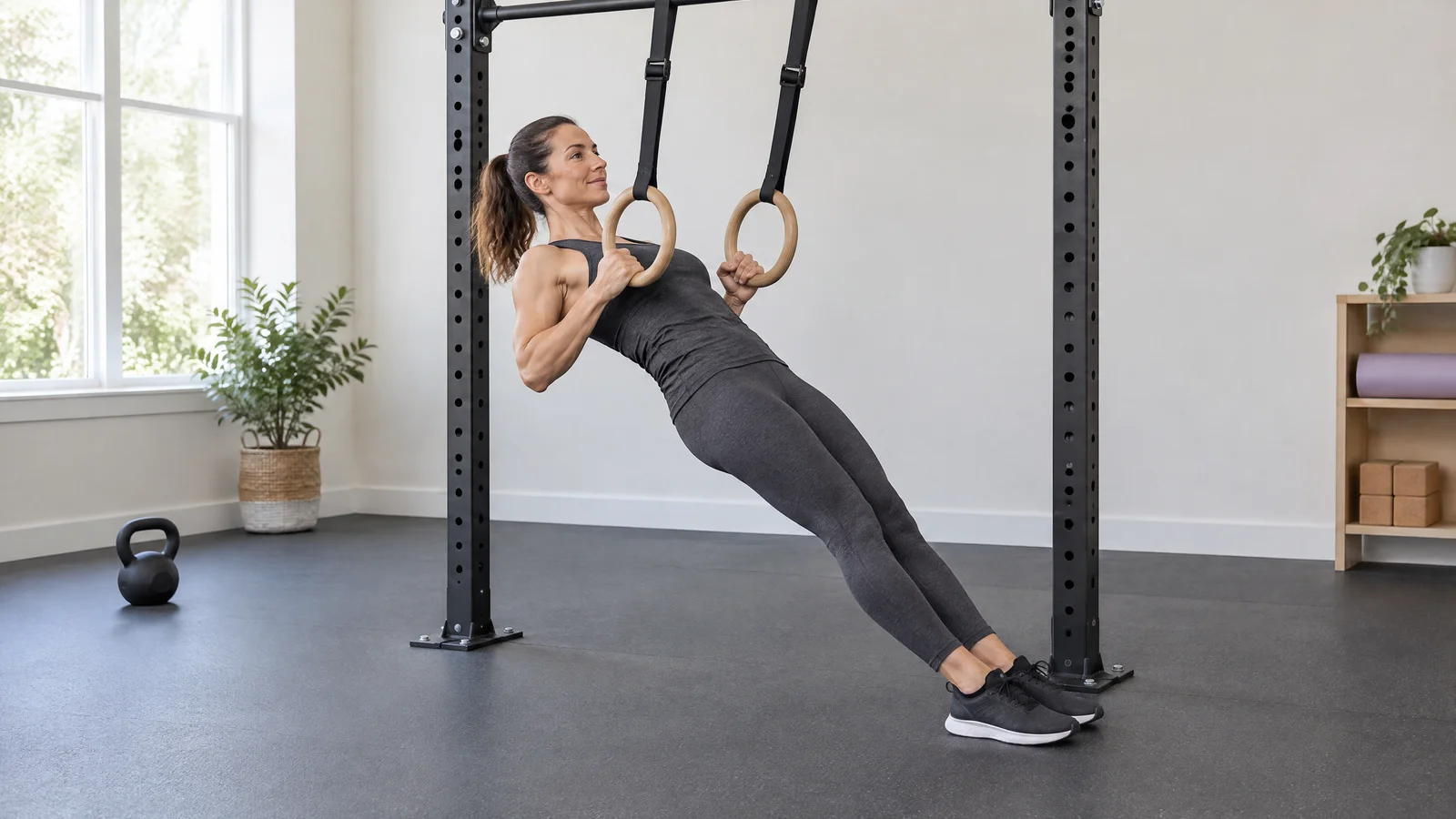
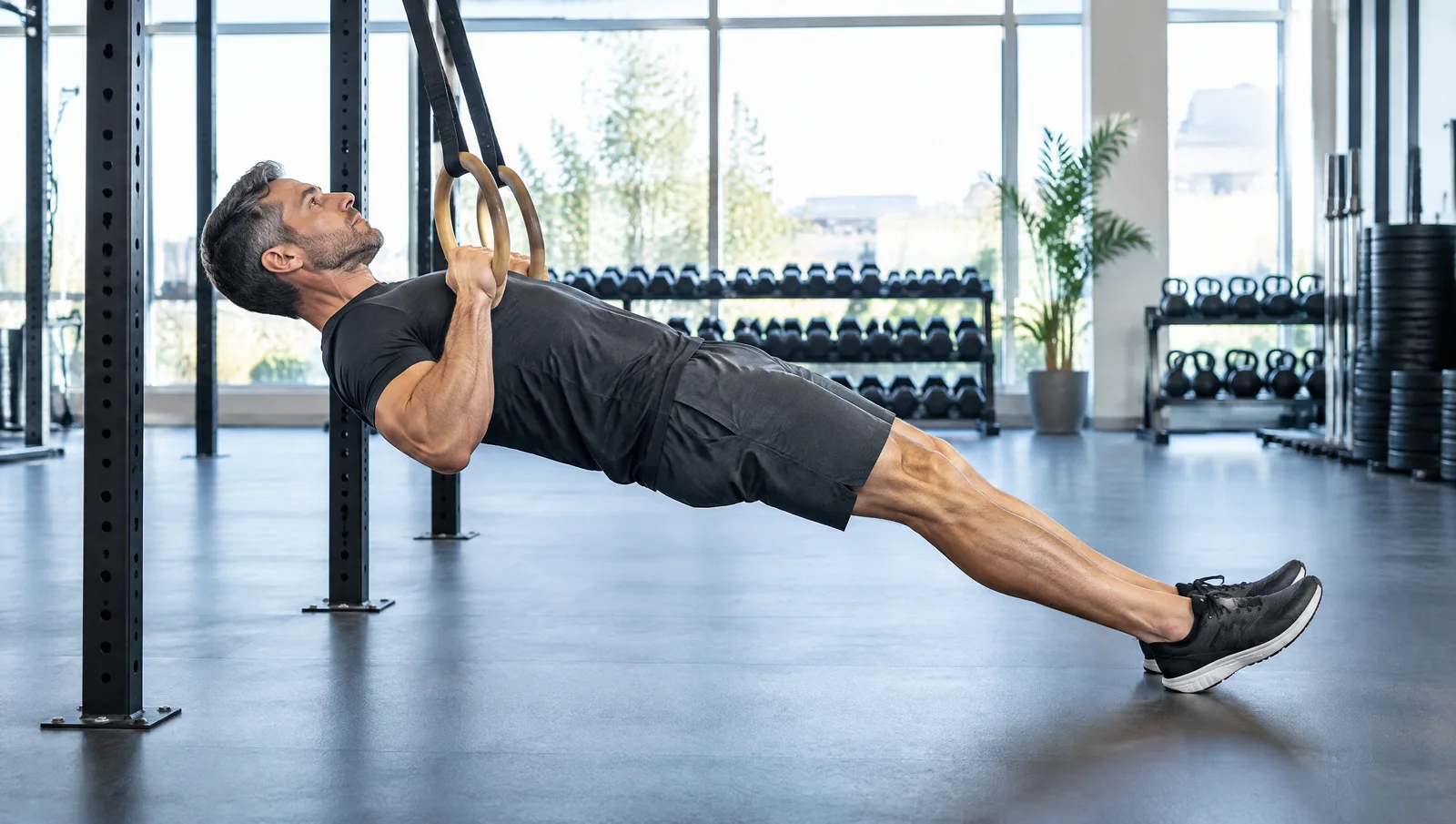
Ring row: pull with your feet on the floor
Face the suspension point, hold the rings and lean back with straight arms. Your feet stay on the floor. Pull your chest towards the handles, then lower yourself under control without letting your hips sag. A more upright position reduces the task in this set-up. A flatter body angle, eventually approaching horizontal, makes it more demanding.1
Ring pull-up: unsupported or with leg assistance
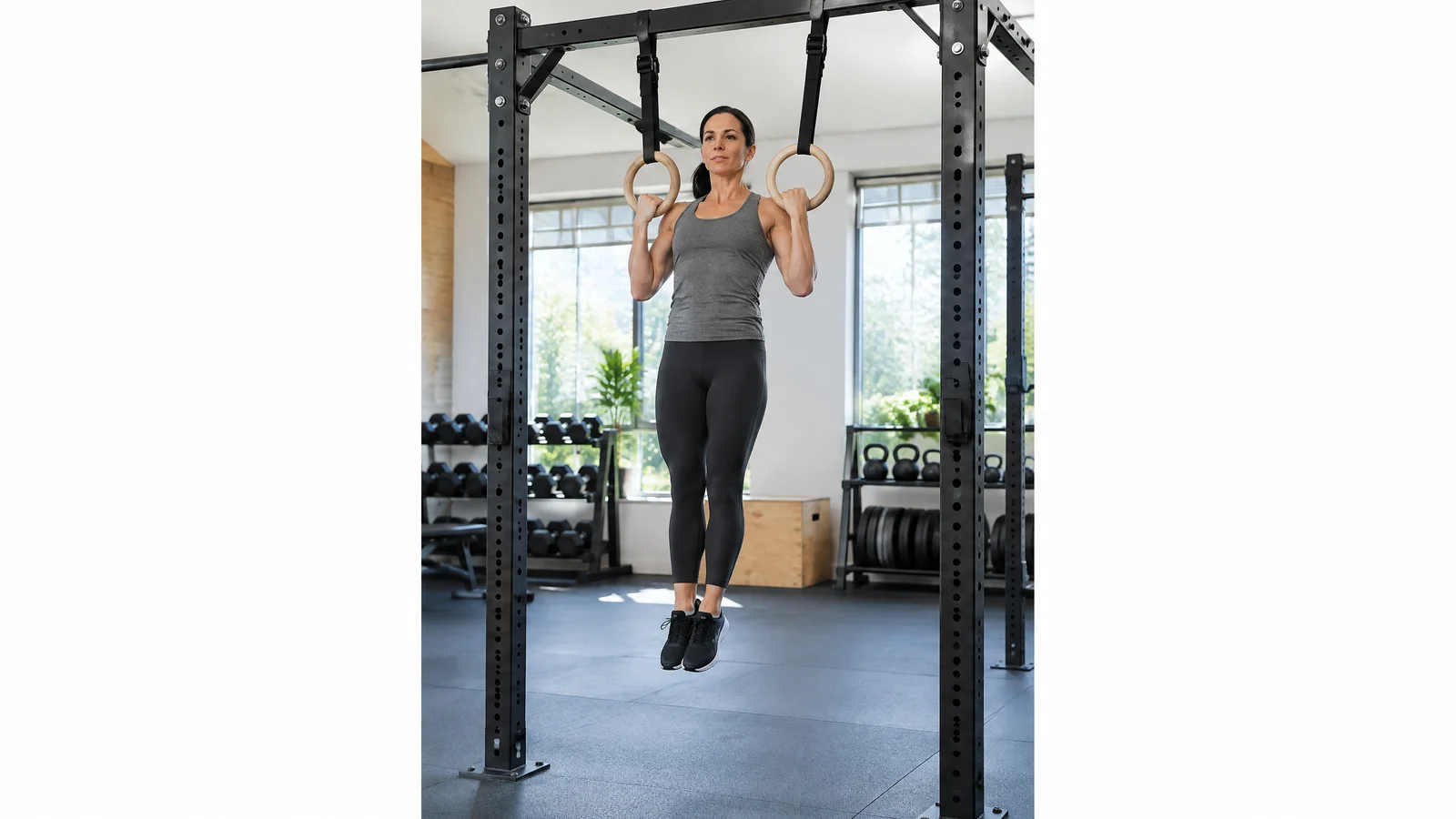
Here you pull your body upwards from beneath the handles, rather than towards them from a leaning row position. Lower yourself under control afterwards. For an assisted version, set the rings so that your feet can remain on the floor. Use your legs to provide the help needed for the chosen movement. This is a foot-assisted ring pull-up, not a ring row.1
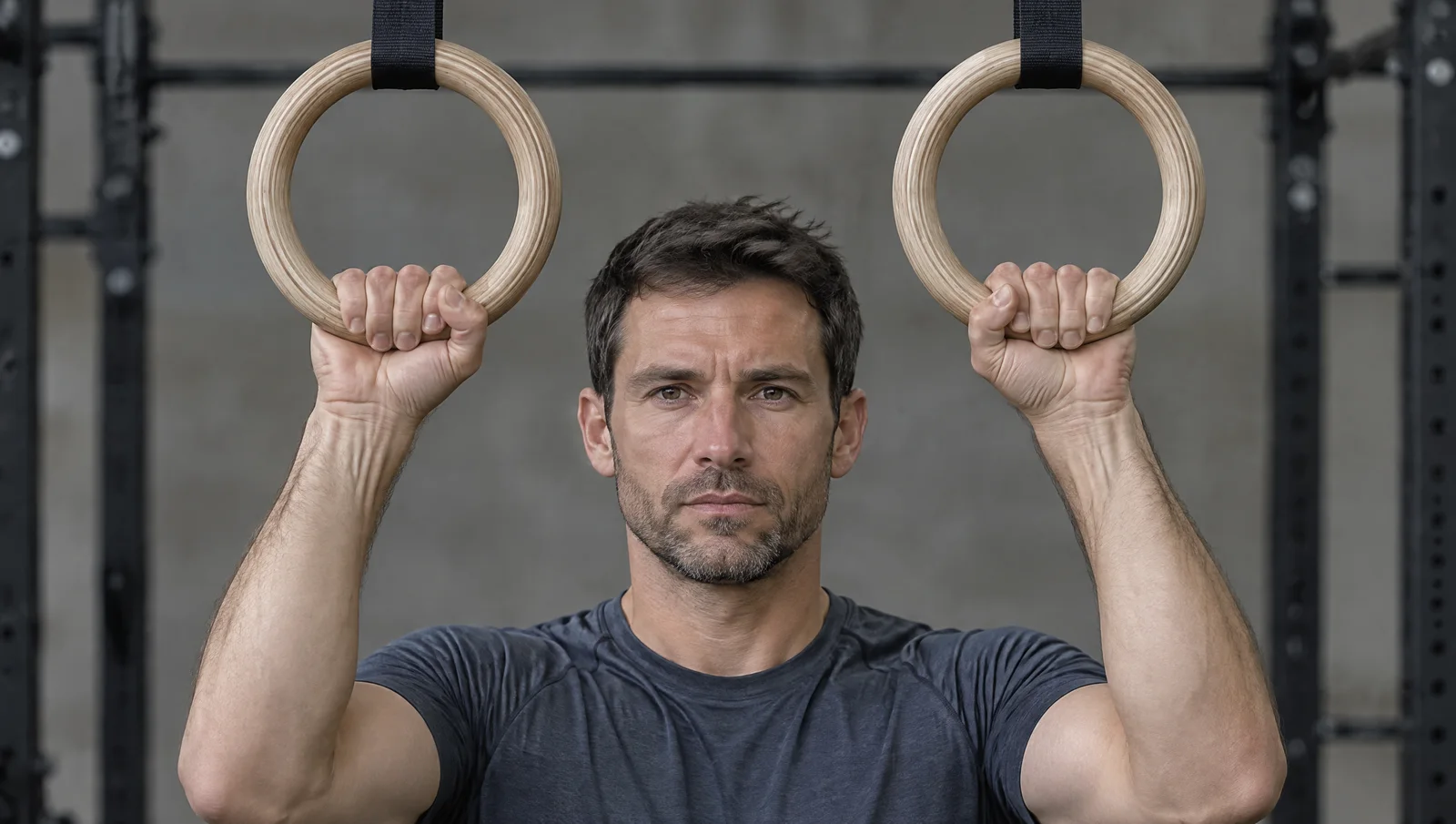
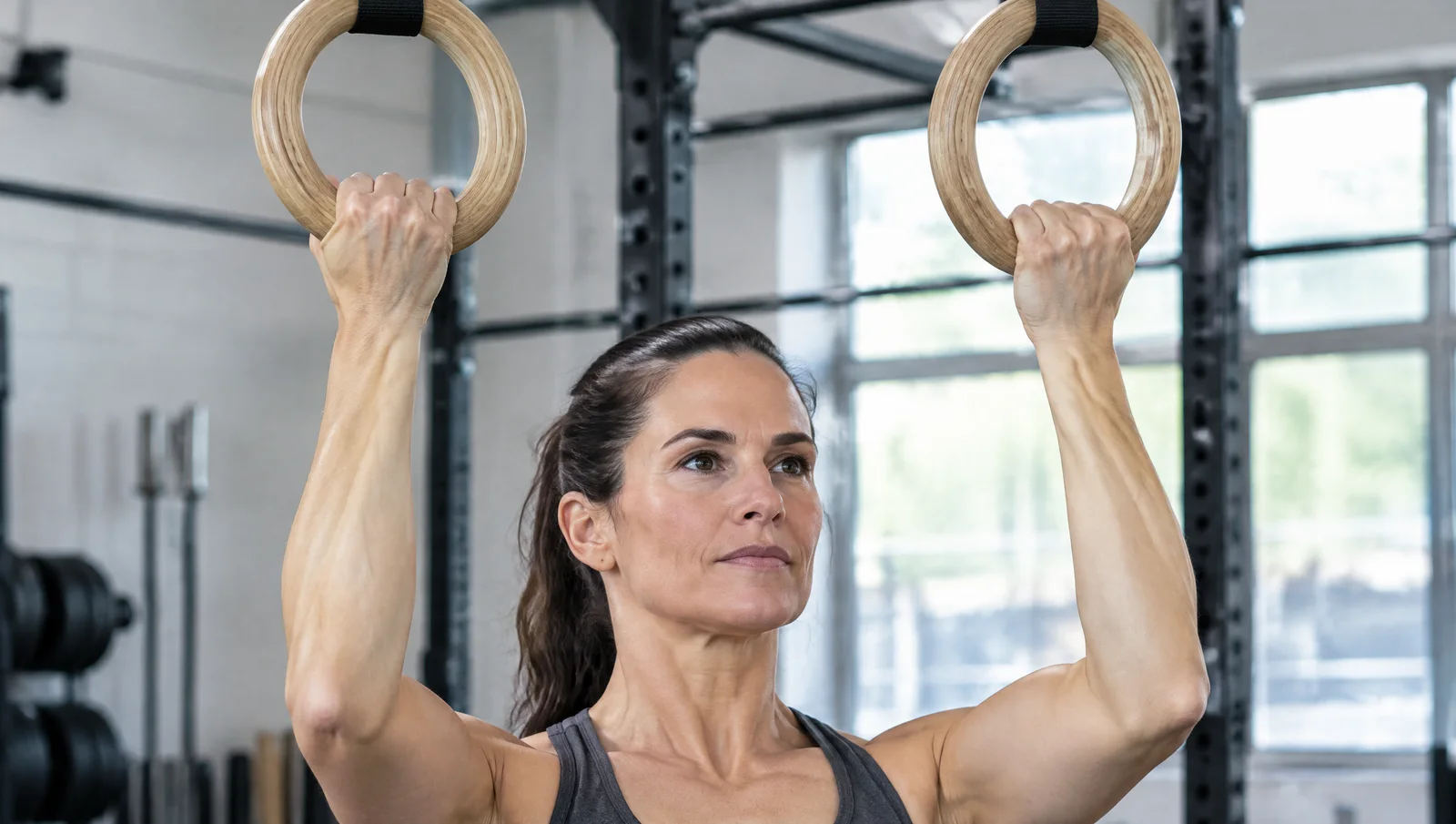
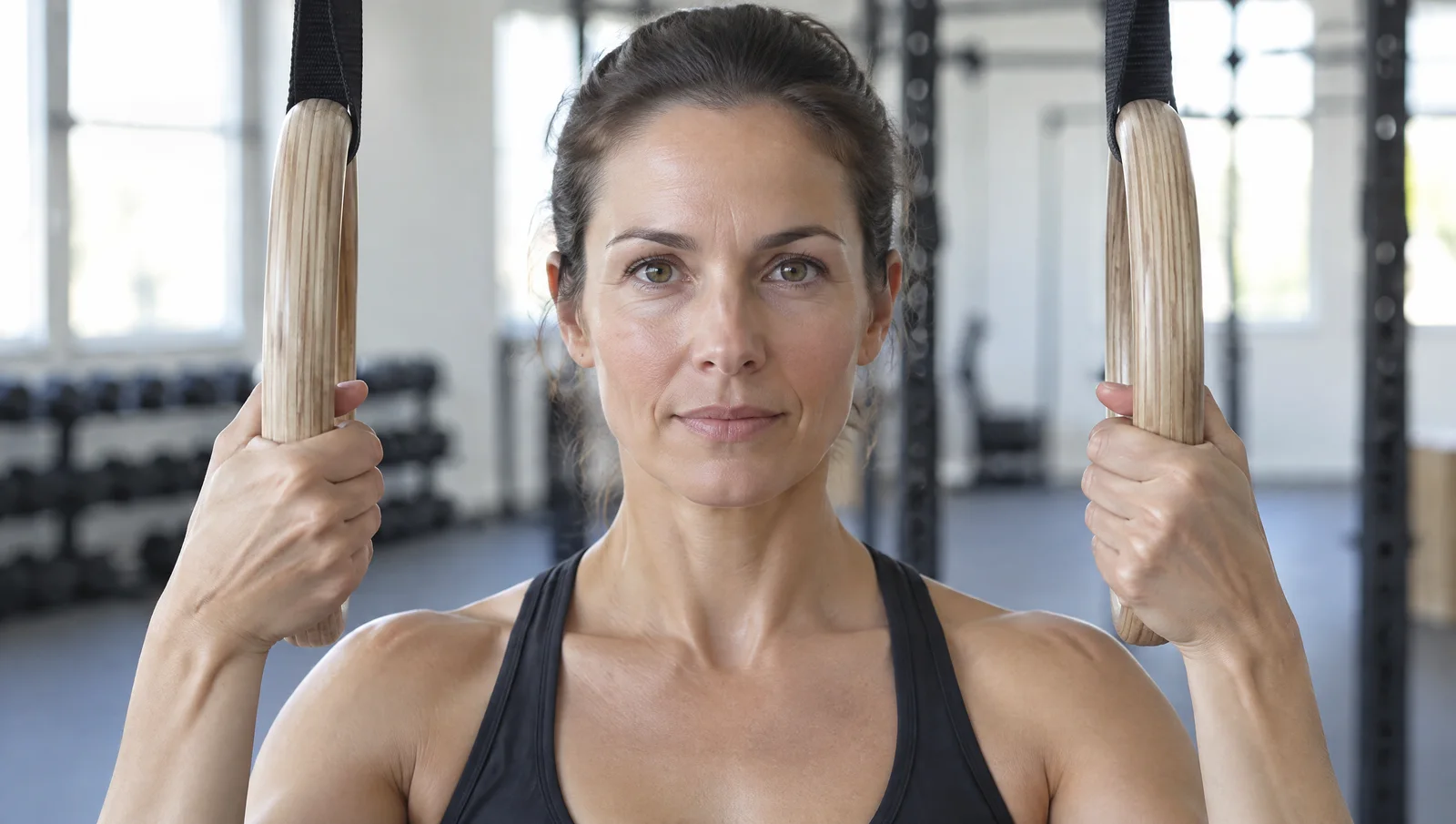
Rings allow several grips. An overhand grip has your palms facing away, an underhand grip has them facing towards you, and a neutral grip has them facing each other. Intermediate positions and rotation during the movement are also possible. Choose a comfortable position you can control rather than holding your wrists rigidly against the movement. A fixed pull-up bar or neutral handles on an overhead ladder provide different grip constraints. The rotating handles give you room to choose a comfortable hand position.1
You can also change the distance between the rings. An extremely wide grip or the strongest possible stretching sensation is not a necessary progression. Keeping the spacing consistent makes repetitions easier to compare than continually changing the set-up.
Additional arm work when useful
Ring curl: bend at the elbows
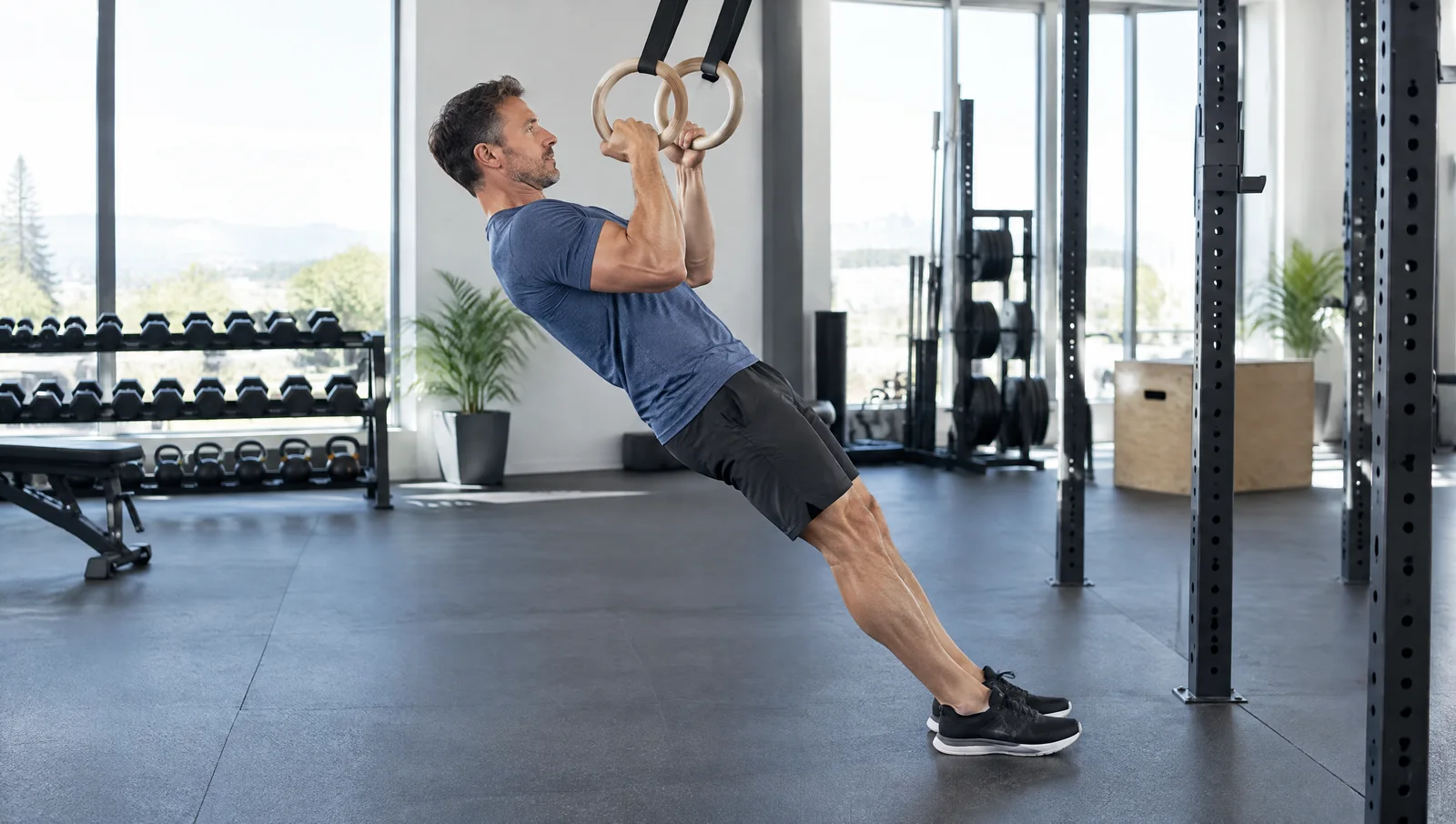
A curl brings your leaning body towards your hands by bending the elbows. Unlike a row, the upper arms stay in front of the body rather than travelling well behind it. Keep your wrists and body line controlled, then straighten your arms to lower yourself again. Ring height and foot position can be adjusted.5 ACE’s detailed curl instructions describe this elbow action on a TRX suspension trainer. Its handles and suspension arrangement differ from two separate rings.6
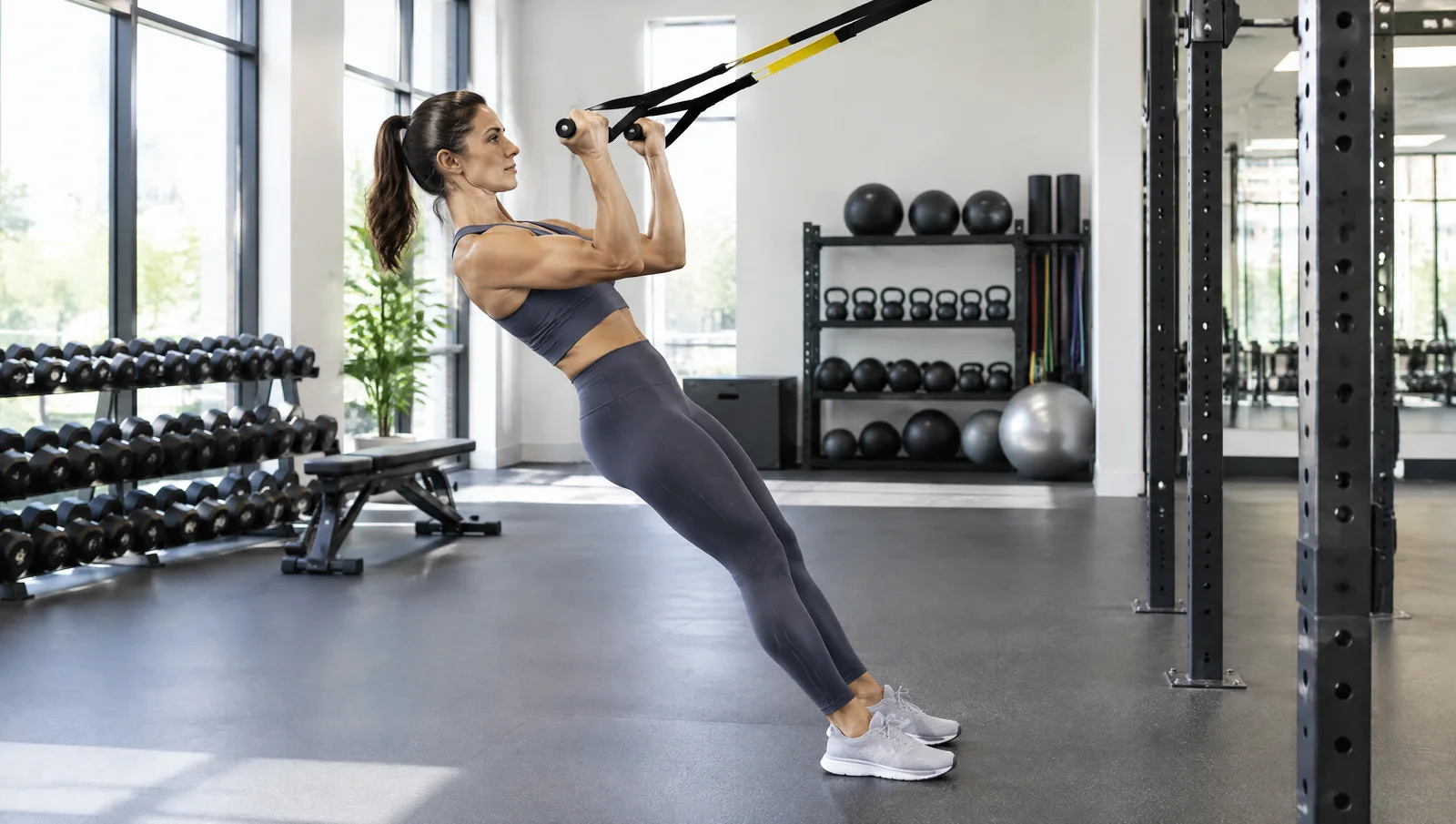
Triceps extension: press your body back through the arms
Hold the rings in front of your head, lean forwards under control and bend your elbows so that your head moves towards your hands. Straighten the elbows to press yourself back. Keep the upper arms relatively still. A more upright position makes this ring variation easier.1
An overhead triceps extension places the hands closer to or above the head. ACE’s explicitly named overhead version uses a TRX suspension trainer. It is a related equipment variation, not an additional instruction for rigging rings.7 Both add triceps work alongside pressing exercises. In session A, ring triceps extensions and curls remain optional.
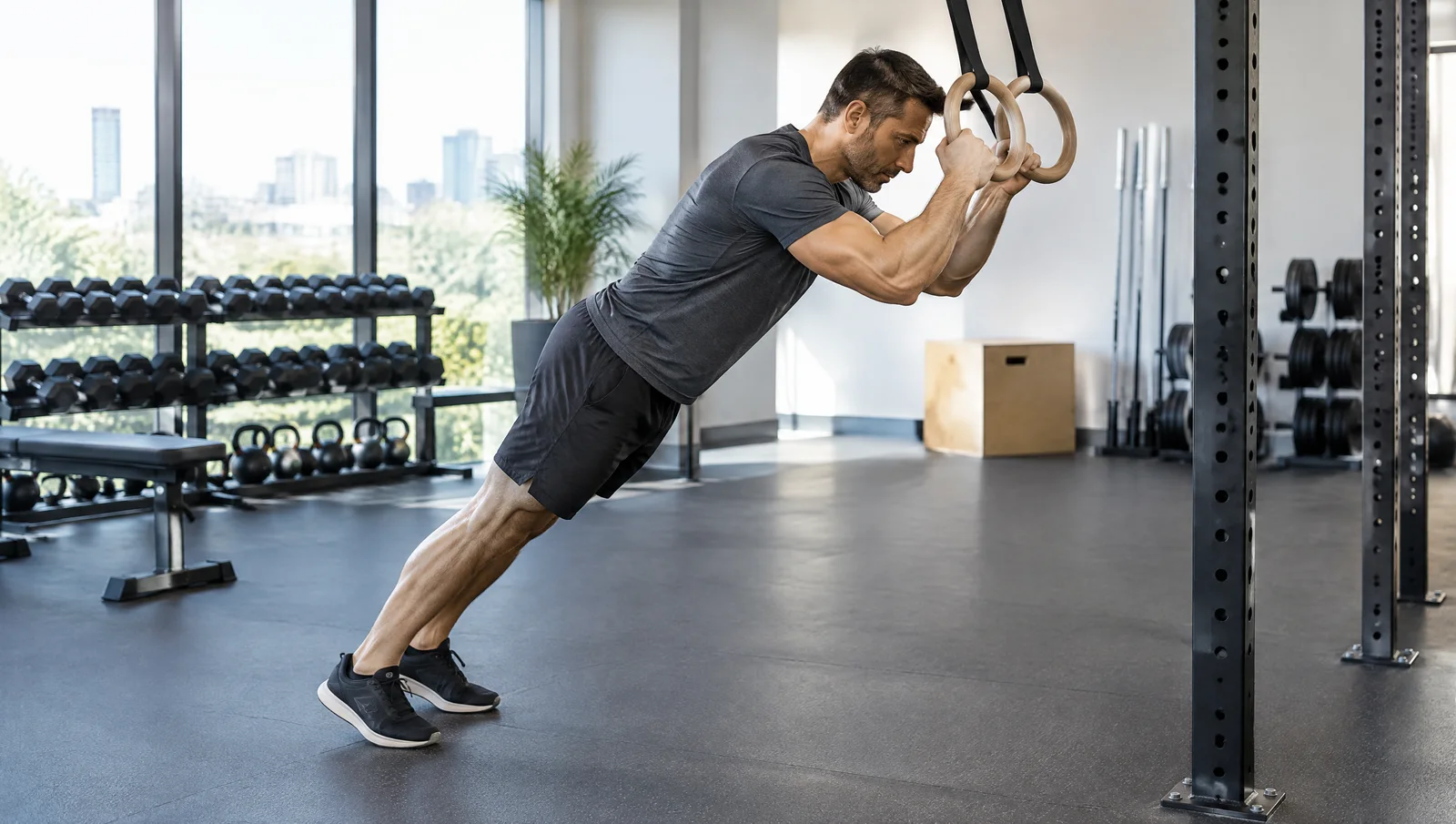
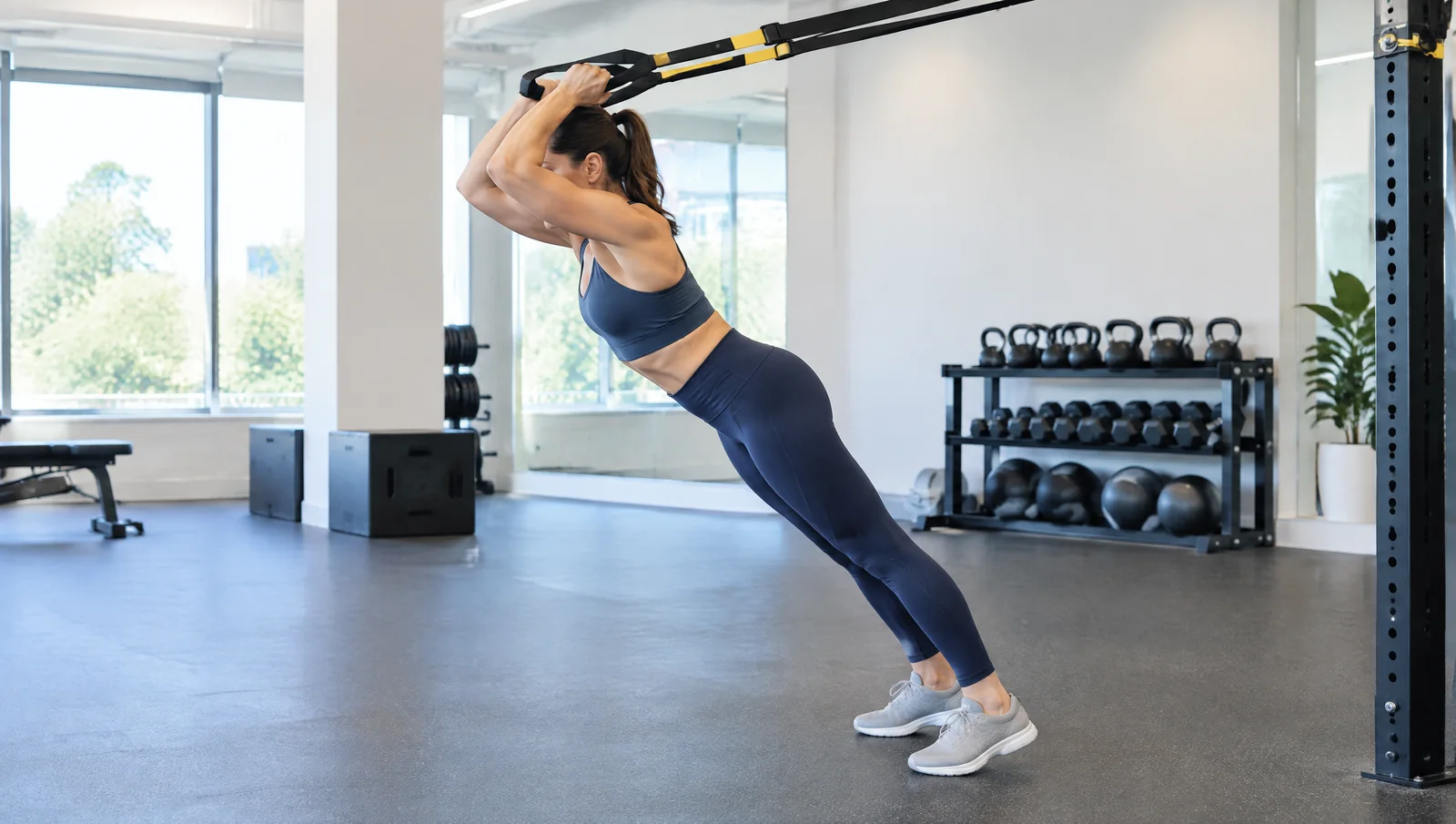
Trunk work: hold position as the limbs move
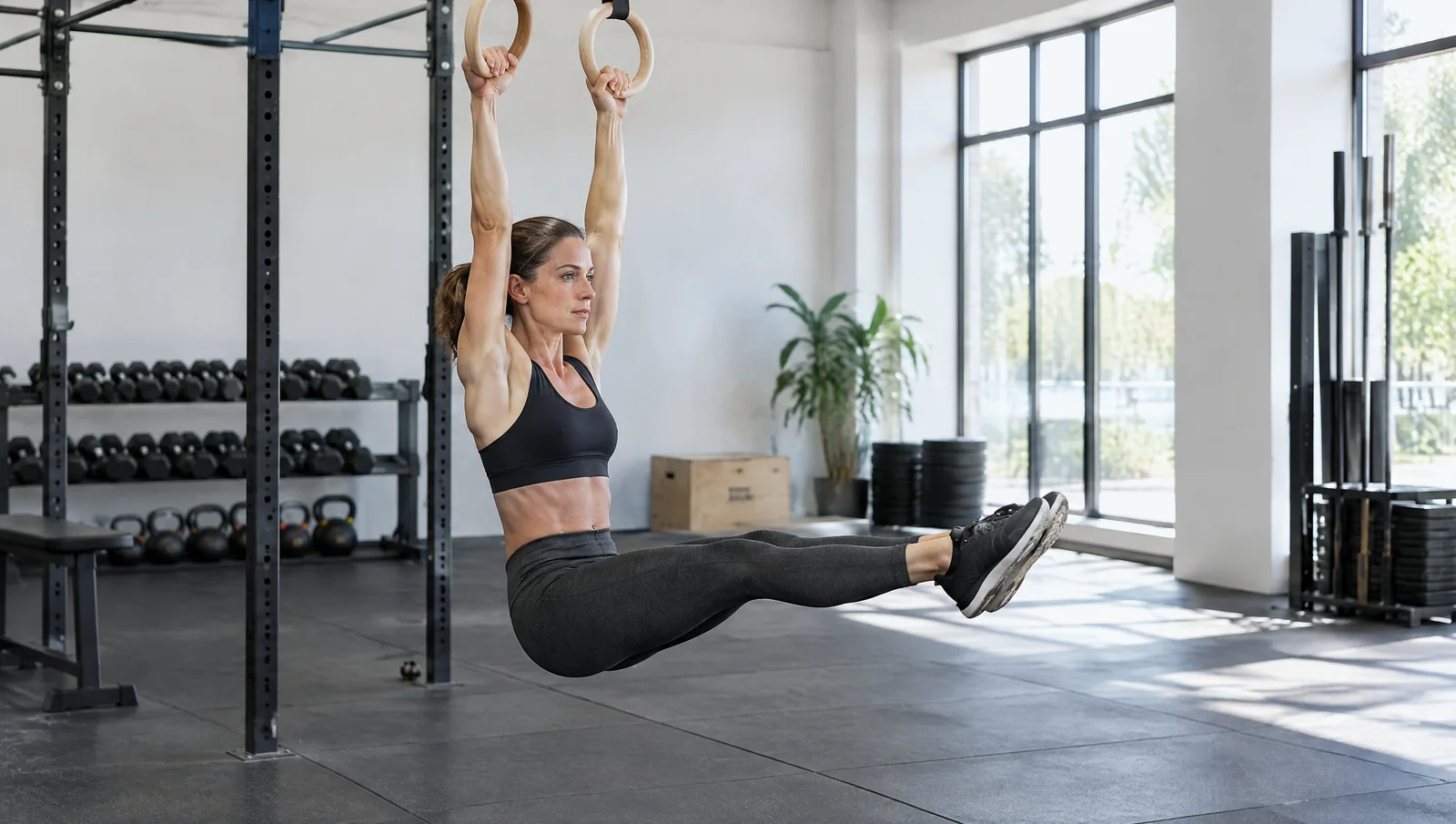
Leg raise or knee raise
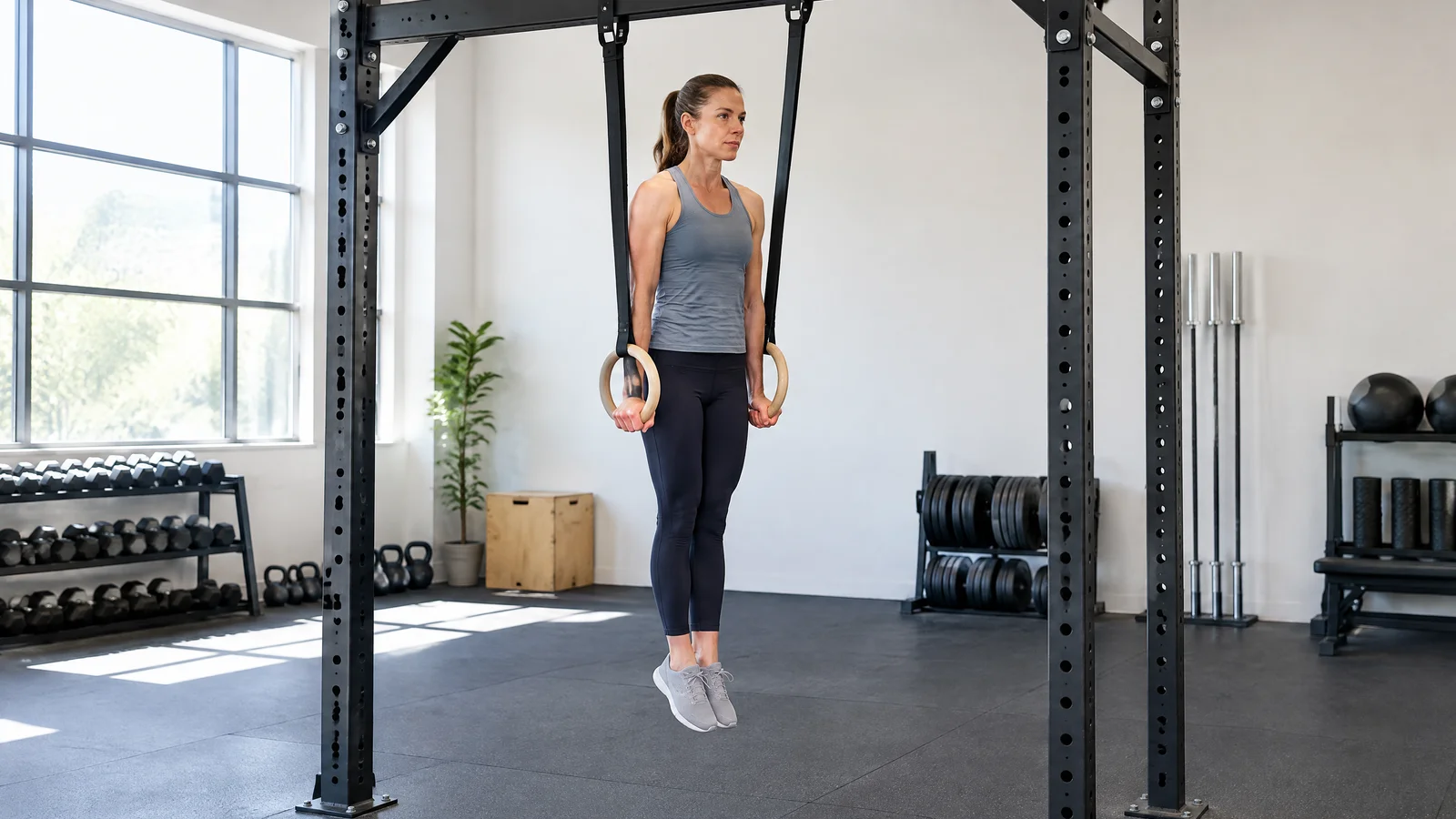
This overview uses a hanging ring variation. You first need to control your grip and hang and be able to leave the position safely. Bring your bent knees upwards, then lower them slowly. Let any swinging settle before lifting again. The knee raise uses a shorter leg lever. Raising straighter legs demands more control and space.15
If your grip gives out first or you can only continue by swinging, the task does not currently fit. You can leave out this optional trunk block while learning the hang or another suitable trunk exercise.
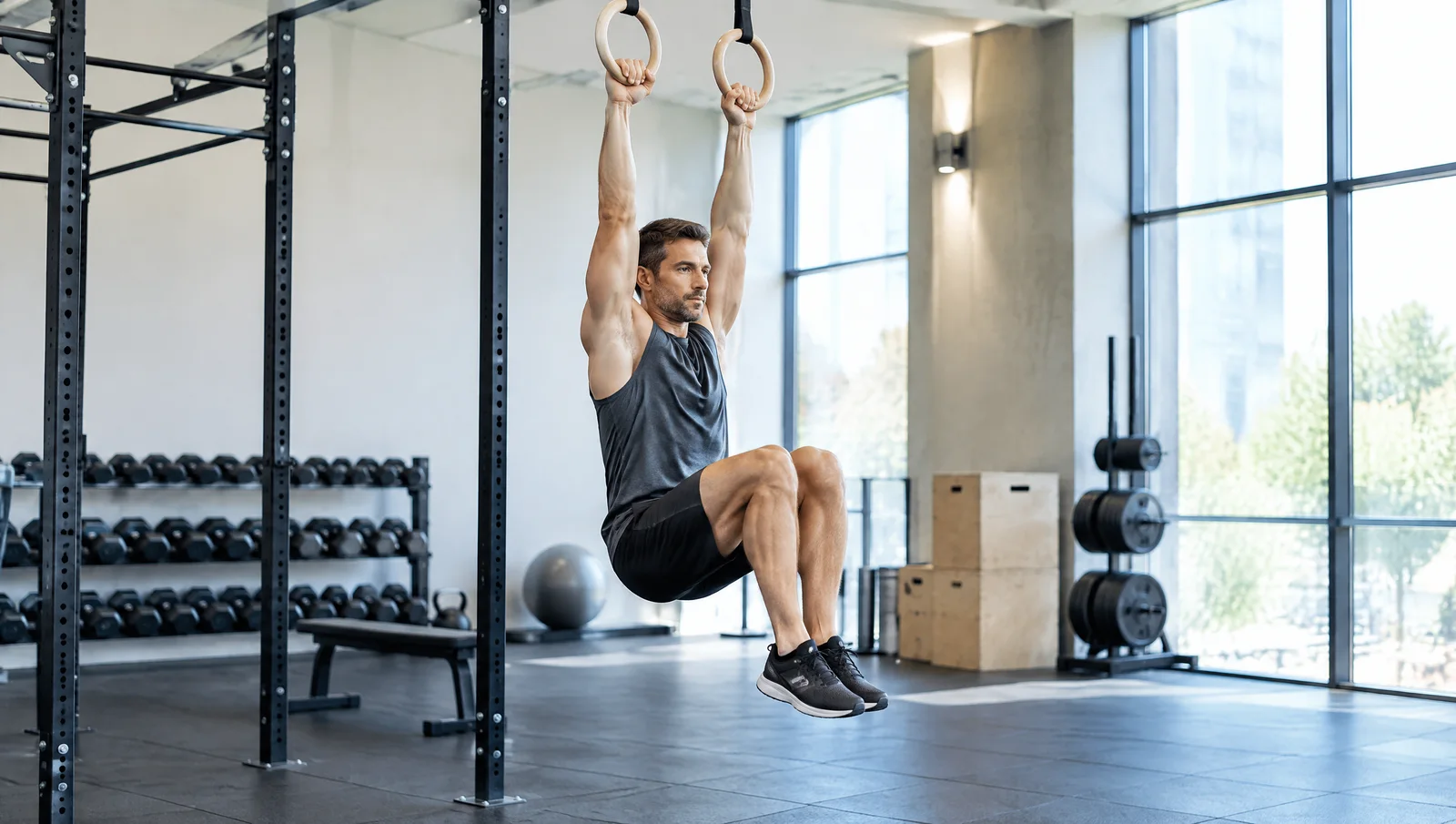
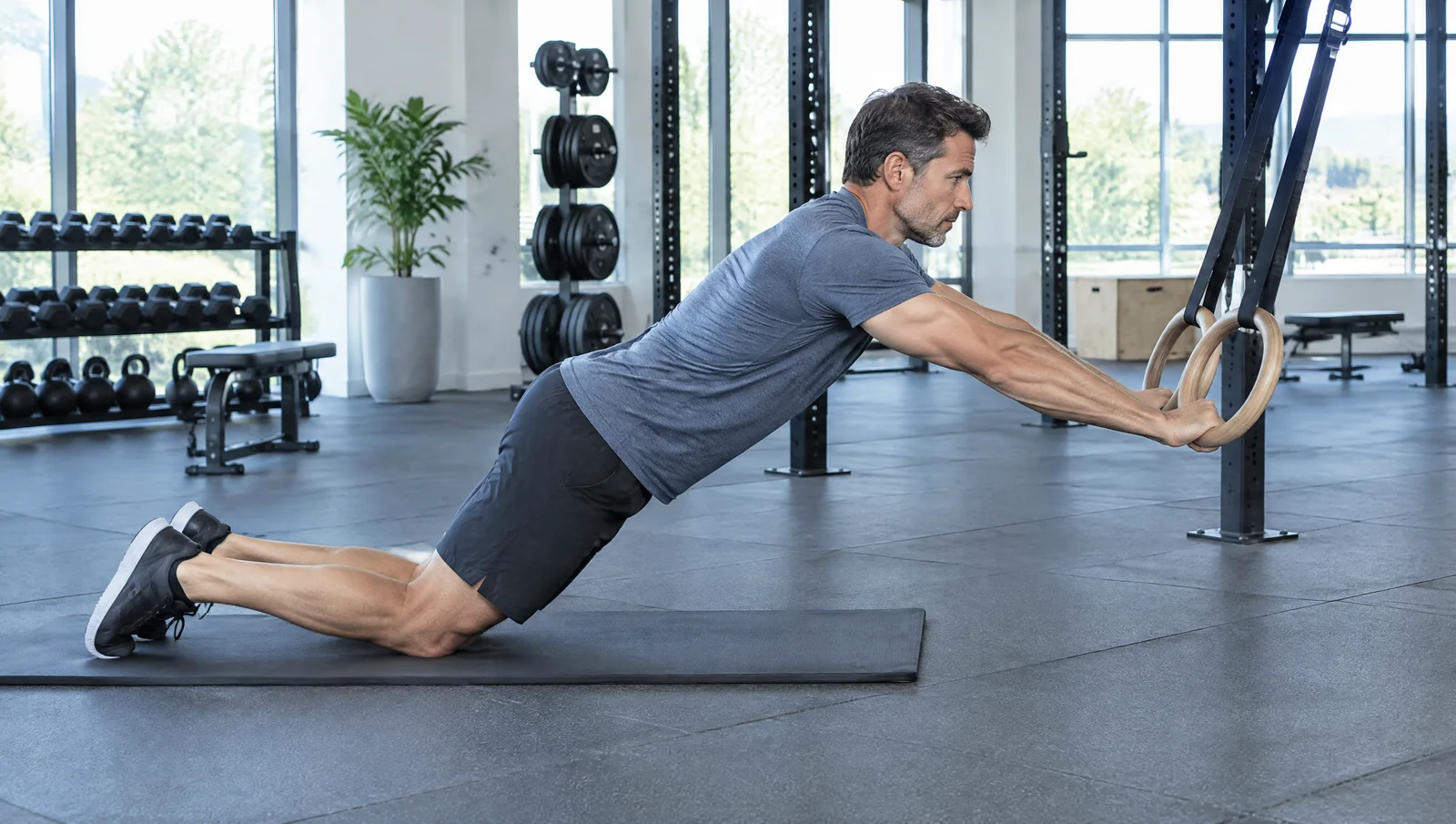
Ring rollout: keep your body line as you reach forwards
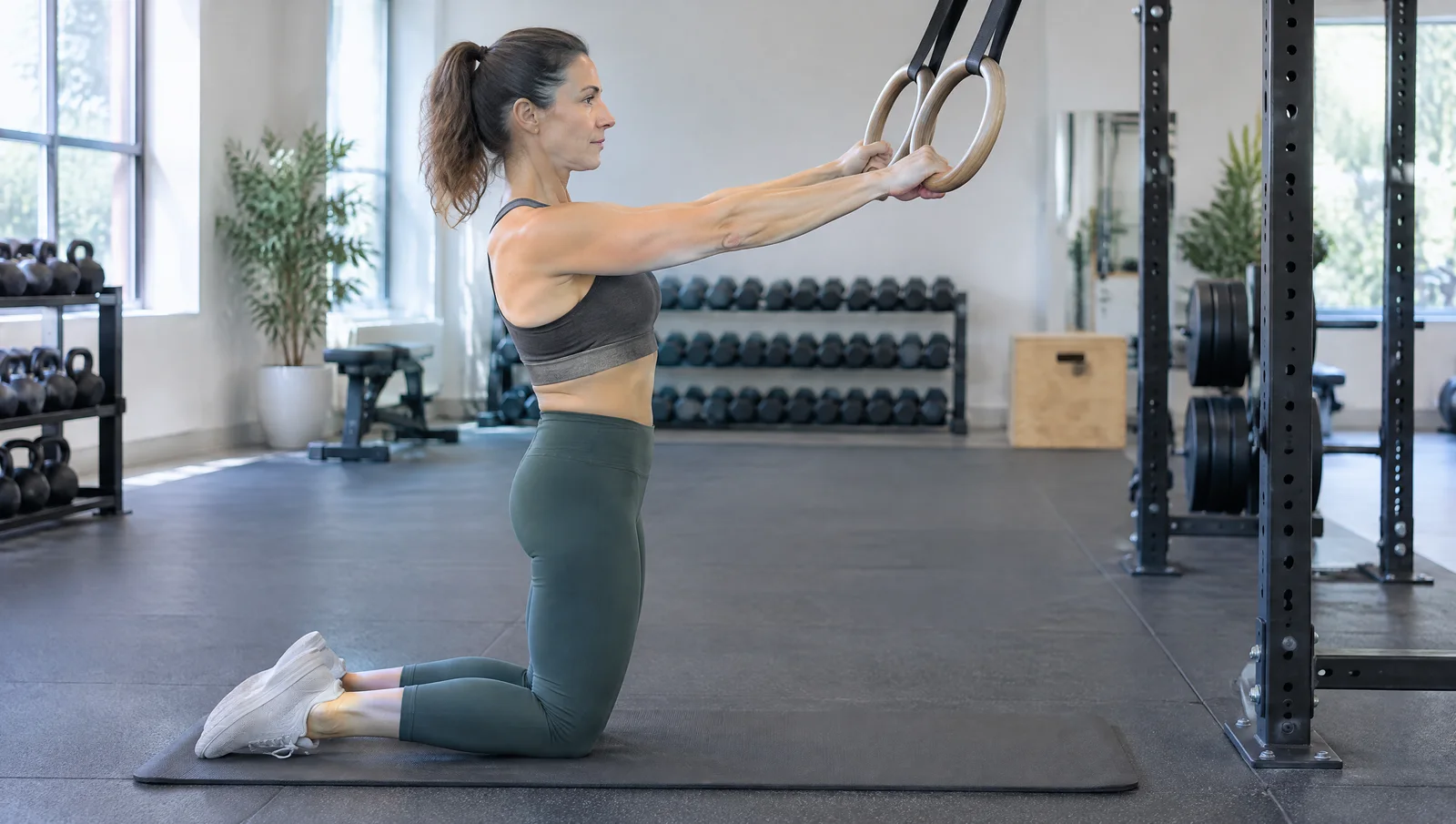
From kneeling, hold the rings with straight arms and slowly reach them forwards. Your abdomen and glutes work to resist the pelvis dropping and the lower back arching. Bring the handles back before you lose that position. A shorter reach or higher rings can make this version easier.1
It resembles an ab-wheel rollout. With the wheel, the handles move along the floor. Rings hang from straps instead. The comparison explains the movement idea, not identical forces or difficulty.
Legs: distinguish hand assistance from a suspended foot
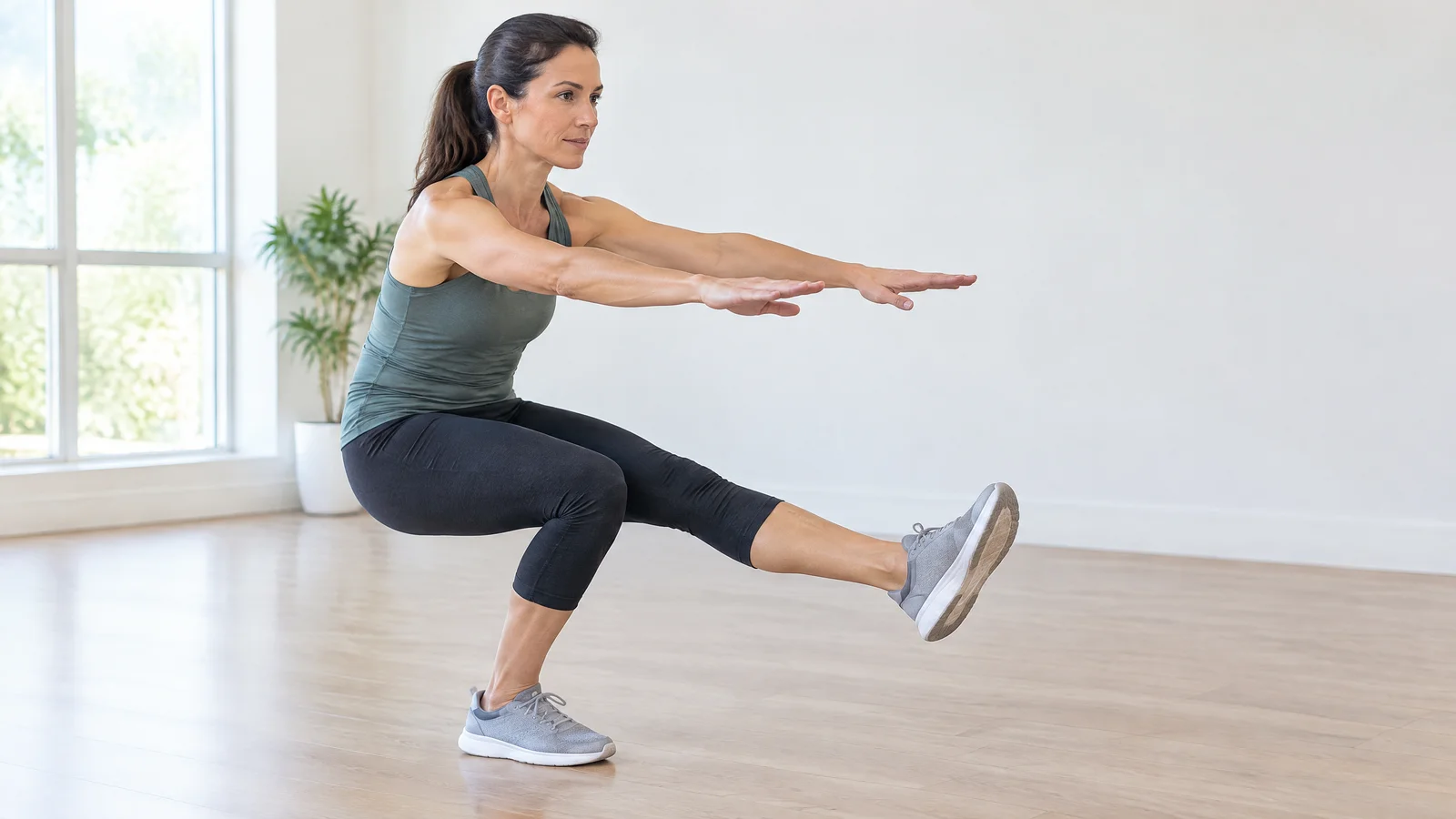
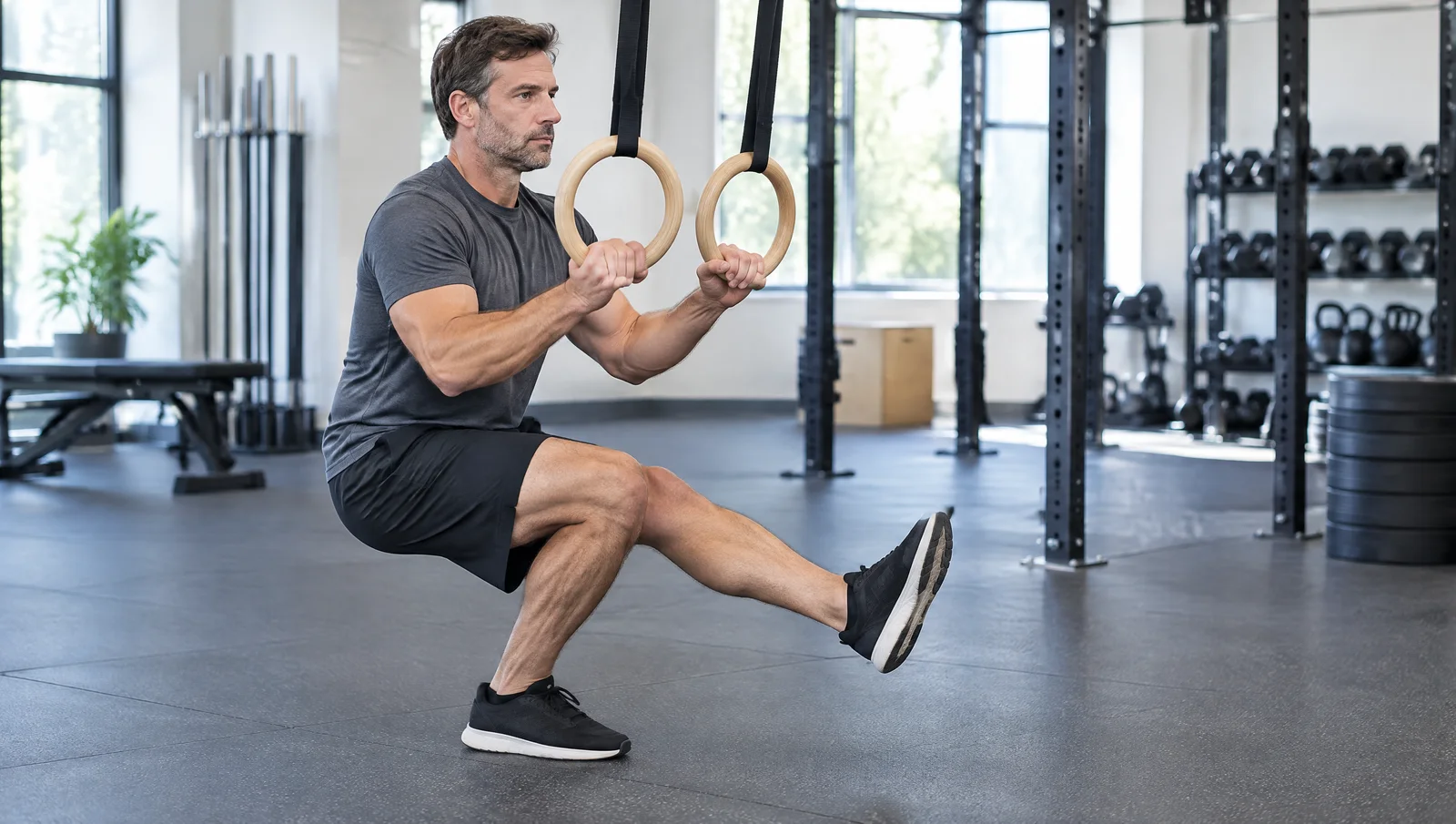
Pistol squat with or without ring assistance
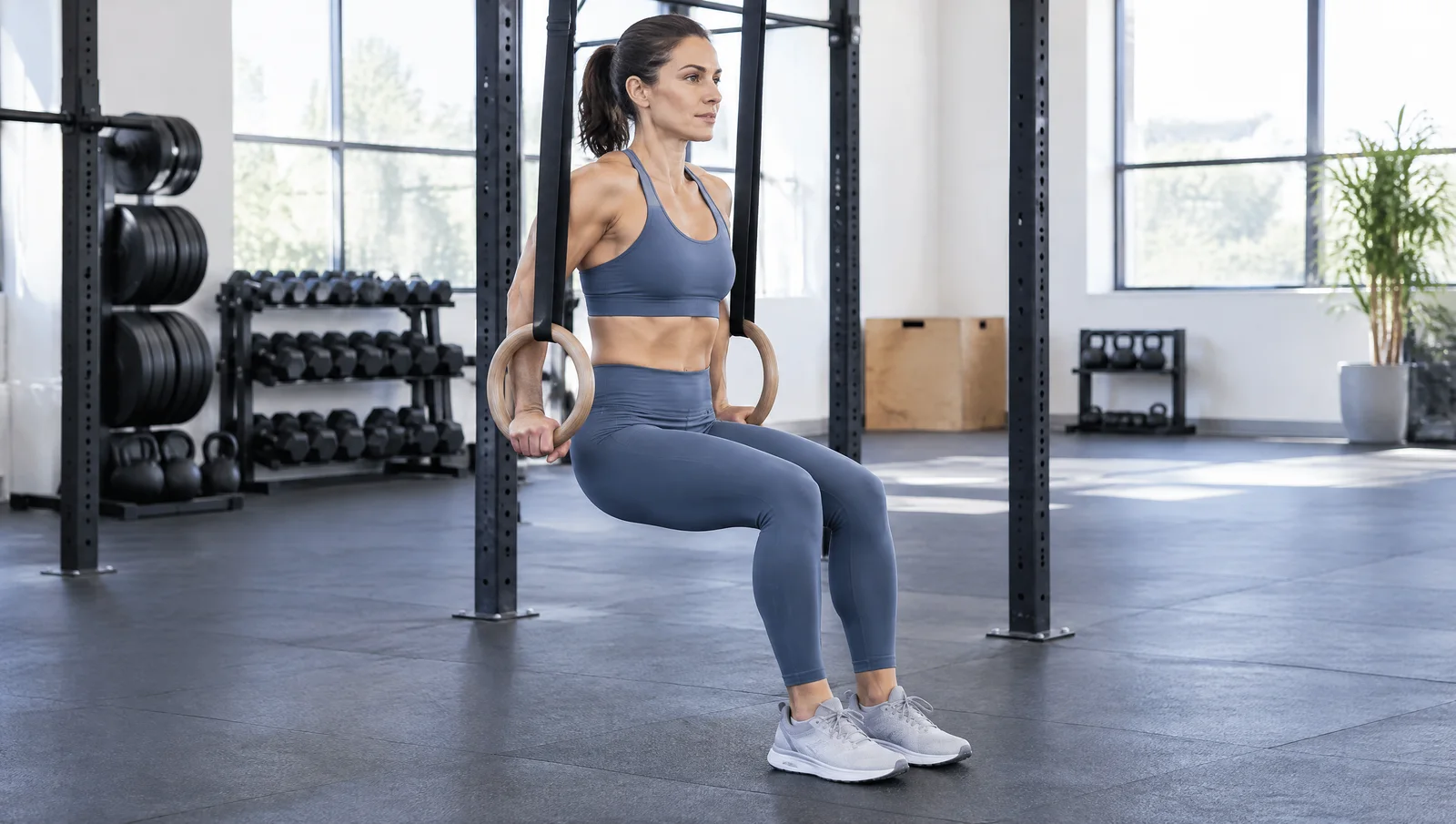
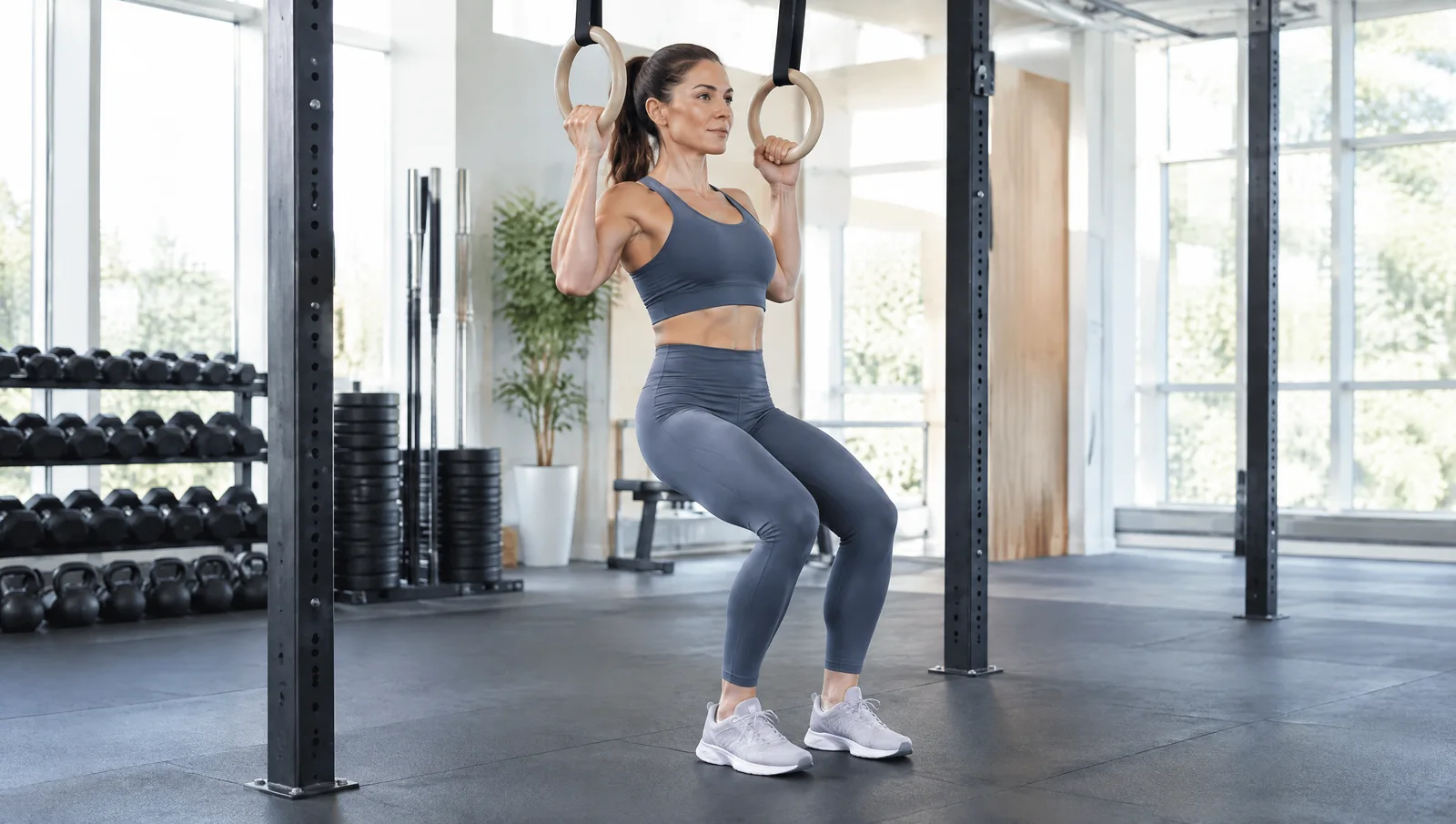
A pistol squat uses one standing leg while the free leg stays in front of the body. Bend the standing leg and return to standing. In the assisted version, hold the rings in front of you and use them for support. Keep the movement controlled over the standing foot rather than leaning far back into the straps.1
Choose a depth and amount of hand assistance that suit your skills. A deep unsupported repetition is one possible skill, not a compulsory goal. If even an assisted pistol is not yet suitable, a split squat with both feet on the floor offers a differently arranged leg exercise.
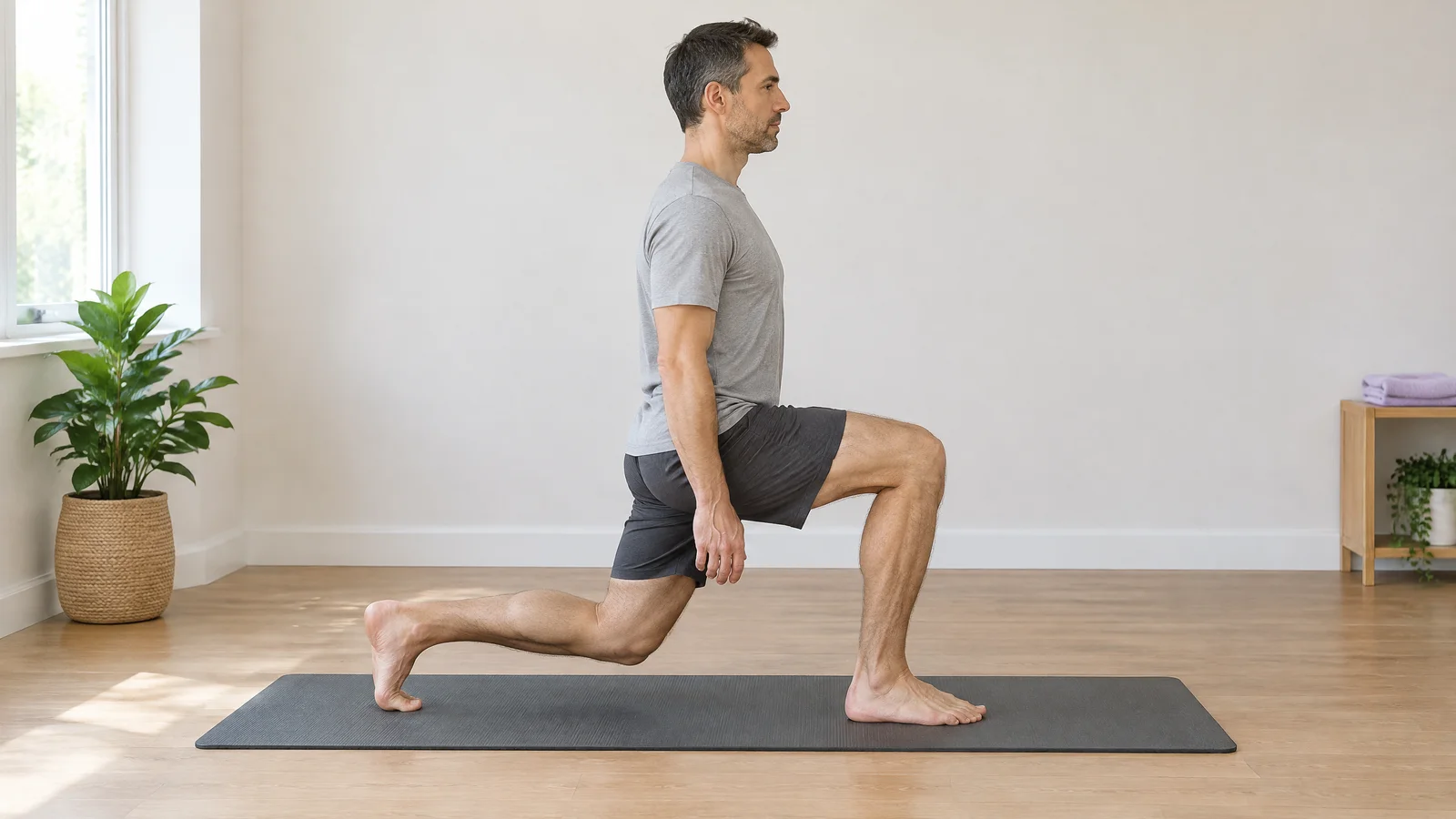
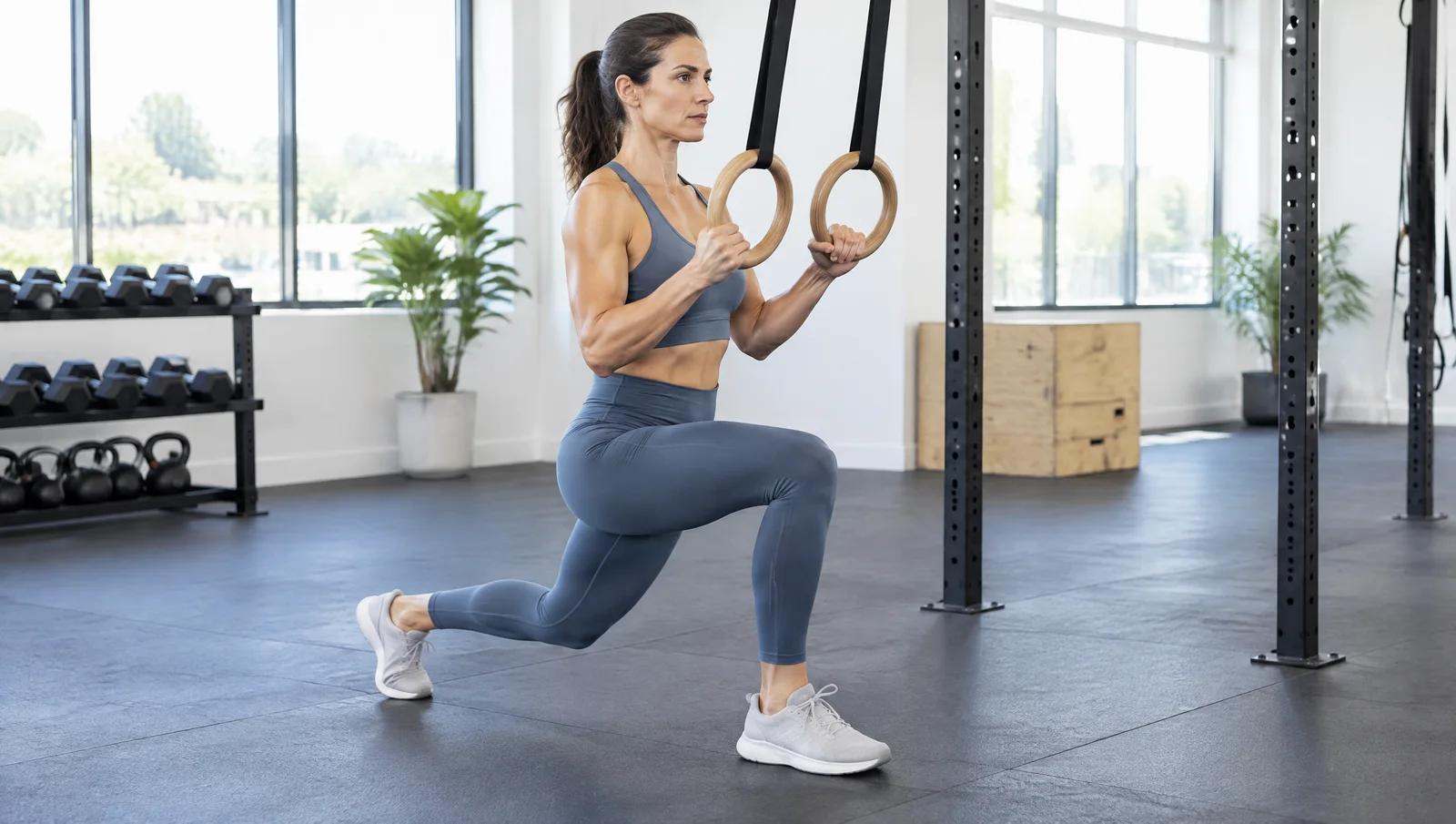
Hand-assisted split squat with both feet on the floor
This is the version used for A05. Hold the rings in front of you and take a split stance with both feet on the floor. Keep the front foot flat and the rear heel lifted. Bend at the knees and hips, lower yourself between your feet and stand back up. Use enough hand support to control your stance and chosen depth. Work both sides.
The detailed manufacturer instructions for this hand-assisted version use TRX handles. Here, the same support principle is adapted to suitable ring handles while both feet remain on the floor.4 A lunge involves stepping into or out of the split stance. It is another leg option, rather than an extra name for every split-squat repetition.
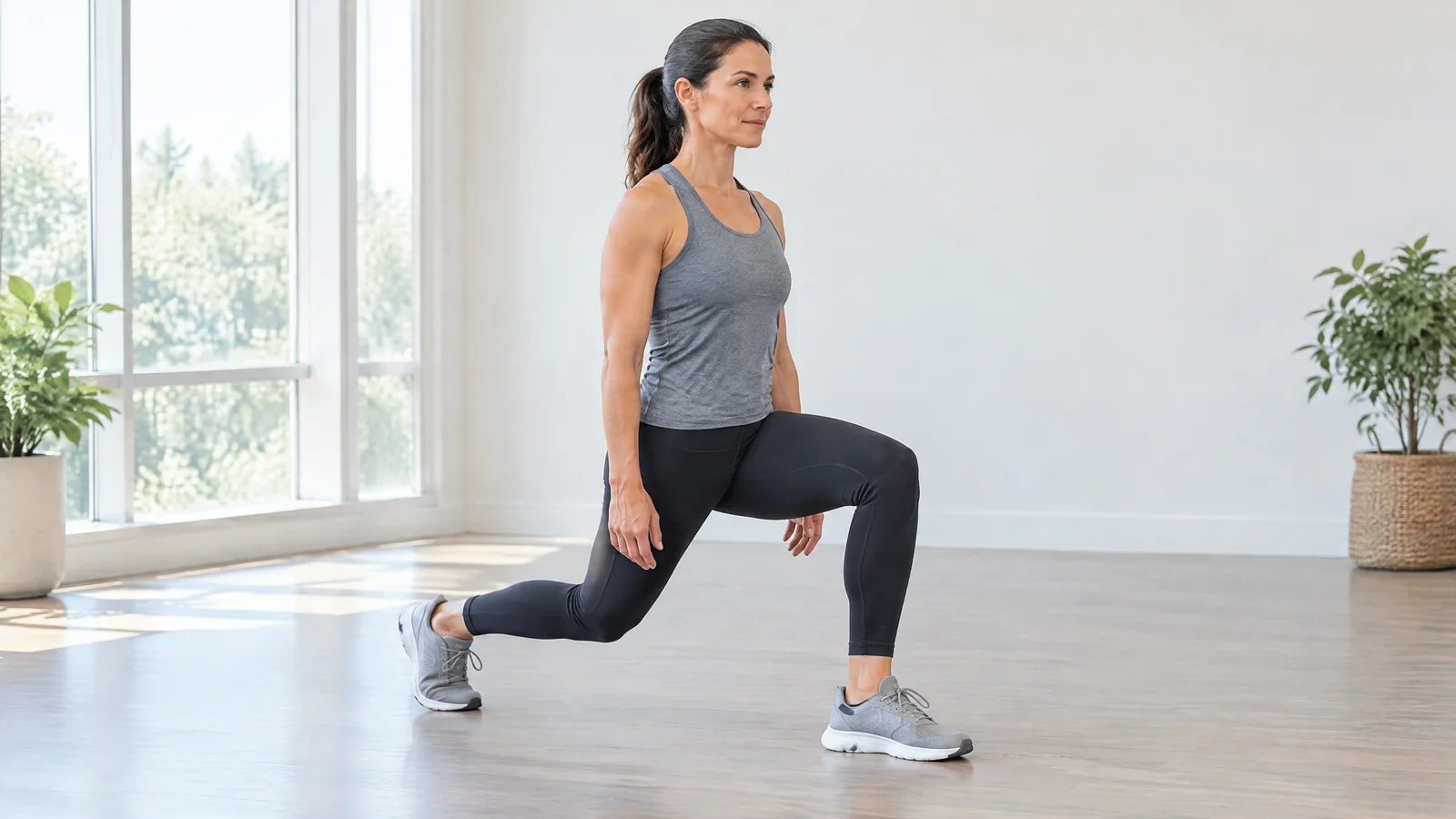
Suspended foot and Bulgarian split squat
A suspended split-squat variation supports the rear foot in suspension. Your hands do not provide the same assistance as in A05, and the moving foot support creates a different control task. A Bulgarian split squat has the rear foot supported in an elevated position. The chosen version needs to make clear which support is fixed and which can move.
ACE describes a suspended lunge with the rear foot in a purpose-designed TRX foot cradle.8 An ordinary ring does not have an identical cradle. A foot-in-ring version therefore needs suitable instruction for that system and an appropriate foot support. Instructions for connecting TRX handles do not explain how to connect two rings. The suspended version is a more demanding alternative here, not the exercise shown at A05.
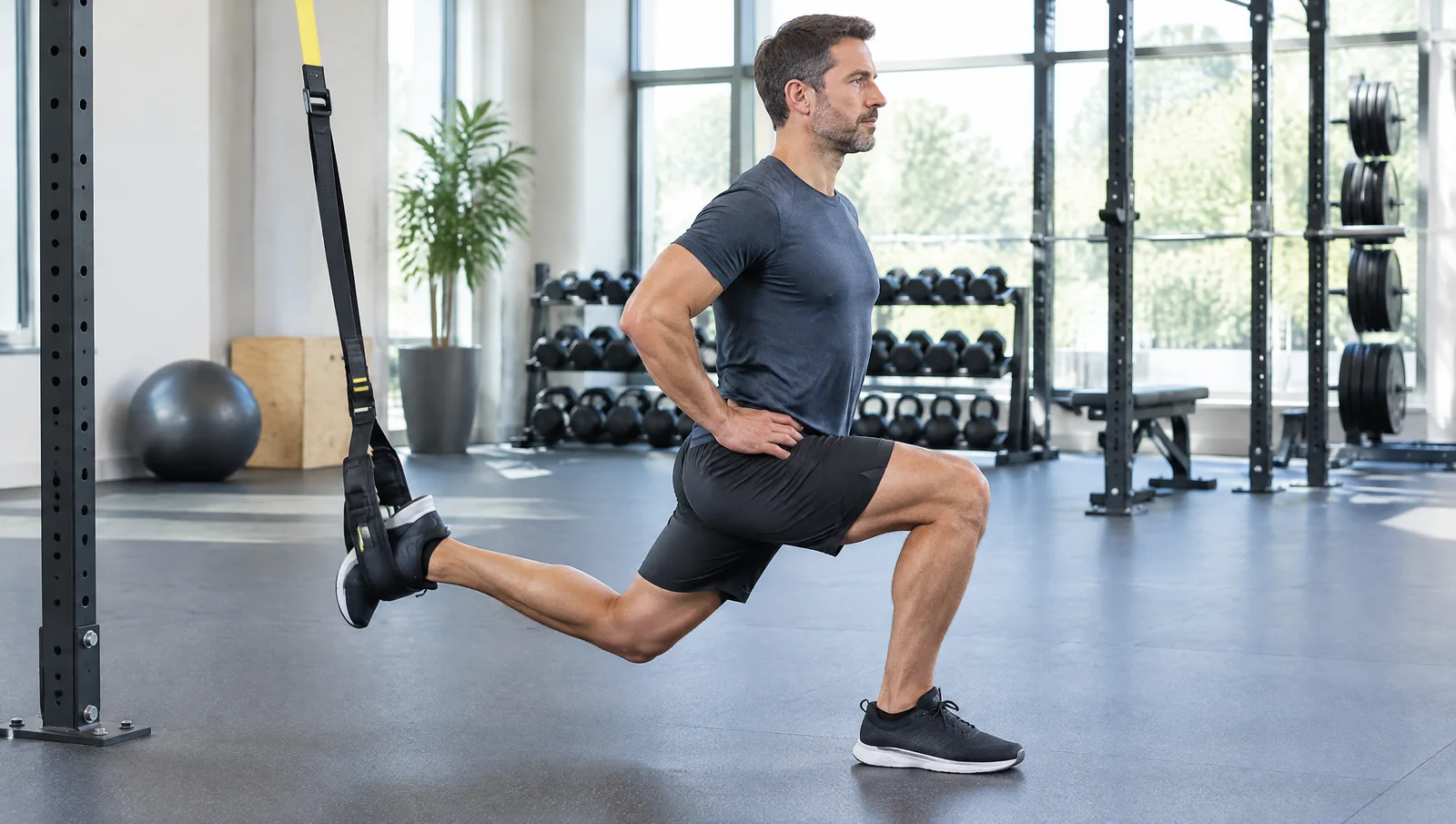
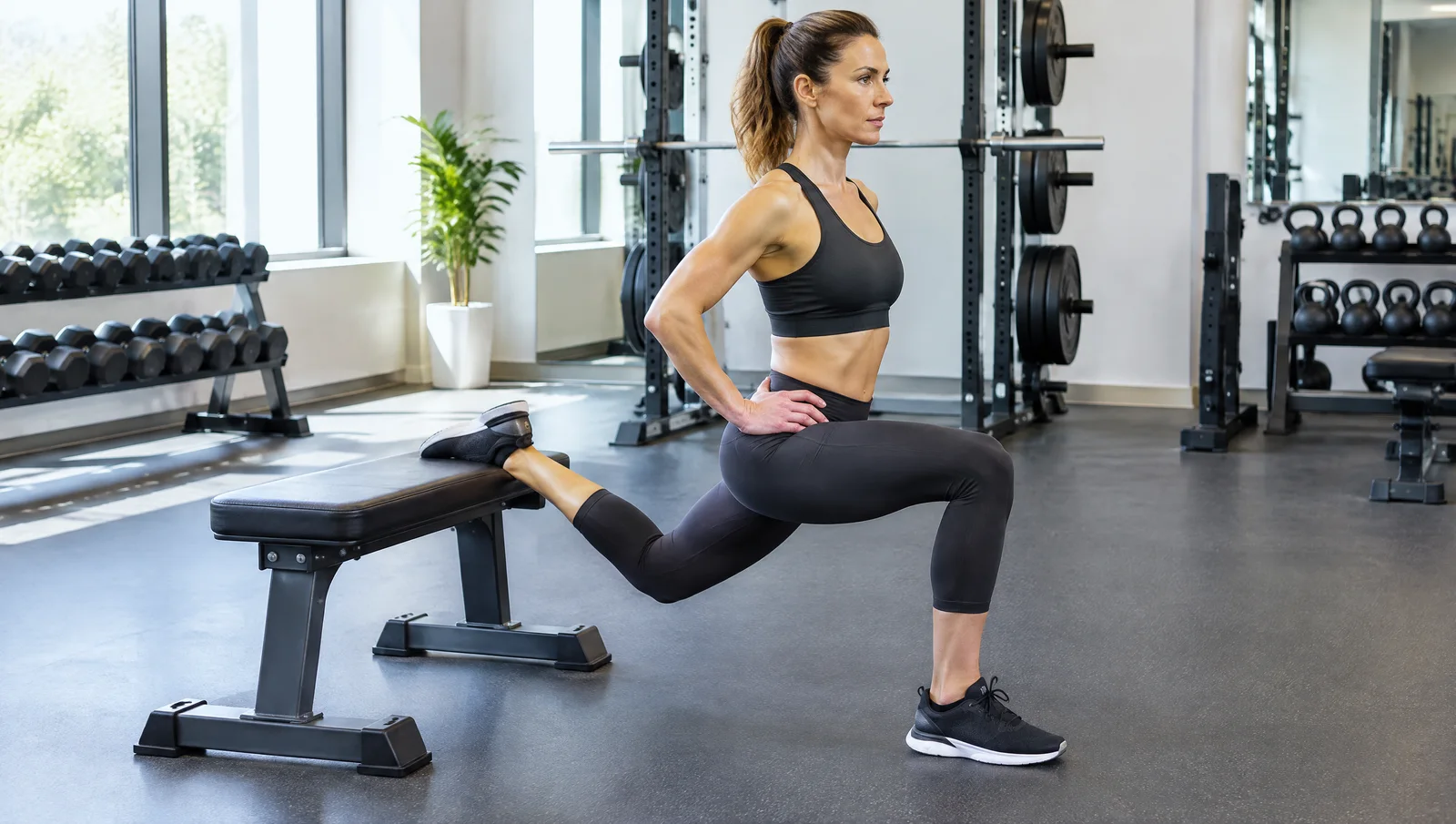
Assisted sissy squat
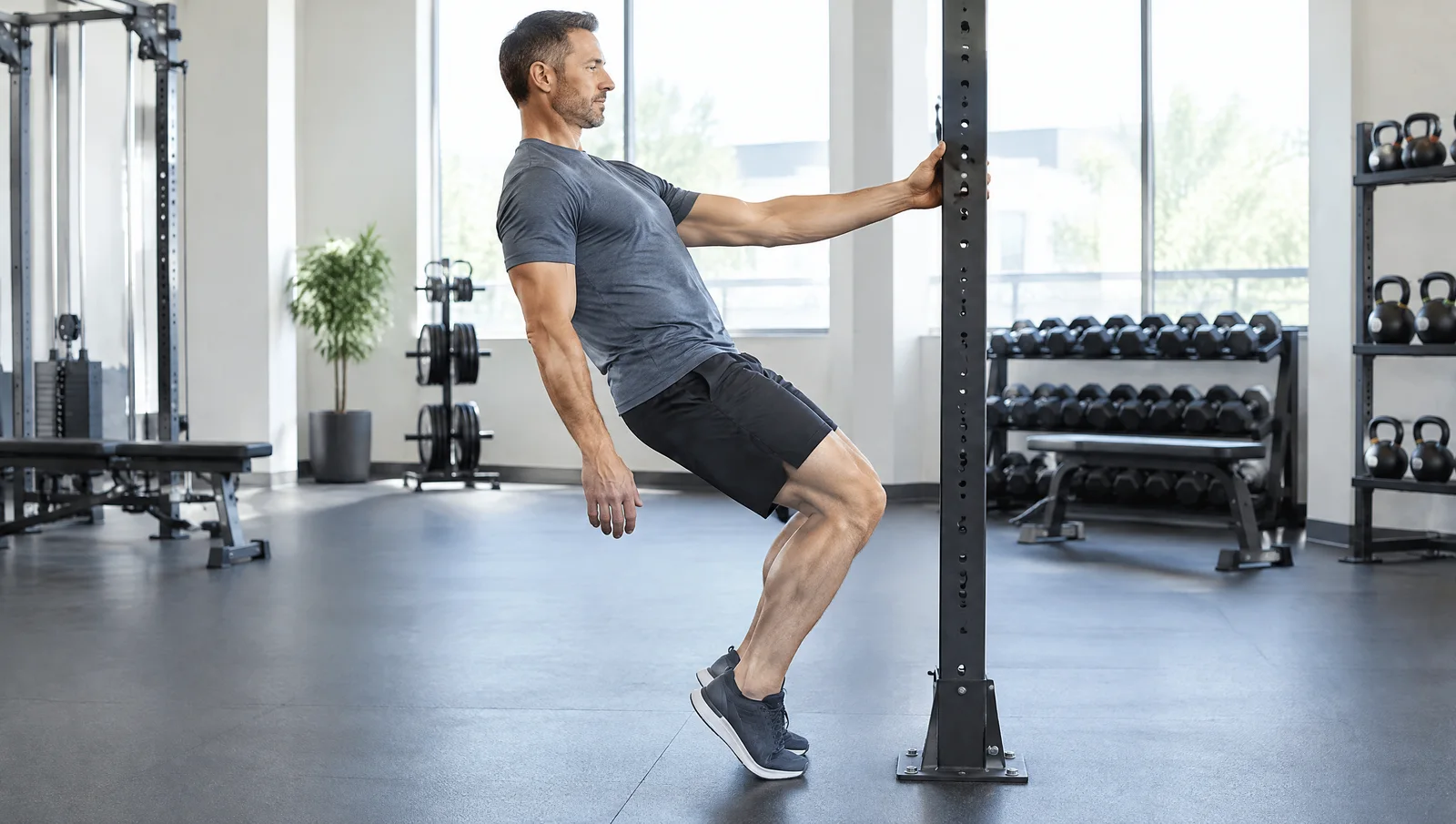
In a sissy squat, the heels rise, the knees move forwards and the hips remain relatively extended. That makes it quite different from sitting back into a conventional squat. The manufacturer’s instructions used here describe a fixed support such as a post or bar.9
Using rings would make that support movable. The sissy squat is therefore included as another type of leg exercise, rather than a complete ring tutorial or an introductory position in the A/B example. Learn a suitable version with instruction instead of aiming for the greatest possible knee depth.
Ring hamstring curl: draw the heels towards you
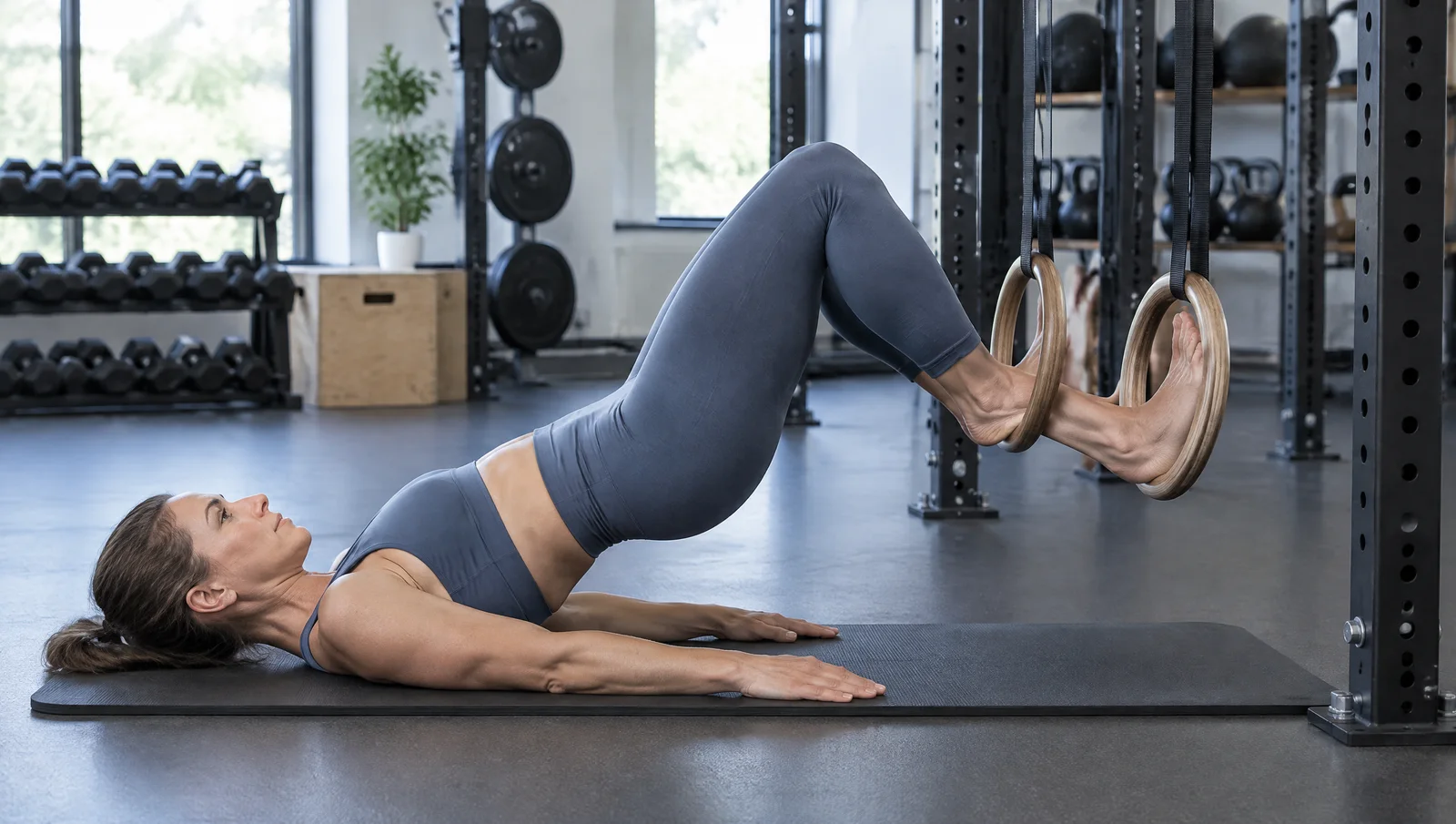
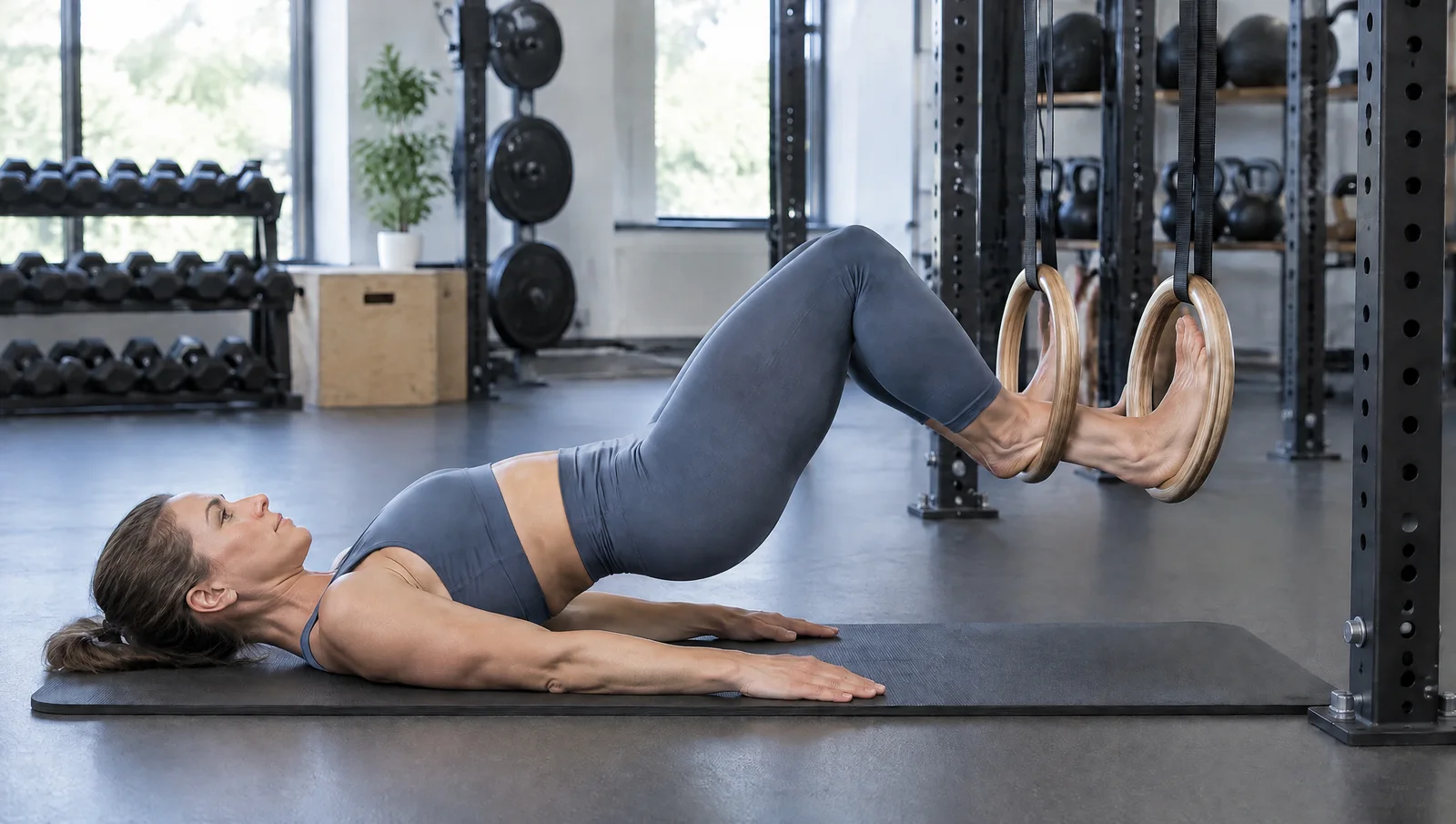
Hamstring curl, leg curl and suspended hamstring curl refer to the same exercise family here. Lie on your back with your heels in the rings. Lift your pelvis, bend your knees and draw your heels towards your body. Slowly straighten your legs again. A smaller movement or keeping the pelvis lower can make the ring version easier.1
This requires a suitable system and a secure fit for your heels. Check the intended use rather than inventing a connection to hold your feet in place. Purpose-designed foot cradles on a suspension trainer are a different set-up from ordinary wooden rings. If suitable heel support is unavailable, a floor glute bridge is a different hip-extension exercise, not an equivalent replacement for the knee-flexion work of this curl.
Hyperextensions: use purpose-built equipment
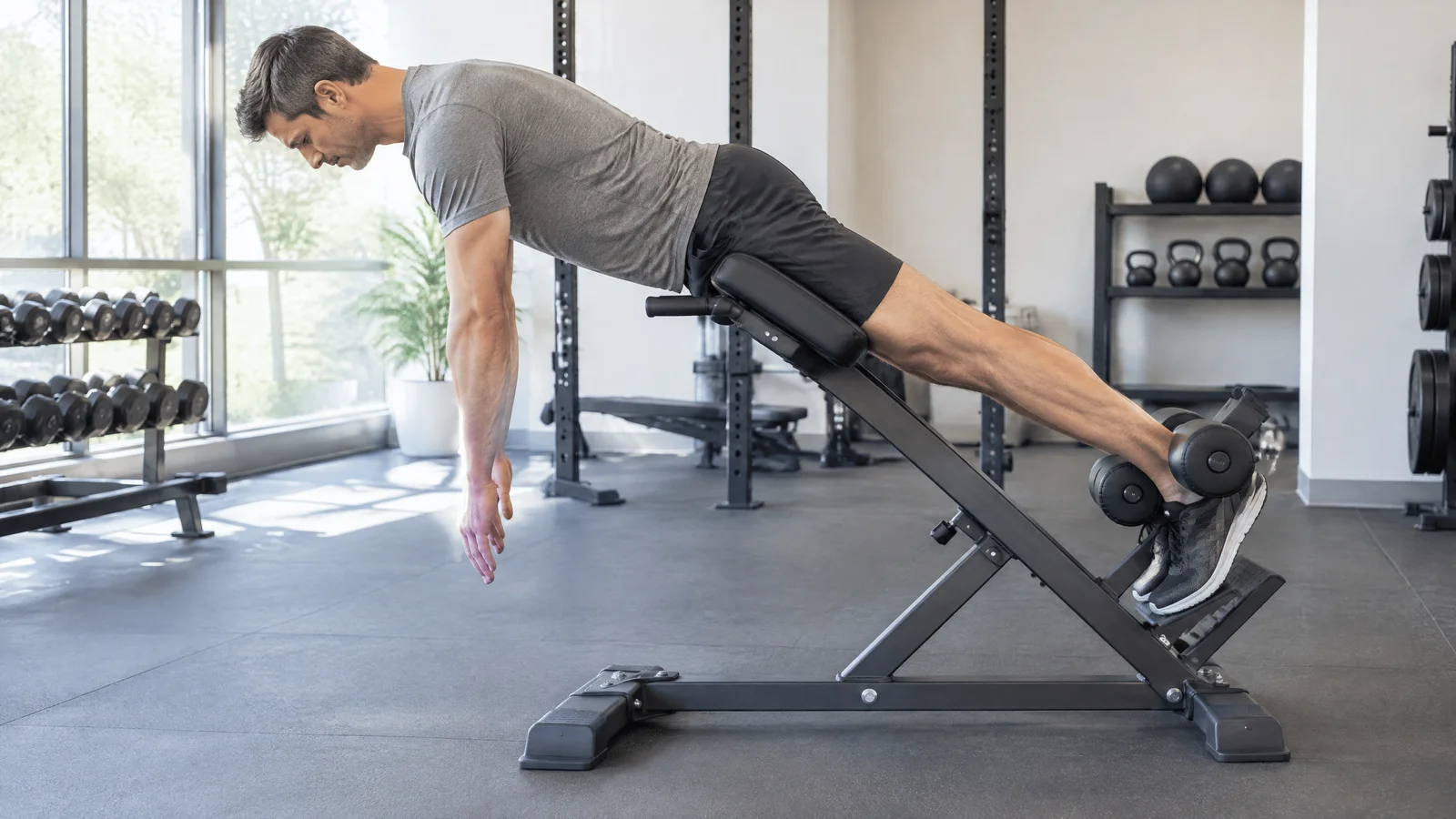
Hyperextensions lower and raise the upper body on suitable equipment, with the pelvis and legs supported as required by the machine. Learn the equipment settings and movement with qualified instruction, including how your hips and back contribute. This article does not give instructions for an improvised connection between rings.
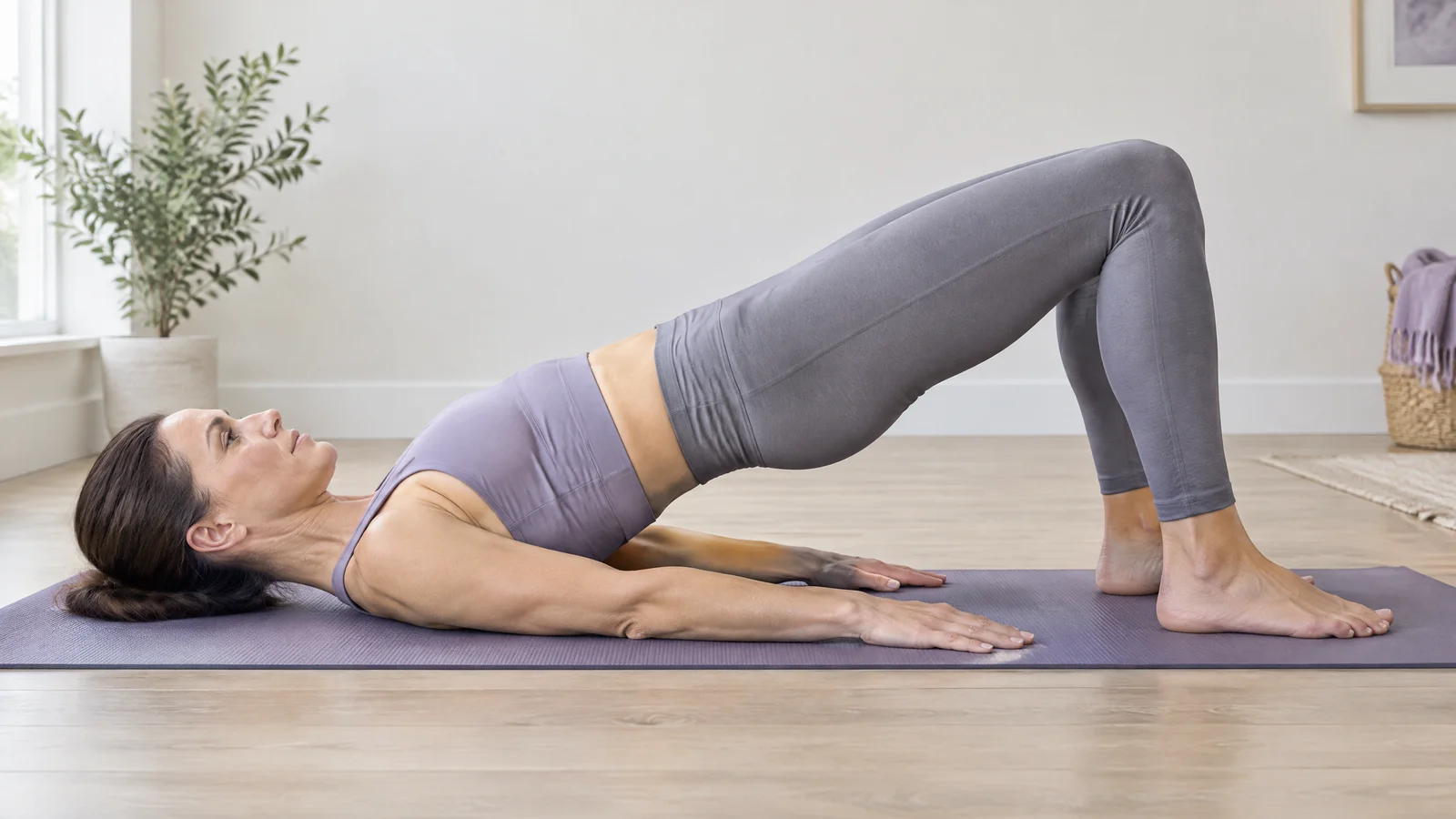
B04 remains Hyperextensions. If you do not have suitable equipment at home, choose a clearly different exercise within that position: a floor glute bridge or, if you have already learnt the technique, a kettlebell deadlift. For the bridge, both feet stay on the floor. From lying on your back, lift your pelvis by contracting your glutes, then lower it again. Avoid gaining extra height by increasingly arching the lower back.10
Glute bridges and kettlebell deadlifts use different set-ups and emphasise different tasks.
Why more wobble is not automatically better
Rings can drift apart and rotate. During pushing or pulling you therefore control the handles as well as your body. When that control task starts dictating the movement, choose an easier variation: stand more upright, shorten the range or use appropriate assistance.1
Research on unstable exercise conditions shows that immediate force or power output can be lower. The relevant review examined acute measurements using different devices. It did not compare long-term muscle growth from rings with growth from fixed handles.11 Choose your variation around the strength task you want to repeat. A curl remains additional arm work even when your trunk helps maintain position.
Progress through angle, assistance and appropriate load
Make progress you can track
In ring rows, a flatter body angle generally increases the pulling task when the rest of the set-up is comparable. For ring push-ups with the feet on the floor, higher handles usually allow a more upright position. Keep spacing, range and execution consistent when changing the angle. Strap markings help you reproduce a set-up, but do not provide a precise measure of resistance.1
There are two distinct ways to make the task easier. In rows and push-ups, a more upright body position reduces the task. In a foot-assisted ring pull-up, the legs help the pulling movement instead. REP describes both options for the respective ring exercises.1 Higher rings may reduce floor contact during an assisted pull-up and make it harder. Ring height is therefore not a universal loading scale.
In an assisted pistol, the variable is hand support. For a kneeling rollout, controlled reach is an obvious starting variable.
Repeat the movement under control and adjust one variable if needed. Record the exercise, ring height, foot position, assistance and repetitions so you can reproduce the set-up. More help is a useful learning adjustment when it lets you practise the intended movement more steadily.1
Added weight is an option for variations you have already learnt. Use suitable training equipment and a set-up designed for that use. An appropriate weighted vest and a suitable loading belt for a hanging exercise serve different purposes. Account for the extra load in the equipment and suspension system, and learn how to enter and leave the exercise safely. A heavily filled everyday rucksack is not the default solution here.25
Two training days with a clear order
A and B as an exercise-selection example
A starts with pushing and pulling at a body angle, while B begins with vertical pulling and a dip. Both include leg work and a trunk option. Choose the variation you can actually control before starting. Warm up with familiar easy movements and rehearse the intended set-up under light loading. A and B are two different sessions, not an automatic prescription for how many days to train each week.
Example plan
Two training days using suitable variations you have already learned. This is not an individual beginner prescription.
This structure is an example, not a requirement for every exercise. The muscle groups indicate the main areas of focus. On day B, ring rollouts are an extra core exercise to include as needed.
7 exercises
Training day A
- Ring push-ups
Chest, shoulders, triceps
- Ring rows
Back, biceps
5 exercises
Training day B
- Ring pull-ups
Back, biceps
- Ring dips
Chest, shoulders, triceps
- Hyperextensions
Posterior chain, lower back
Use suitable equipment after receiving instruction
Alternative exercise
Without suitable equipment: glute bridges - Ring rollouts
Abs, core
The rollout occupies B’s fifth position. Choose the additional trunk block according to your needs, skill level and other training demands. An unsupported pistol and its assisted version are alternatives within B03, not two consecutive exercises. A07 also asks you to select one version. A’s arm exercises supplement pushing and pulling, and do not both have to appear in every session.
The order provides a clear outline, but cannot decide individual suitability. Dips, hanging, pistols and the equipment at B04 each have their own prerequisites. If suitable heel support is unavailable, leave out the ring hamstring curl until an appropriate alternative has been selected. The gap is an exercise-selection question, not a reason to improvise a risky fastening.
Sets, repetitions and rest as an example
For dynamic variations you have already learnt, a traditional set-based example could use three sets, eight to fifteen controlled repetitions and two to three minutes of rest between sets. These numbers illustrate the organisation. They are neither an individual beginner dose nor the only useful range for strength or muscle growth. Work both sides for one-sided exercises. Do not force timed holds into a repetition prescription.15
Choose a variation and amount of work that let you control the movement through the end of the set. Stop when grip, body line or movement range deteriorates noticeably, and adjust the next effort. Learning a new exercise may call for substantially fewer repetitions and sets. The current ACSM overview separates load, volume and other variables according to the training goal. It examines general resistance training in healthy adults, rather than this specific ring programme.12
Rep ranges for muscle growth: what fits your training? explains how load, rep count and proximity to failure fit together. It puts the set example in context without turning it into a fixed growth zone.
Individual sets or a circuit?
With individual sets, repeat one exercise with recovery between efforts before moving on. This makes the same movement and set-up easier to compare. A circuit moves between several exercises. Choose easier, familiar variations whose quality you can maintain through the changes.
Shorter rests change fatigue and organisation. They do not replace controlled increases in loading. Take time to establish your grip and make necessary height adjustments rather than rushing between different set-ups. Session length follows from exercise selection, volume, rest and equipment changes, not simply the letter A or B. Plan aerobic movement and balance tasks alongside this strength work.1213
Other adjustments you can make later
More controlled repetitions, a deliberately slower lowering phase and a different body angle change different parts of the task. Record what actually changed when comparing sessions. A longer repetition is different from more external weight, and the slowest possible movement is not automatically the most effective.12
Single-arm and single-leg variations change load distribution and control substantially. Rotational tasks require their own exercise selection. Learn these separately rather than treating them as compulsory upgrades when a basic exercise becomes easier. Olympic ring gymnastics is a sport with a long preparation process. An everyday strength routine does not require you to work through a gymnastics skill ladder.
How I combine rings and kettlebells
Since leaving the gym, I have combined rings and bodyweight training with kettlebells.
This is my personal routine, not a recommendation to follow it exactly. Everyone needs to work out what suits them.
Keep meals and activity in the same daily overview
If you want to record your nutrition alongside training, The 8 Protocol lets you log meals in a food diary. The Apple Health connection is optional. Manual exercise tracking can also be enabled by choice: entering an activity and duration produces an expenditure estimate that you can overwrite. It is not an exact measurement of ring-training energy expenditure and does not coach your training. Exercise calories are not currently added to your calorie target.14 An option to add exercise calories to your calorie target is planned.
Choose strength tasks that fit your life
The useful connection to healthy ageing is strength and movement competence: applying force repeatedly, controlling your body and practising different movement tasks. General resistance-training research shows improvements in strength and several functional tests, including getting up from a chair.12
In practice, begin with a suitable training point and manageable pushing and pulling variations. Add appropriate leg tasks, trunk work where useful, and a kettlebell as another form of loading. Walking, cycling or other aerobic movement and appropriate balance work retain their own place.13
Persistent symptoms, existing conditions or uncertainty about a movement call for individual professional advice. An exercise overview cannot replace equipment instruction or a personally adapted programme. Rings are a versatile tool. What matters is the task you can perform under control and develop sensibly.
Sources
- REP Fitness, Rachel MacPherson: Gymnastics Rings Workout for Full Body Control. Manufacturer technique article covering the named ring variations, assistance and progression. Not evidence of general superiority. Accessed 7 November 2026.
- inSPORTline: User Manual, IN 7259 Gymnastic Rings CF020, pp. 3 to 6. Safety and use instructions for this model, not approval of another ring set or attachment point. Accessed 7 November 2026.
- TRX: 5 Common Questions About Installing the TRX XMount. Product-specific mounting and substrate requirements, not general approval for rings. Accessed 7 November 2026.
- TRX: 20 TRX Exercises to Do With a Suspension Trainer + Workouts, section 16, Split Squats. Describes hand assistance with both feet on the floor using TRX. Ring handles are an equipment adaptation here. Accessed 7 November 2026.
- GORNATION: 14 Calisthenics exercises on gymnastics rings. Manufacturer descriptions including curls, flies, knee raises and added load. Not an intervention study. Accessed 7 November 2026.
- ACE: TRX Biceps Curl. Elbow mechanics on a suspension trainer. Accessed 7 November 2026.
- ACE: TRX Overhead Triceps Extension. Overhead variation explicitly using TRX. Accessed 7 November 2026.
- ACE: TRX Suspended Lunge. Rear foot in a purpose-designed cradle, not instructions for connecting rings. Accessed 7 November 2026.
- GORNATION: The Assisted Sissy Squat. Describes assistance from a fixed support. Accessed 7 November 2026.
- ACE: Glute Bridge. Floor bridge as a separately named alternative. Accessed 7 November 2026.
- Marquina Nieto et al. (2021): Effects on Strength, Power and Speed Execution Using Exercise Balls, Semi-Sphere Balance Balls and Suspension Training Devices. Systematic review of acute performance measurements, not a long-term test of muscle growth from ring training.
- ACSM (2026): Resistance Training Prescription for Muscle Function, Hypertrophy, and Physical Performance in Healthy Adults. Overview of systematic reviews on general resistance training. Does not test this A/B example or establish an exclusive repetition range.
- WHO: Physical activity. General activity framework, not an evaluation of a ring circuit. Accessed 7 November 2026.
- The 8 Protocol on the App Store. Description and release notes covering optional exercise tracking, editable estimates and exercise calories currently not being credited to the calorie target. Checked 7 November 2026.
- Exercise and A/B organisation example for ring training (video). Set, repetition and rest example at 15:16 to 15:27. Topic source, not evidence of effectiveness or an individually assessed programme. Accessed 7 November 2026.