
Calisthenics and kettlebells: strength without a gym
A pull-up looks straightforward from a distance: take hold of the bar and pull yourself up. Trying it reveals how much is involved. Your arms pull, your trunk holds its position and your grip has to support you. That combination makes bodyweight training interesting. You work on strength while learning to control a movement, and your starting task can be much smaller than a full pull-up.
Calisthenics uses your body weight as its main source of resistance. A push-up moves your body against gravity, while a squat works through your legs and hips. Difficulty depends on more than how much you weigh. Support, body angle and leverage all change the task. A wall push-up and a floor push-up therefore belong to the same movement family, despite feeling very different. 12
Add a kettlebell and you can put together a workout with little equipment. A bar provides a place to pull, while the floor provides a surface to push against. The bell adds external load for the legs and hips. 34
For ring exercise choices and two illustrated session outlines, see Gymnastic rings training: choose your exercises.
Four directions with different goals
Endurance: repetitions and sets
Endurance calisthenics, also called “reps and sets”, centres on repeated basic exercises. You practise push-ups, pull-ups and dips, working towards more controlled repetitions. More demanding combinations link several exercises together. Muscular endurance means being able to repeat a muscular task, rather than simply produce force once.
Here, “endurance” does not automatically mean the same thing as aerobic exercise such as brisk walking or swimming. Repeated push-ups challenge the muscles involved. Whether a whole session also counts as aerobic activity depends on its actual intensity and duration, not the name of the training style. 5
Weighted calisthenics and streetlifting: adding load
Instead of making sets longer, you can add external load to an exercise you already control. A weighted pull-up lifts the extra load with your body. A weighted dip lowers and presses it from an arm-support position. A muscle-up combines pulling below a bar with a transition into support above it. A weighted muscle-up makes that complex task harder still. Streetlifting squats also use external load. The exercises included in a competition depend on its format. 67
Streetlifting gives these exercises a competitive setting focused on heavy loads. You do not need a maximum single attempt to make your own training worthwhile. Added weight is one possible progression once the underlying movement is repeatable. A muscle-up remains a separate skill, not simply a pull-up with another repetition attached.
Freestyle: linking movements creatively
Freestyle brings strength together with dynamic elements. Examples include pulling sideways from a pull-up movement, a kick with one foot and a turn referred to as a “360”. A muscle-up may form part of a sequence. The appeal lies in connecting movements through rhythm and spatial awareness. 7
These elements require their own learning process, suitable space and guided preparation for grip changes and exits. They are not an automatic next step after reaching a certain number of pull-ups. There is plenty to practise without ever learning a rotation around a bar.
Statics: holding demanding positions
In a human flag, the body is held roughly horizontal to the side of an upright support. A planche holds the body off the ground on the hands, with the feet unsupported behind it. A front lever suspends the body horizontally beneath a bar. Those long levers explain much of the difficulty. 7
A handstand is another distinct skill: you balance upside down over the small support area provided by your hands. Pike push-ups and handstand push-ups introduce overhead pressing. An L-sit combines arm support with legs lifted in front of the body. These skills can become long-term goals. Qualified coaching can help you prepare the support position, mobility, equipment setup and exit. Appropriate basic exercises are enough to get started. 7
Developing strength and learning movements
During a push-up, the chest, shoulders and triceps contribute to pressing while the trunk holds the body together. Raising the hands changes the task without requiring a different machine. Body weight does not have to mean a fixed training load. 12 3
A small study illustrates the strength-training potential. Eighteen male sports students aged 19 to 22 trained with either adjusted push-ups or light bench presses for eight weeks. Both groups increased measured chest and triceps muscle thickness and improved their bench-press test performance. The finding concerns the chest and triceps in this specific programme. 8
Muscle mass, strength and movement skill describe different things. Strength, muscle size and power: what are you training? explains how to distinguish your goals and the relevant training measures. Having more muscle tissue is not identical to producing more force in a particular task. Learning to control a movement requires practice in its own right. That distinction matters when thinking about ageing, because standing up, climbing stairs and lifting an object involve both force and coordinated movement. Resistance training is also addressed in professional guidance for older adults. 9
In a pilot study of eight independently living older adults, averaging 70 years of age, performance on a 30-second repeated chair-rise test improved during a bodyweight programme that began with online supervision. Questionnaire measures of everyday function did not change significantly. There was no control group, and the programme used simple exercises rather than pull-ups or dips. 10
Longer-term research helps explain the interest in strength training within longevity discussions. A review of 16 observational cohorts in adults without major disease at baseline found an association between muscle-strengthening activity and lower mortality. These observational associations do not establish that calisthenics extends life. The practical question is which movements you want to keep practising in everyday life. 11
The exercises: pushing, pulling, legs and core
Choose movements, not just exercise names
A push-up moves you away from the floor. A pull-up brings you towards a bar. A squat asks something different of your legs. Grouping exercises by these movements makes a long list easier to navigate. It helps you see which tasks your training already includes and where you might want another option. The five families here are pushing, pulling, knee-bending leg exercises, hip extension and core exercises.
You do not need every variation. A wall push-up may be the right starting point, while a ring push-up adds another challenge. Choose a movement you can currently control. Bars, rings and raised supports also need a secure setup designed to bear the load. Furniture does not become exercise equipment simply because it happens to be the right height.
Push-ups: raised hands, the floor and rings
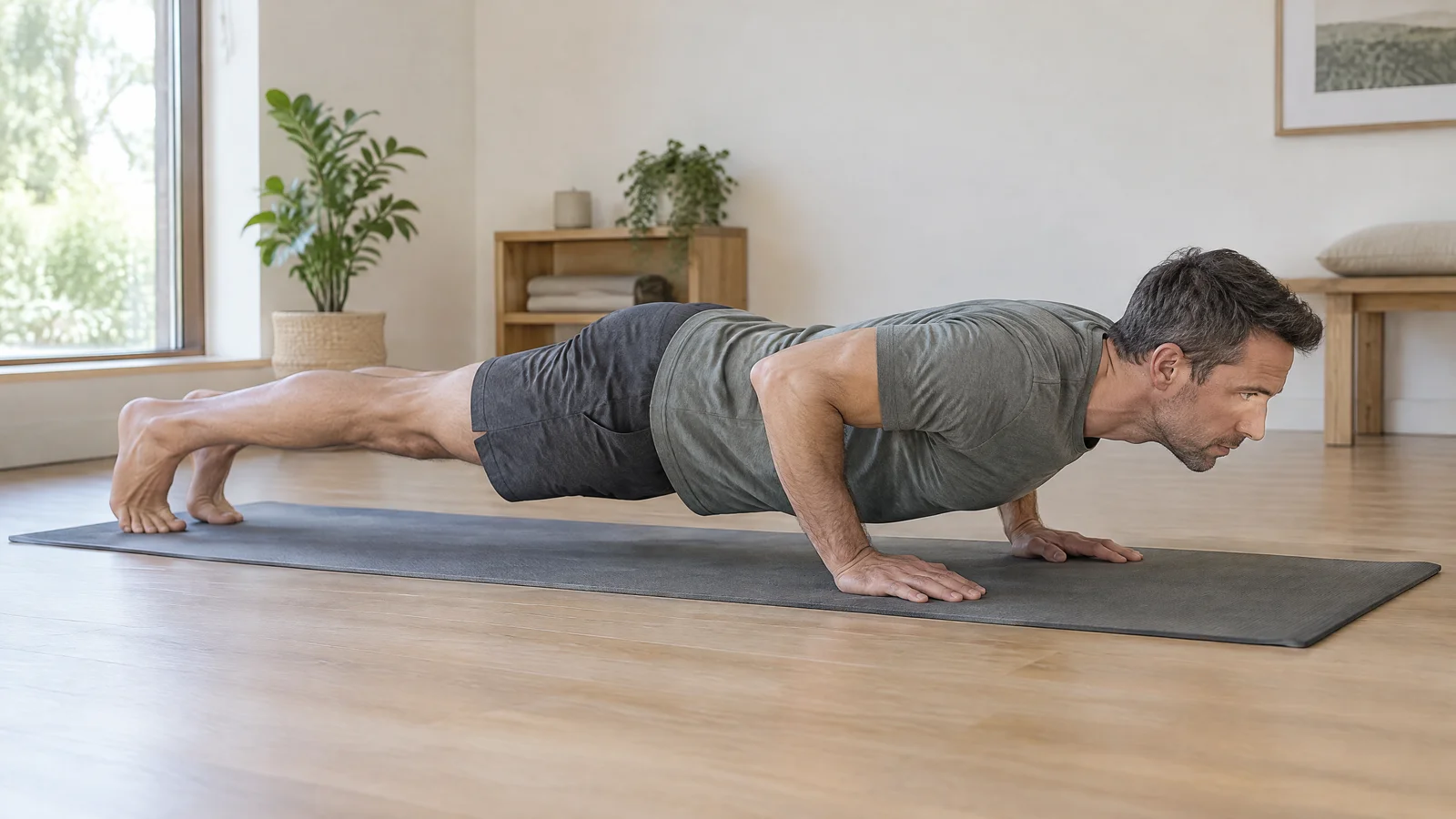
Push-ups involve the chest, shoulders and the backs of the upper arms. Your trunk also works to hold your body in position. For the floor version, place your hands roughly shoulder-width apart beneath your shoulders. Engage your abdomen, glutes and thighs, then lower and press up with your body moving as one unit. Keep your head in line with your body. If your pelvis drops first or your hips rise separately, that coordinated movement is not yet consistent. 1
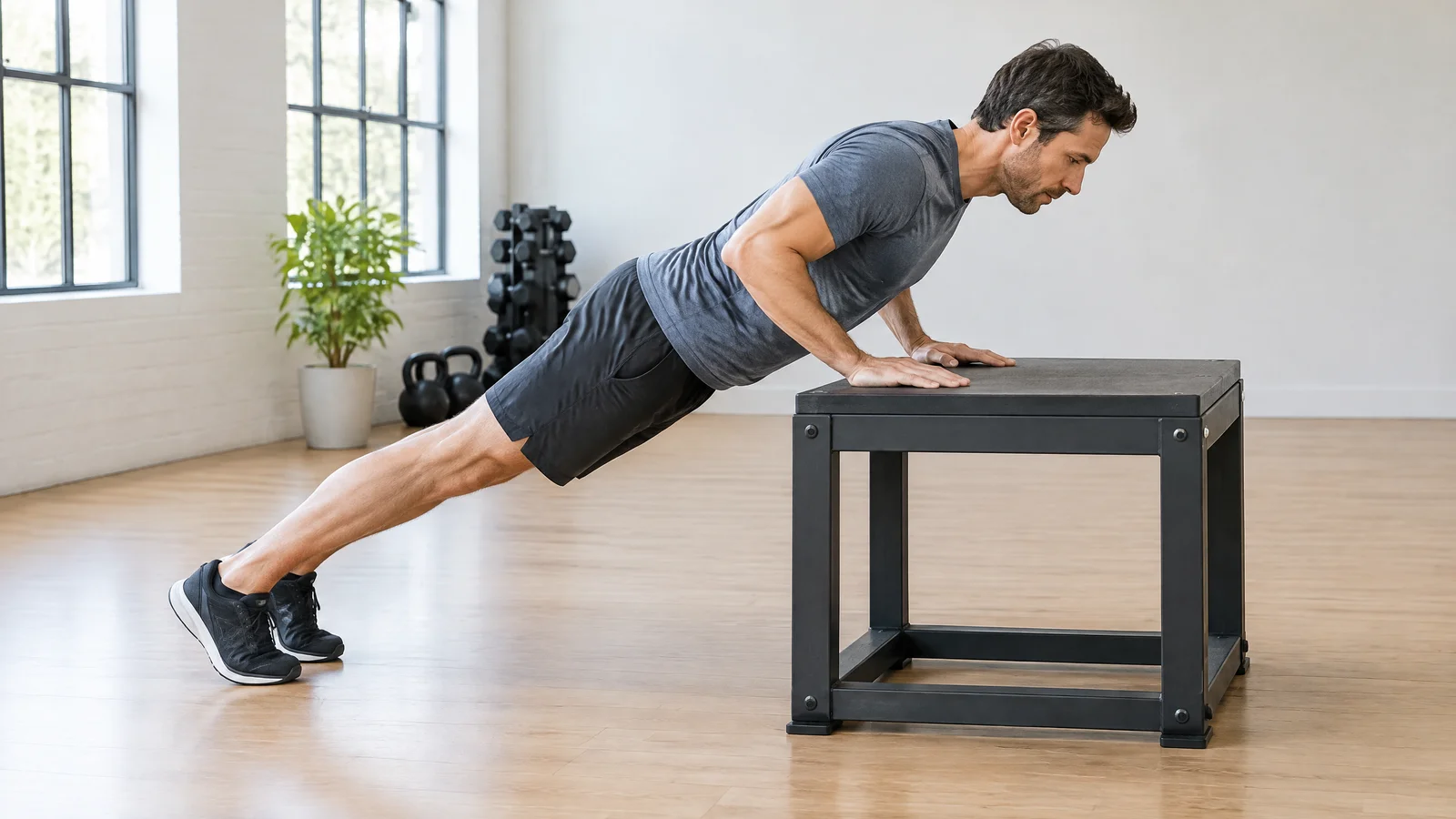
Raising your hands makes the task more manageable. A wall lets you practise pushing from a more upright position. A secure raised surface offers another option before moving to the floor. Choose a height that lets you keep your body together rather than struggle through individual repetitions. Wall push-ups can also remain a useful exercise in their own right, even if doing them on the floor is not your goal. 2 3
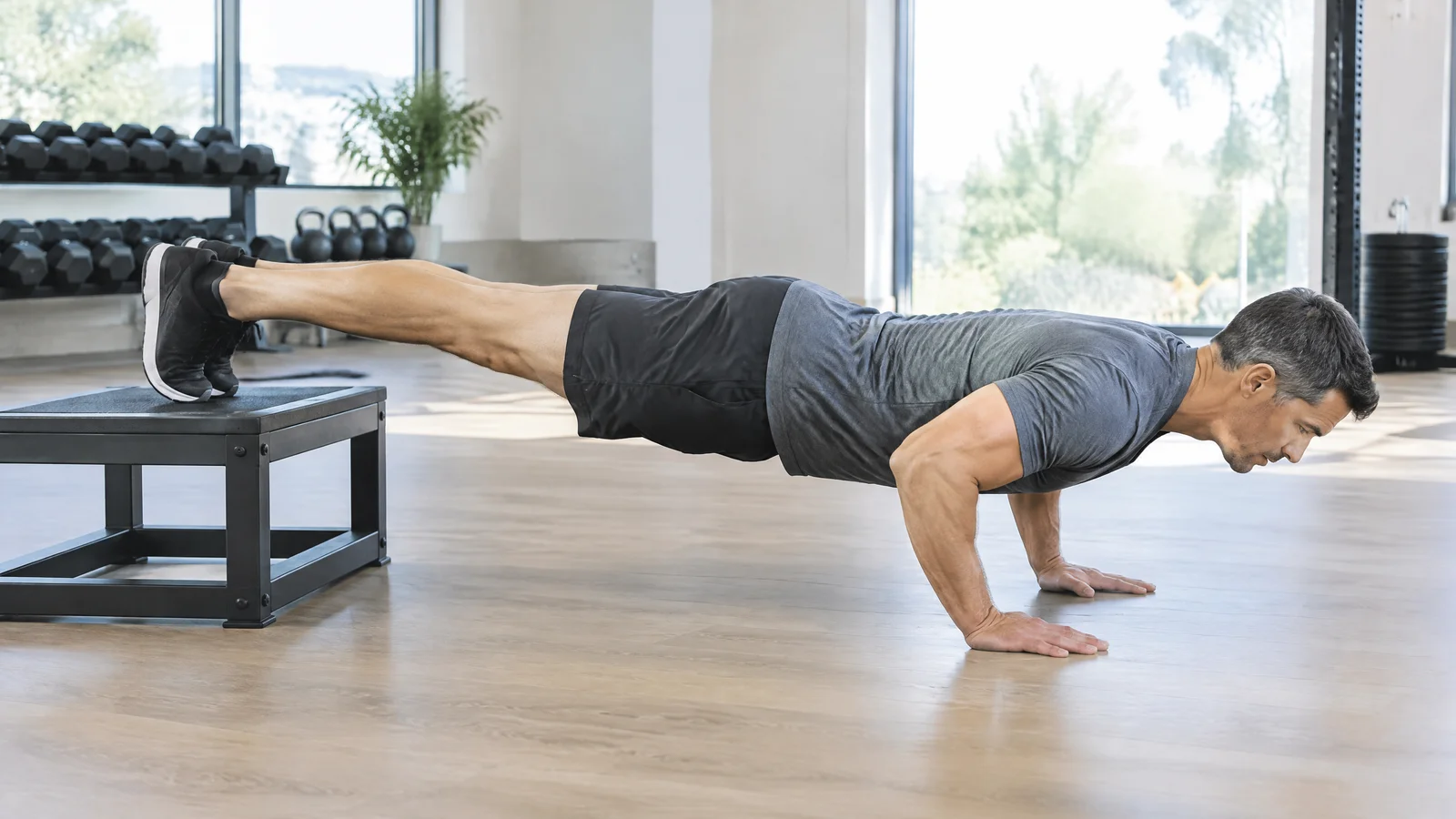
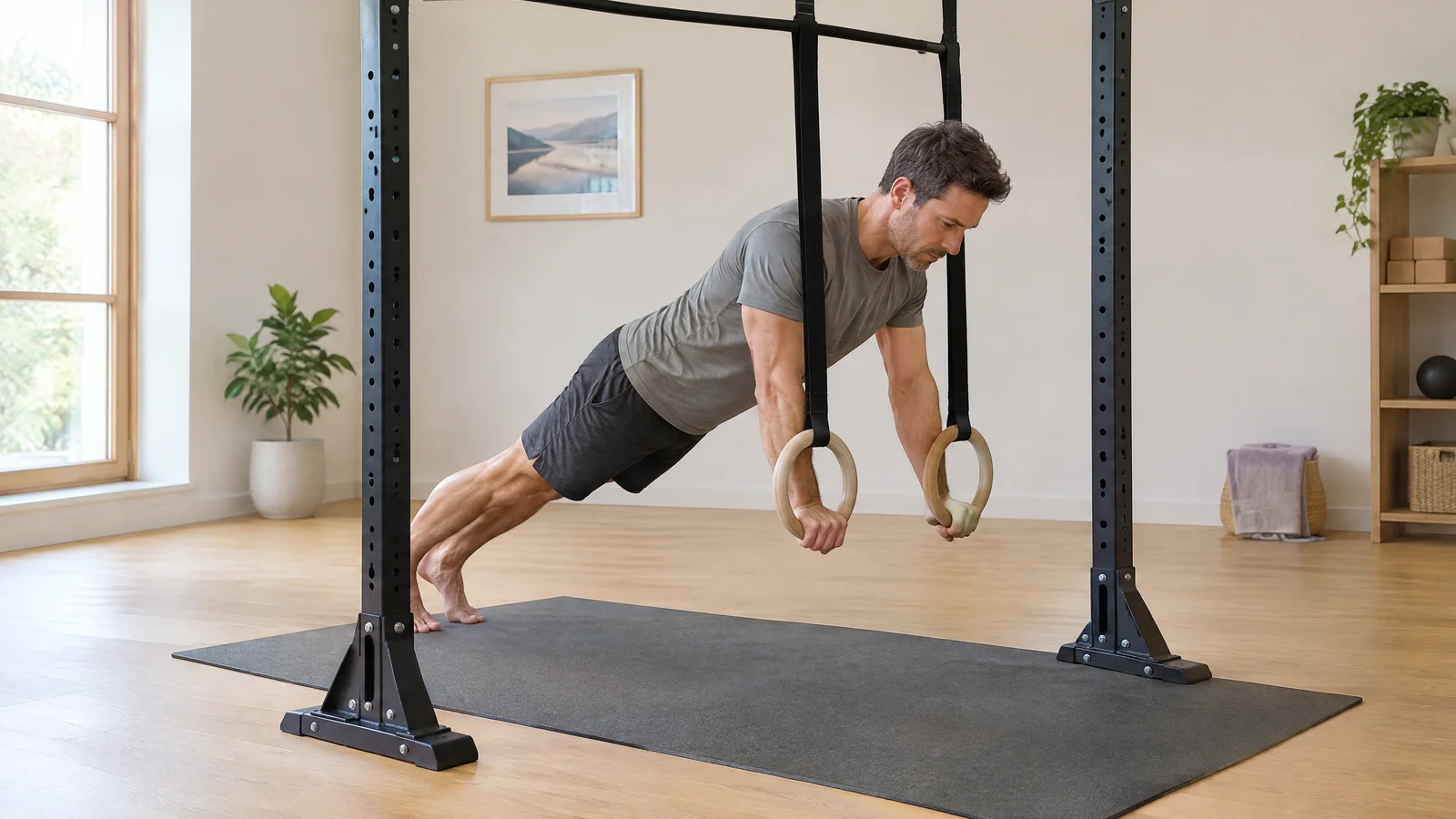
Elevating your feet changes the challenge in the other direction. Your hands stay low while your feet rest on a suitable support. With ring push-ups, the handles can move as well. Try either variation only once you can hold a stable push-up position. You can therefore adjust the body angle or choose to work with moving handles. Get shown the setup and movement before using rings. 7
The chest press and bench press provide familiar gym comparisons. In those exercises, you push an external resistance away from you. In a push-up, you move your body relative to its support. They share a pushing pattern without making identical demands. A chest-press machine needs an appropriate setup, while bench pressing adds the task of handling a free weight. 3
Dips and ring dips: pushing from a support position
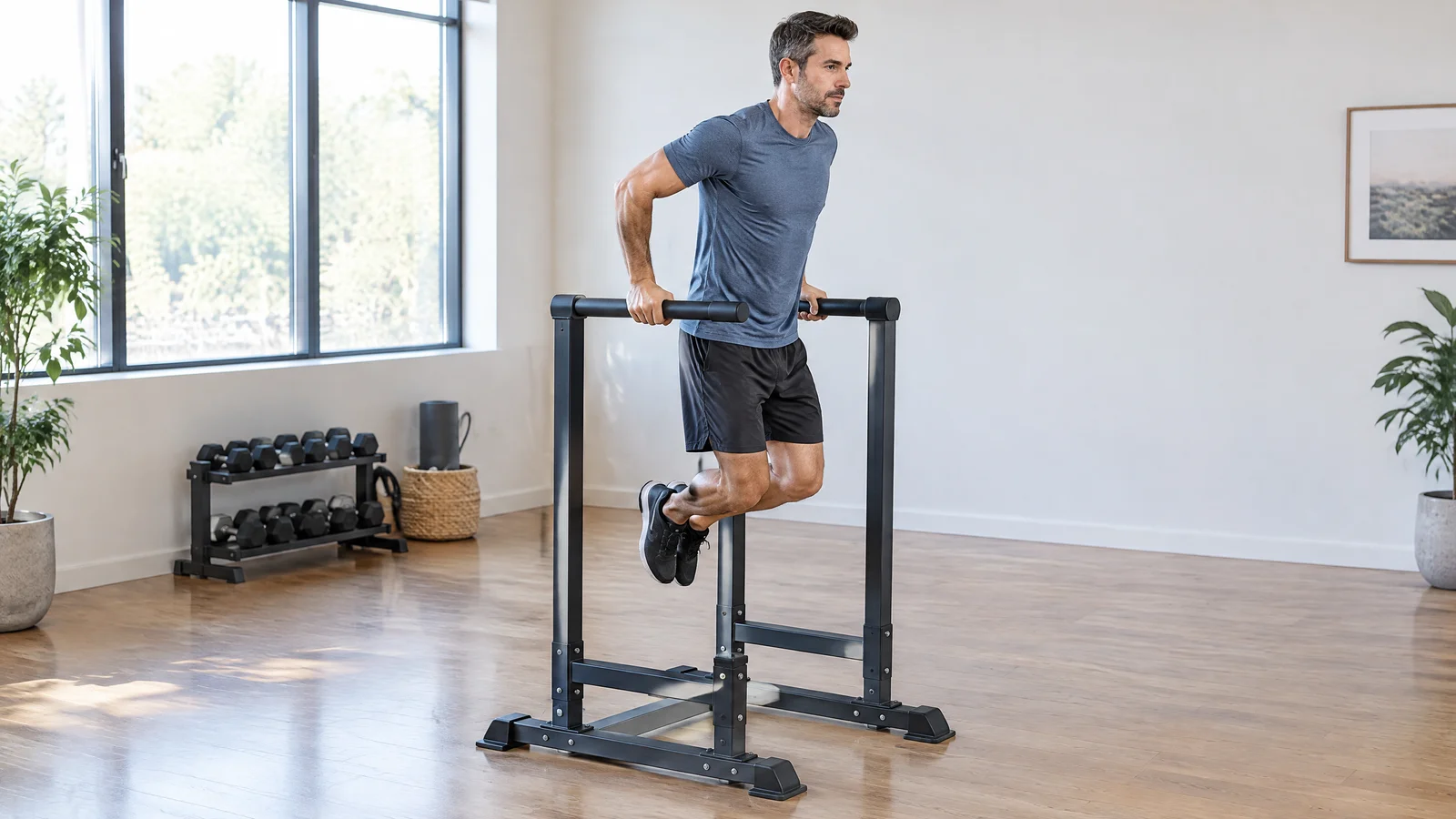
In a dip, you support your body between parallel bars or the handles of a purpose-built dip station. Start in a controlled arm-support position with your trunk engaged. Bend your elbows to lower your body, then press back up. Your elbows move behind you as they bend. Unlike a push-up, your feet do not share the load on the floor. That helps explain why a dip can be demanding for a newcomer. 12
Being able to support your weight is a prerequisite, not something to discover halfway through a deep first repetition. Do not force a depth you cannot control. If you cannot yet maintain the support position, a suitable push-up variation offers another way to practise pushing. It does not reproduce every part of a dip, but it gives you a different pressing option for your training.
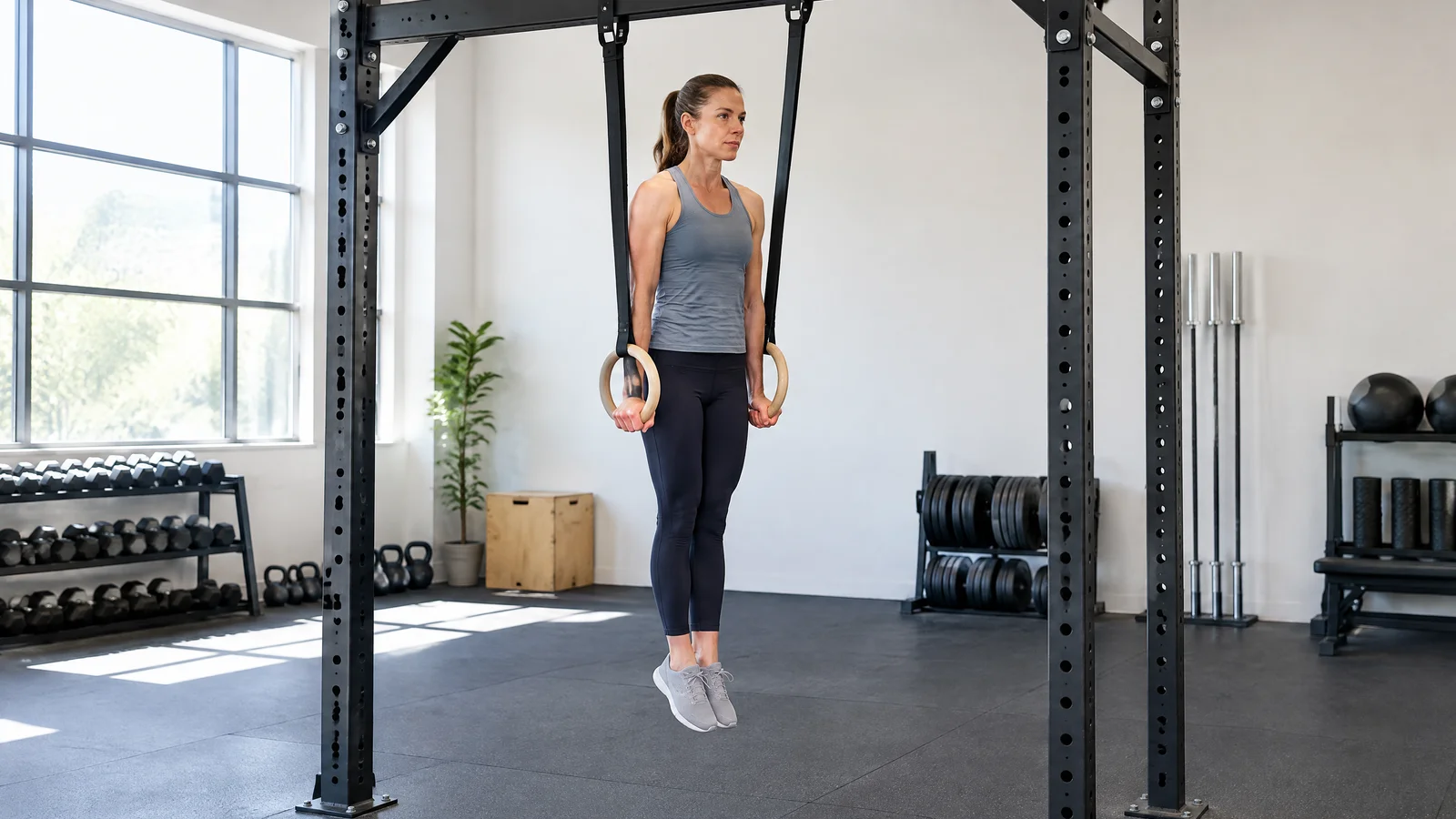
Ring dips add the challenge of controlling moving handles. They are an advanced option that needs its own preparation. Two loose chairs are not a suitable default substitute for parallel bars. If supporting your weight causes pain, stop rather than trying to get through the movement with momentum. 7
Pike push-ups and handstand push-ups: pressing overhead
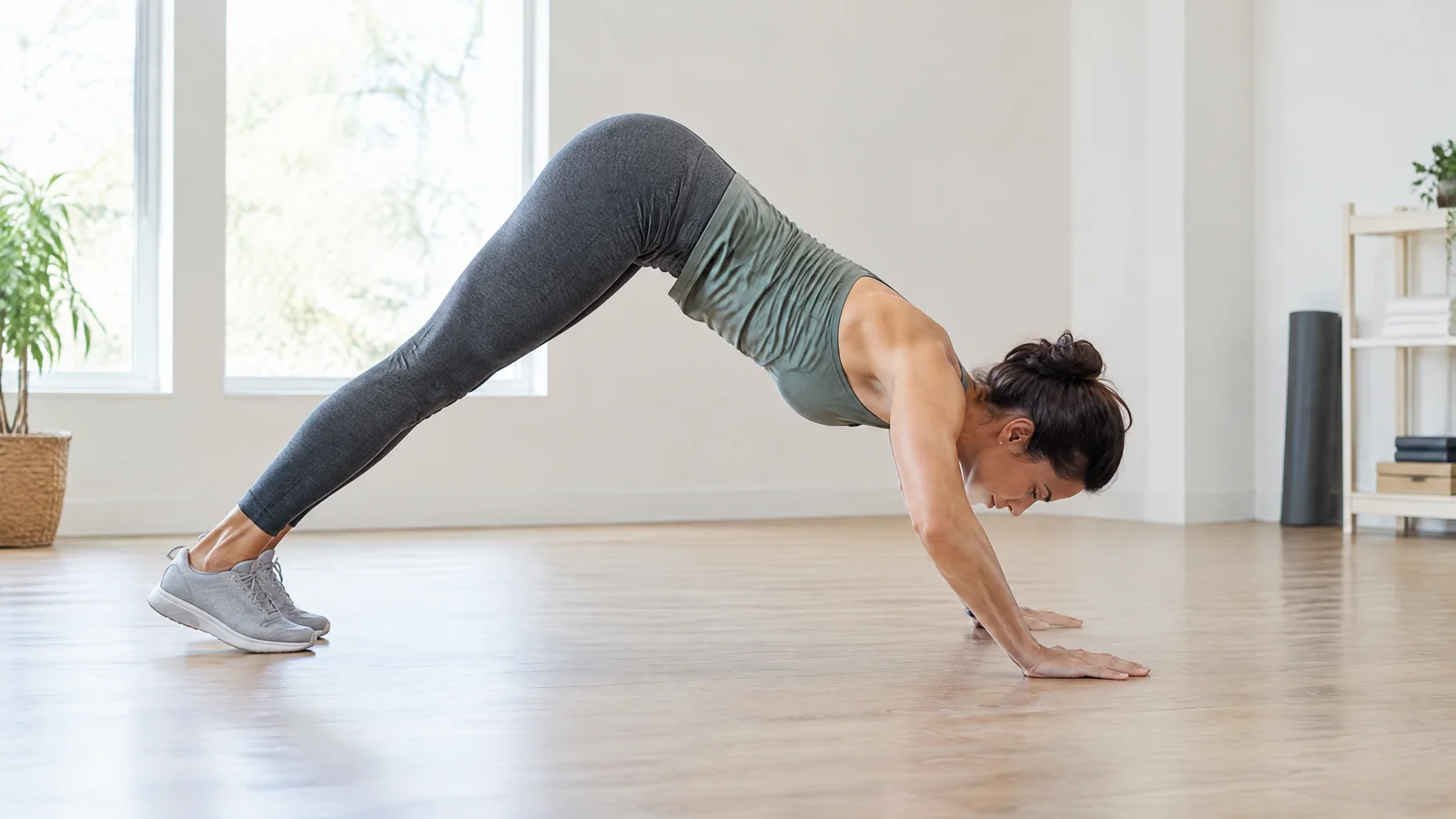
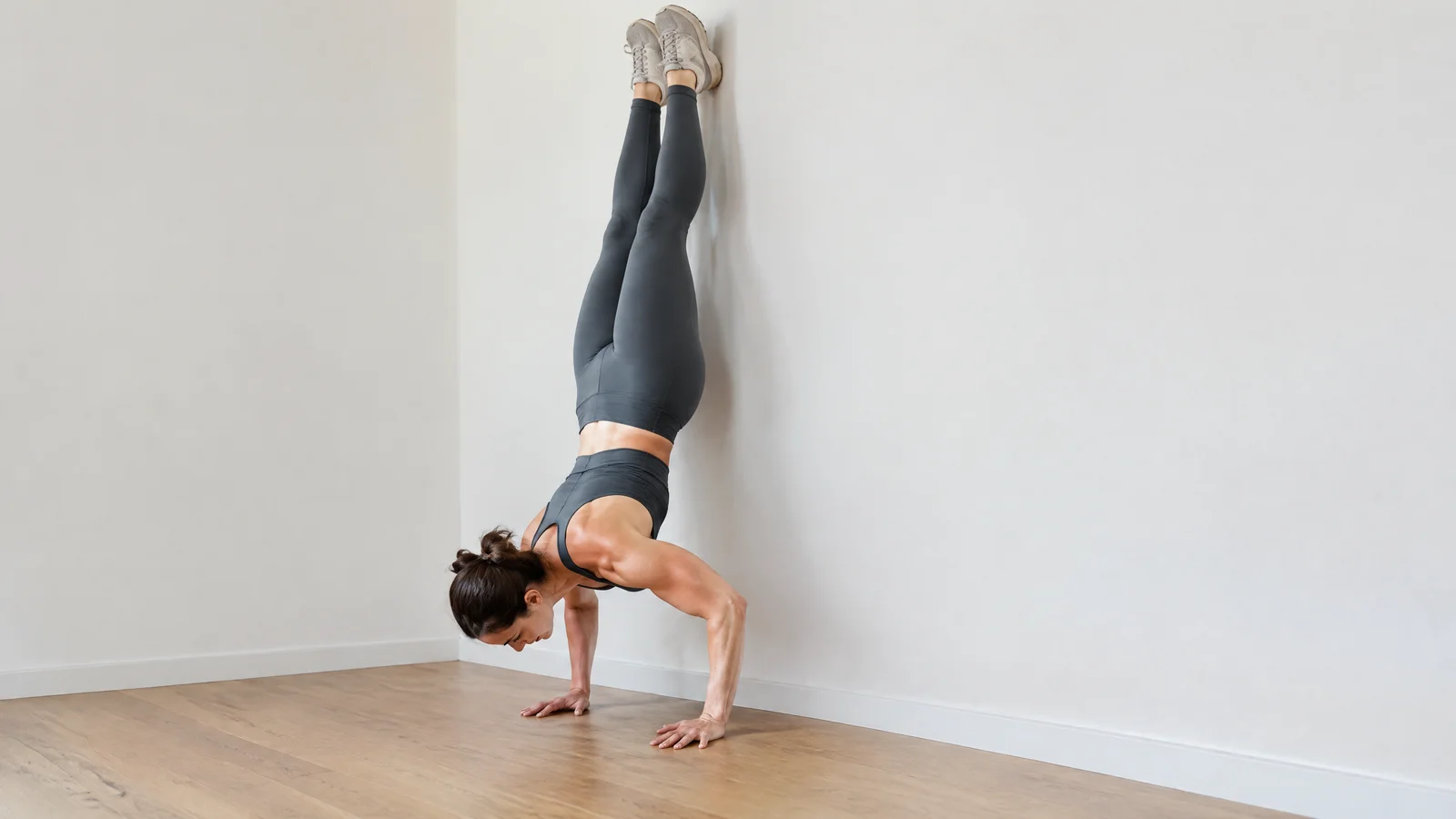
A pike push-up uses a raised-hip position that resembles an upside-down V. The press is directed more overhead than in an ordinary push-up. A handstand push-up takes the pressing movement into an inverted position. Both belong to the overhead-pressing family, but they differ substantially in difficulty and in how you manage your body weight. 7
These variations require suitable shoulder mobility and the ability to bear weight through your arms. A handstand push-up also calls for a controlled inverted position and a safe exit learned beforehand. Doing a few more floor push-ups does not cover all that preparation. If overhead bodyweight pressing interests you, practical coaching is a better starting point than experimenting with bringing your head closer to the floor.
Pull-ups and ring pull-ups: pulling your body upwards
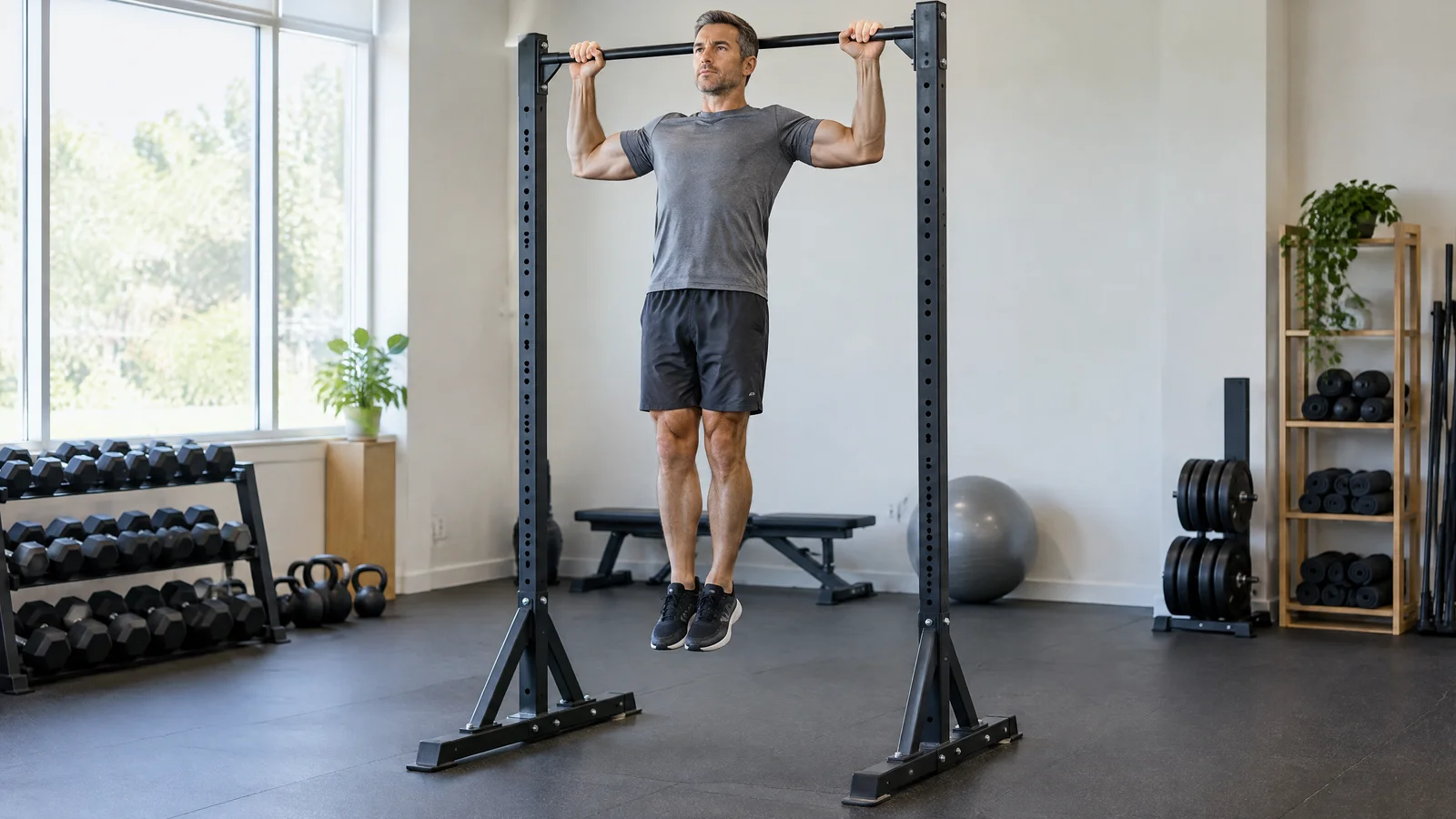
In a pull-up, your hands hold a bar above your body. For the overhand version described here, your palms face away from you and your thumbs wrap around the bar. Keep your trunk stable as you pull yourself up under control. Lowering is part of the repetition too. Swinging your legs or hips does not replace that controlled pulling movement. 6
Your body weight is already a substantial resistance. An assisted pull-up can reduce the pulling task, using a purpose-built machine or help from a qualified trainer, for example. Get shown how to use the chosen setup rather than forcing an unassisted repetition with momentum. 3
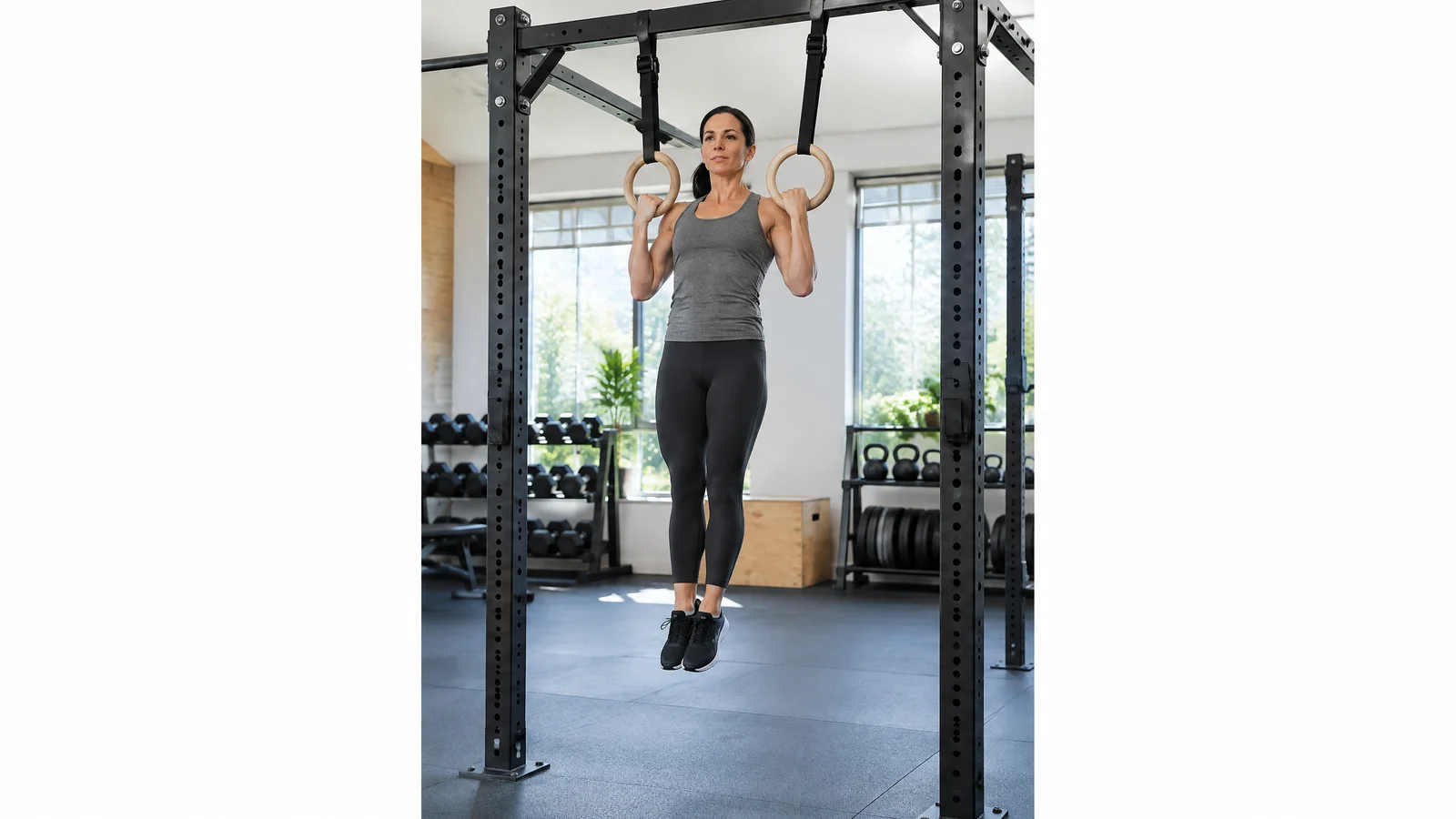
Ring pull-ups use two suspended handles instead of a single fixed bar. The rings can move and rotate, changing the grip task and making a dependable suspension system essential. The underlying movement remains vertical pulling. 7
Inverted rows: pulling with your feet on the ground
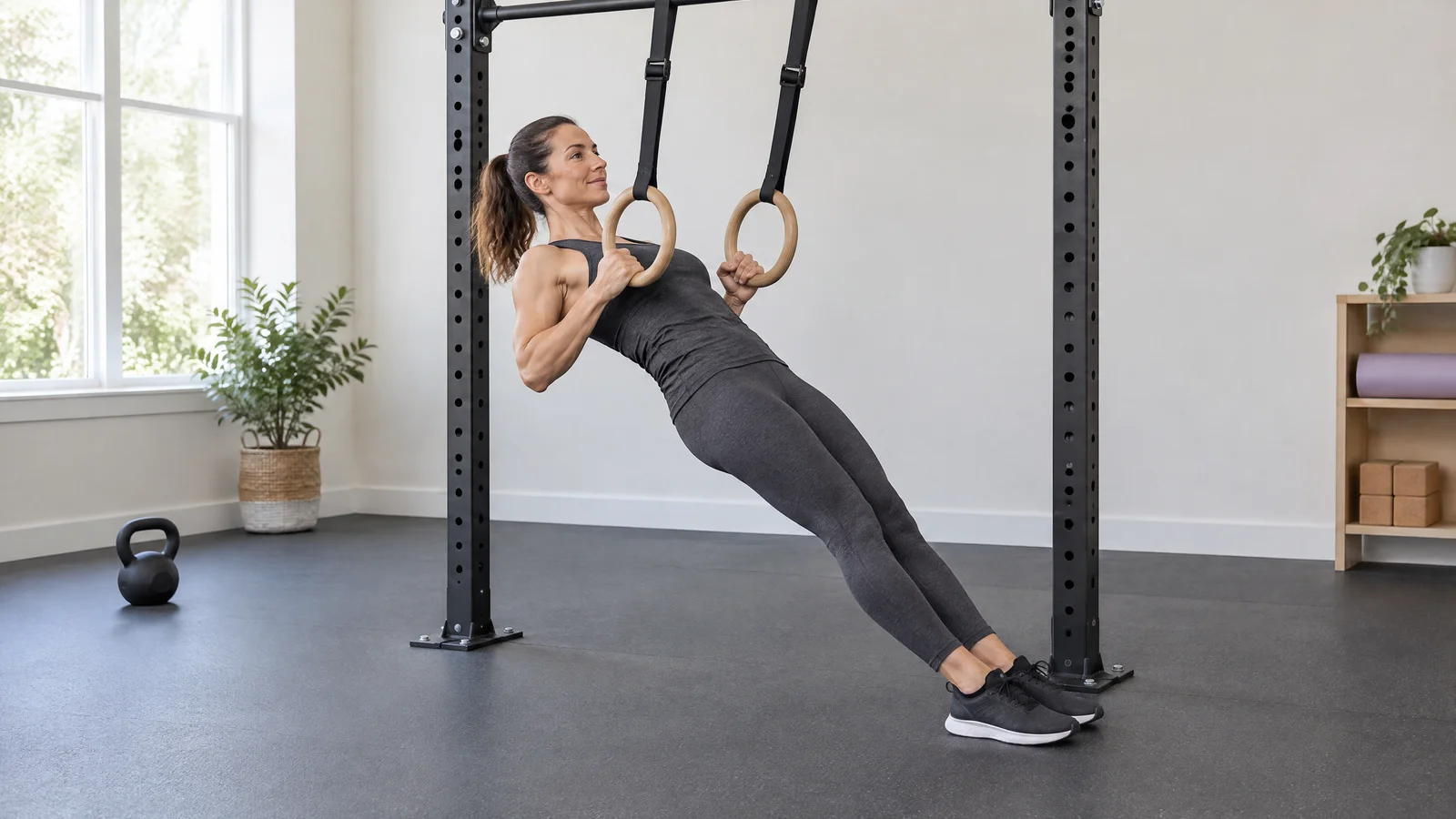
For an inverted row, your body is underneath a suitable fixed bar with your feet on the ground. Pull your body towards the bar, then straighten your arms again under control. Maintain your body line rather than letting your hips sag. Suspension handles or rings add the task of controlling moving grips. For the suspension version, you can place one foot slightly ahead of the other. Unlike a pull-up, your body is inclined or close to horizontal. 313
Your body angle gives you a way to adjust the challenge. More upright versions are less demanding than those closer to horizontal. You therefore do not need to achieve a pull-up before practising a bodyweight rowing movement. The setup must still be designed for this pulling load. An improvised arrangement using a table or door handle is not the same thing.
Squats: lowering and standing on both legs
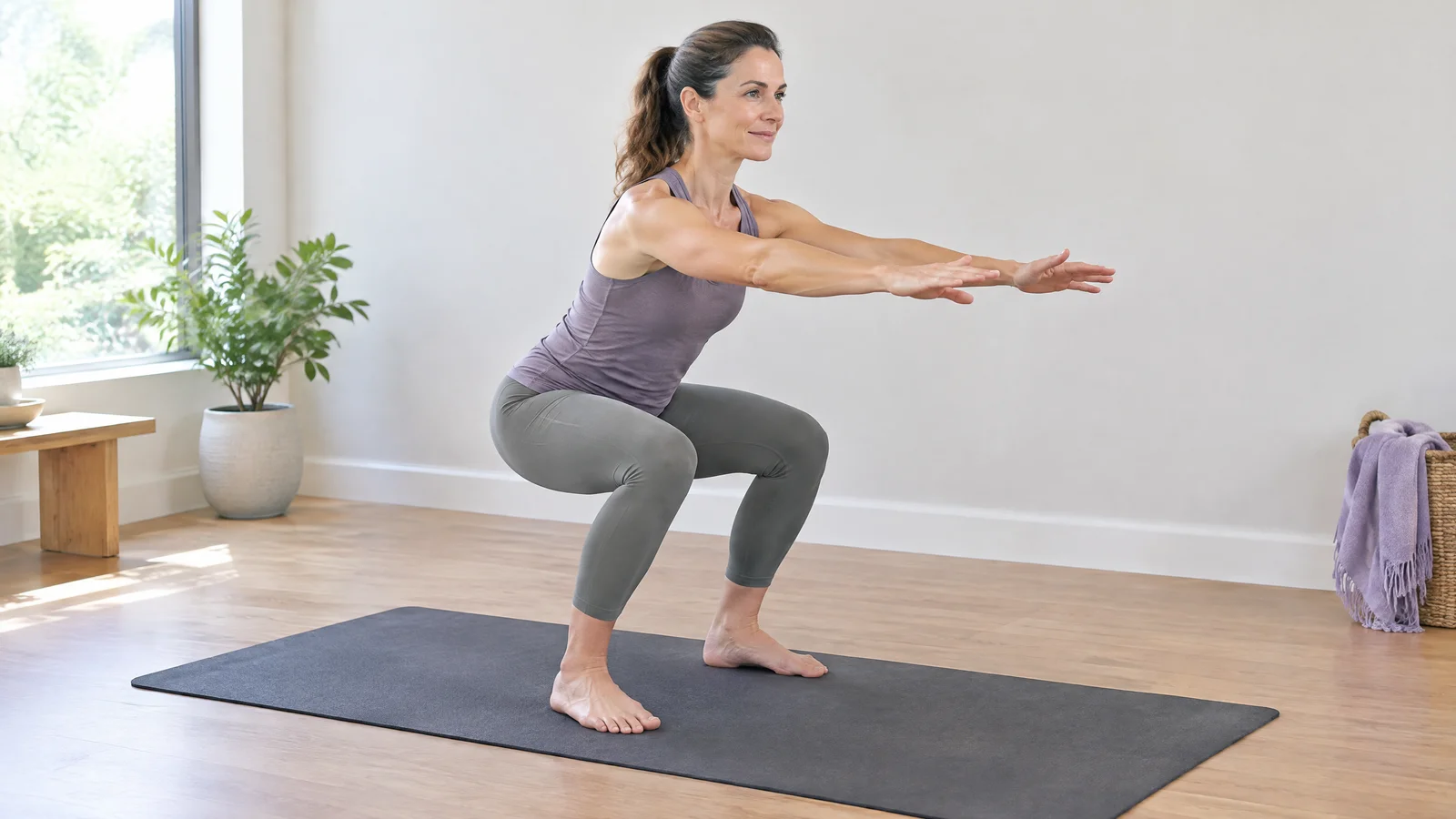
A squat bends your knees and hips as you lower your body, then brings you back to standing. For an accessible starting point, hold a firm support and use a small squat. Lower only as far as feels comfortable and remains controlled. Reaching a particular depth is not a condition you have to meet before the exercise counts. 2
Standing up from a stable chair makes the movement equally tangible. The chair must not roll or slide. Sit down under control and practise a suitable version of standing up, rather than choosing the lowest seat you can struggle out of. 2
The leg press provides a gym comparison. You extend your legs against an external resistance while the machine supports and guides your body. A free squat also asks you to organise your stance and whole-body movement. Both can have a place in leg training without being the same task. 3
Lunges, split squats and pistol squats: different ways to emphasise one leg
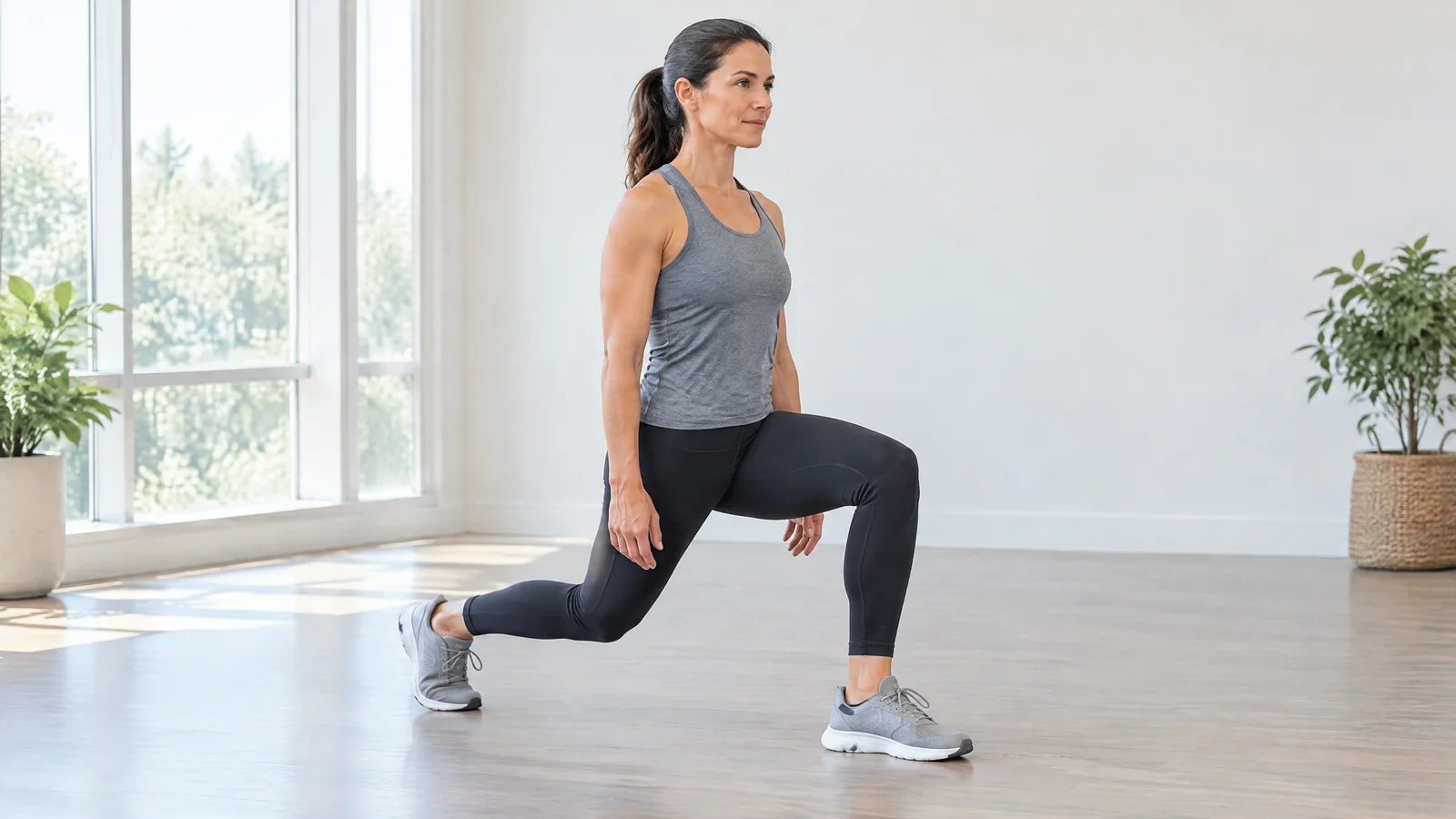
For a forward lunge, take a controlled step forwards from standing. Transfer weight onto the front foot, lower your hips and bend your legs through a range you can manage. Push through the front leg to return to standing. Placing and reversing the step are part of the task. 14
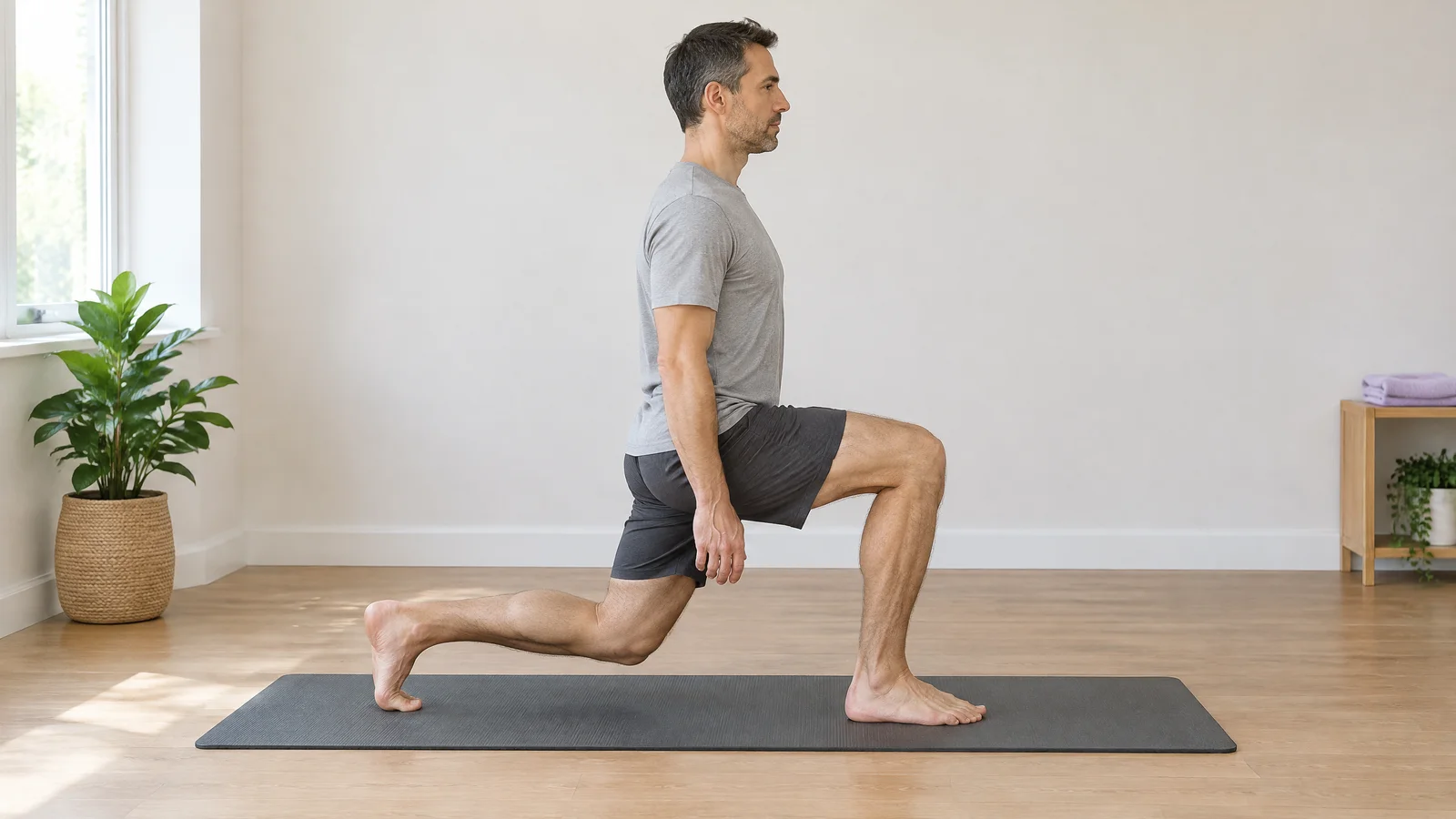
In a split squat, your feet are already staggered and stay in place throughout the repetitions. Keep the rear heel raised. Bend your legs to lower your body slowly between your feet, then rise again. Your knees follow the direction of your toes. A smaller depth is one way to adjust the task. Holding a fixed support reduces the balance demand. 15
Both distribute the work differently from a squat with your feet side by side. They offer ways to give each leg a more prominent role. That does not mean your first attempt needs a long stride or a deep range of movement.
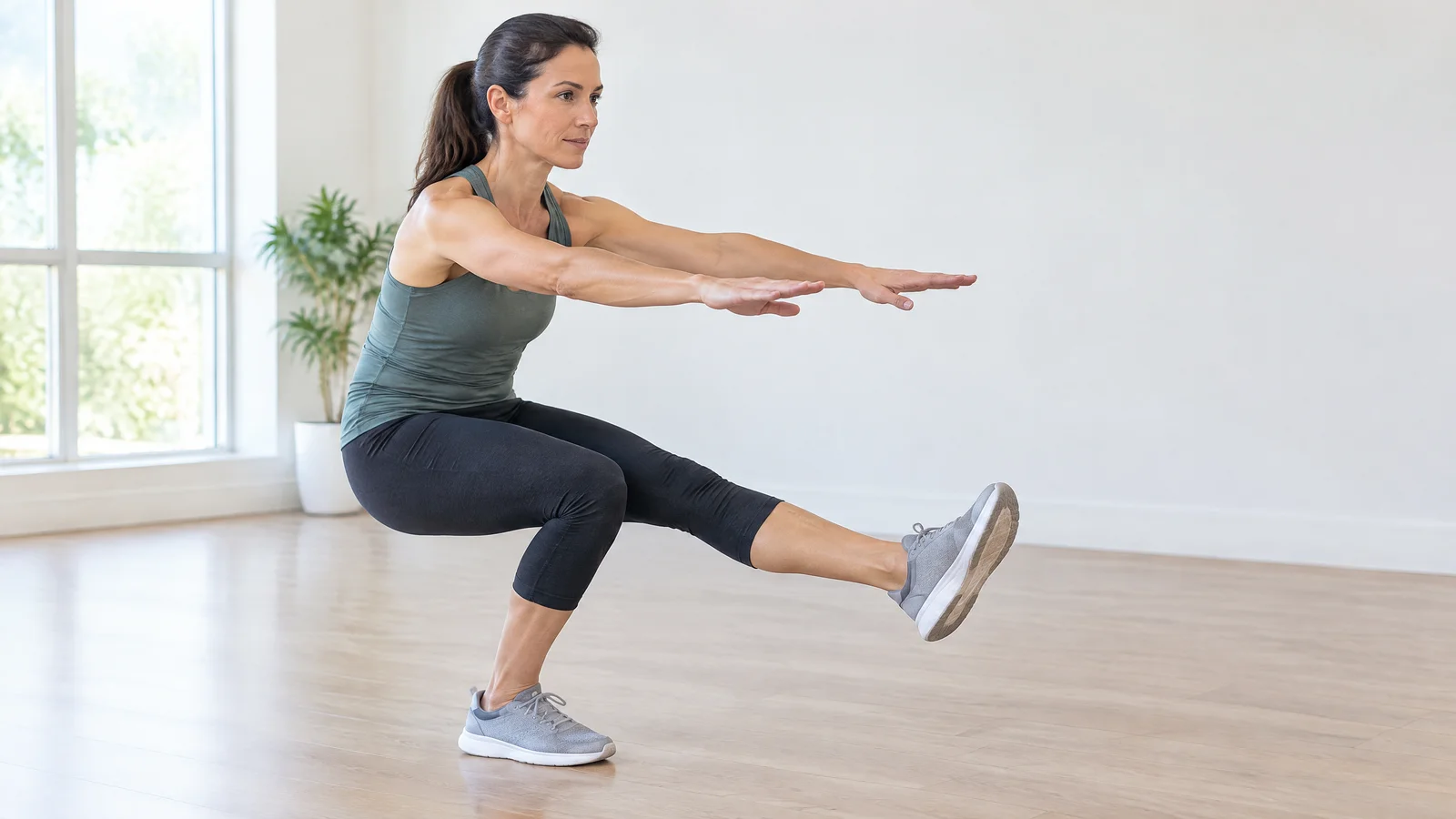
A pistol squat is a much more demanding single-leg squat with the free leg held in front. Strength, balance and the necessary range of motion have to come together. If it interests you, get help choosing suitable preparation. Adding a kettlebell to a two-legged squat offers another way to increase resistance for the legs. 73
Deadlifts and single-leg deadlifts: moving through the hips
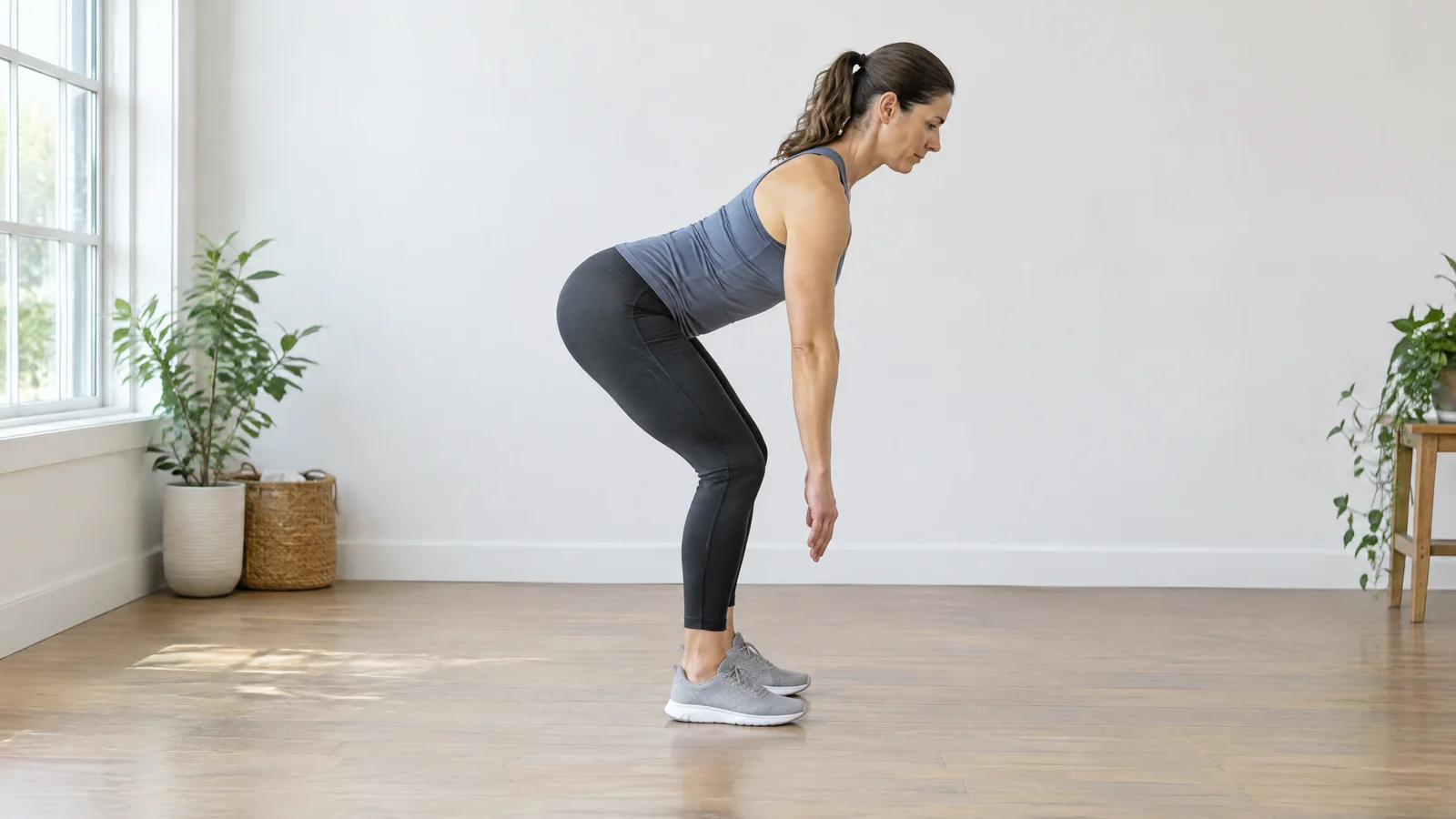
The deadlift centres on a hip hinge. Your torso tips forwards as your hips move back, then you return to standing. Adding an external load makes it a lifting task. This family complements squatting rather than offering another name for the same movement. Controlled deadlifting also provides a foundation before adding a kettlebell swing. 4
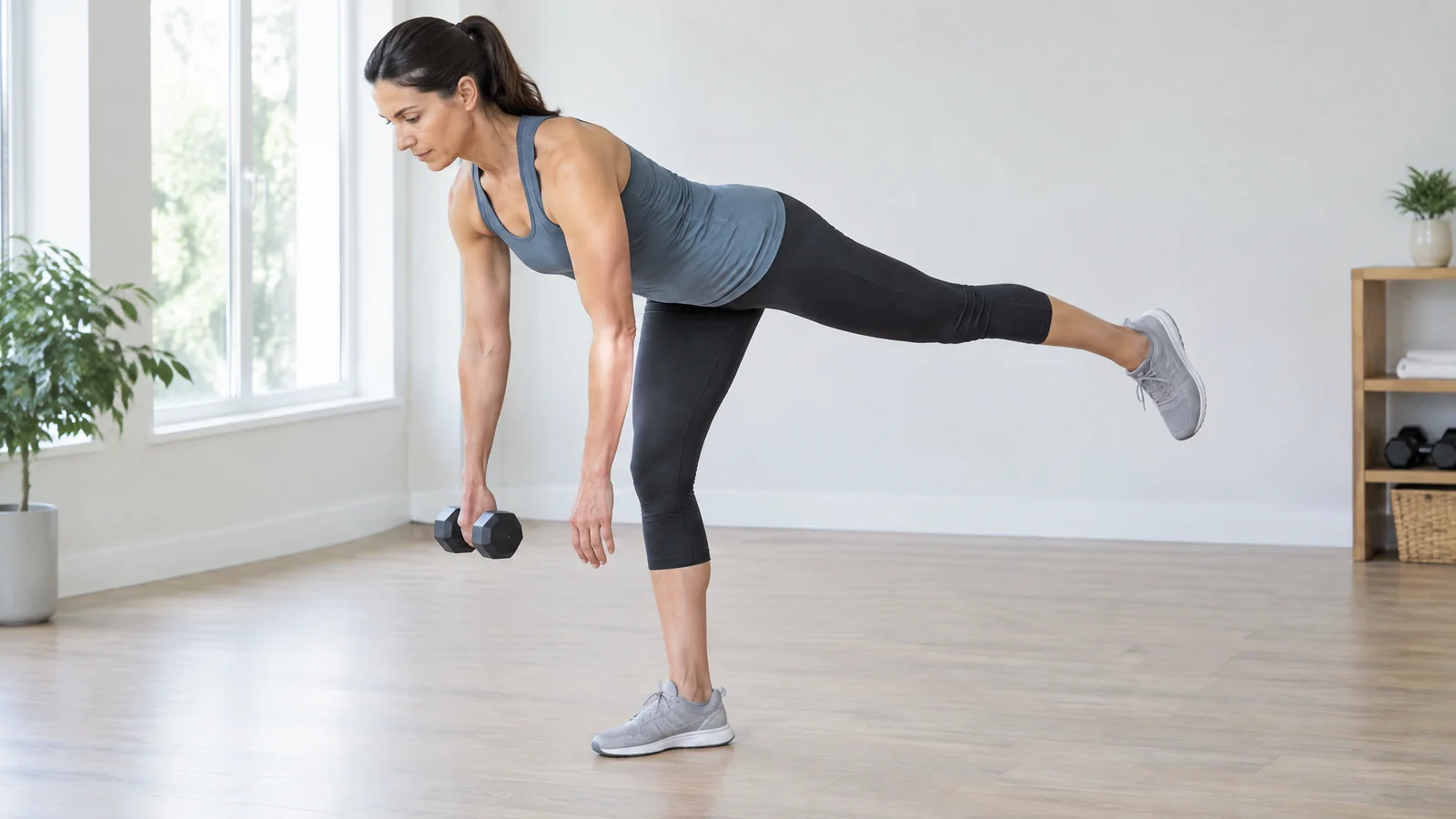
In a single-leg deadlift, keep the supporting knee slightly bent. Hinge forwards at the hip as the free leg moves behind you. Maintain a stable back position. Press the supporting foot into the floor and return to an upright single-leg stance under control. In the dumbbell version described here, hold the weight in the hand opposite the supporting leg. 16
Balance becomes a task of its own alongside the hip movement. If it takes all your attention, first learn a two-legged hip hinge: with your knees slightly bent, move your hips back towards a nearby wall, then return upright. A trainer can show you the position. Holding a fixed support is another way to adjust the balance demand of the single-leg version. 3
Glute bridges and back extensions: hip extension from another position
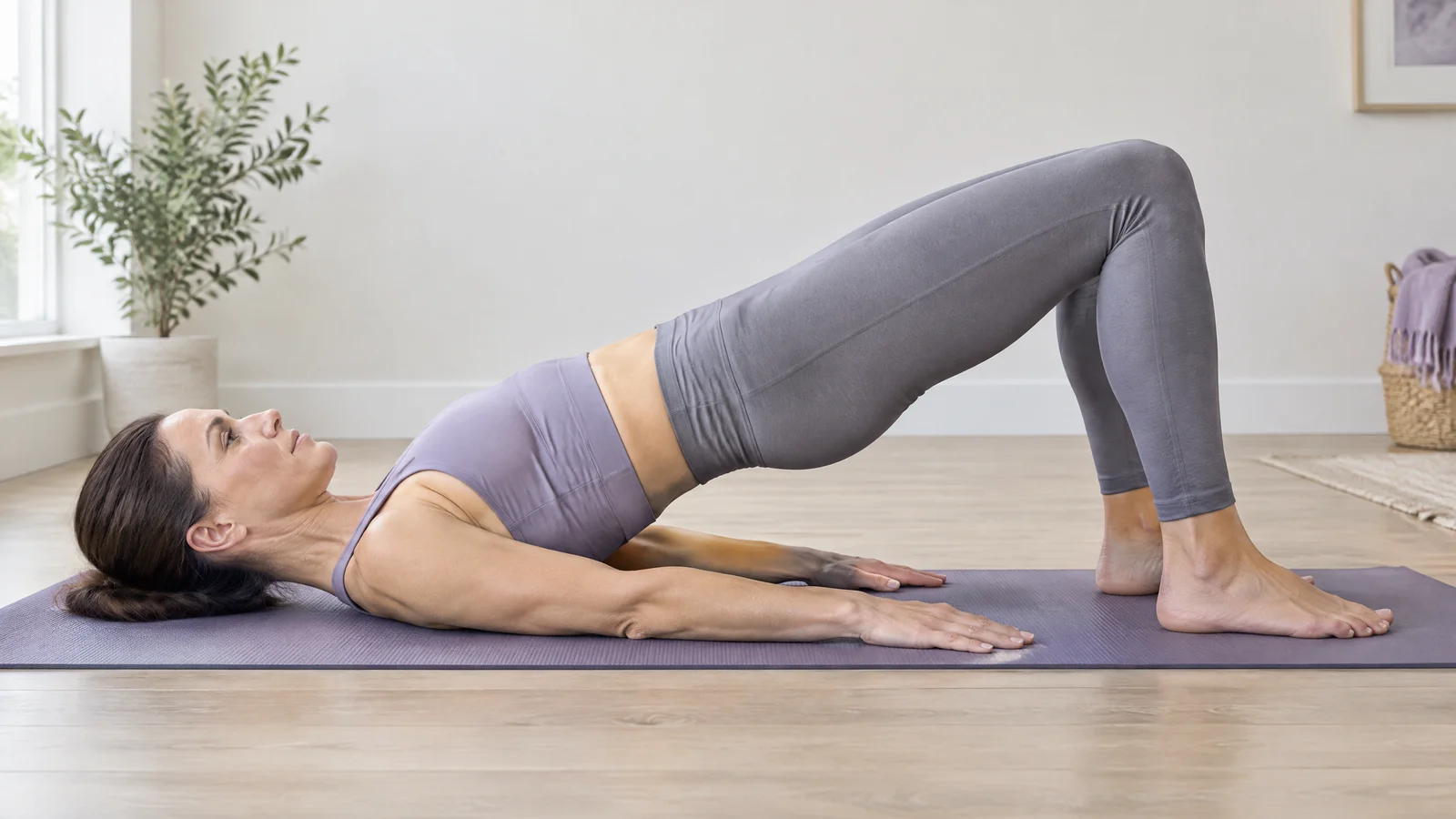
For a glute bridge, lie on your back with your feet planted. Gently engage your abdomen and lift your hips by contracting your glutes. Do not create extra height by pushing into an exaggerated lower-back arch. Lower your pelvis again under control. 17
This starting position differs considerably from a standing deadlift. It lets you explore hip extension without also having to balance on one leg.
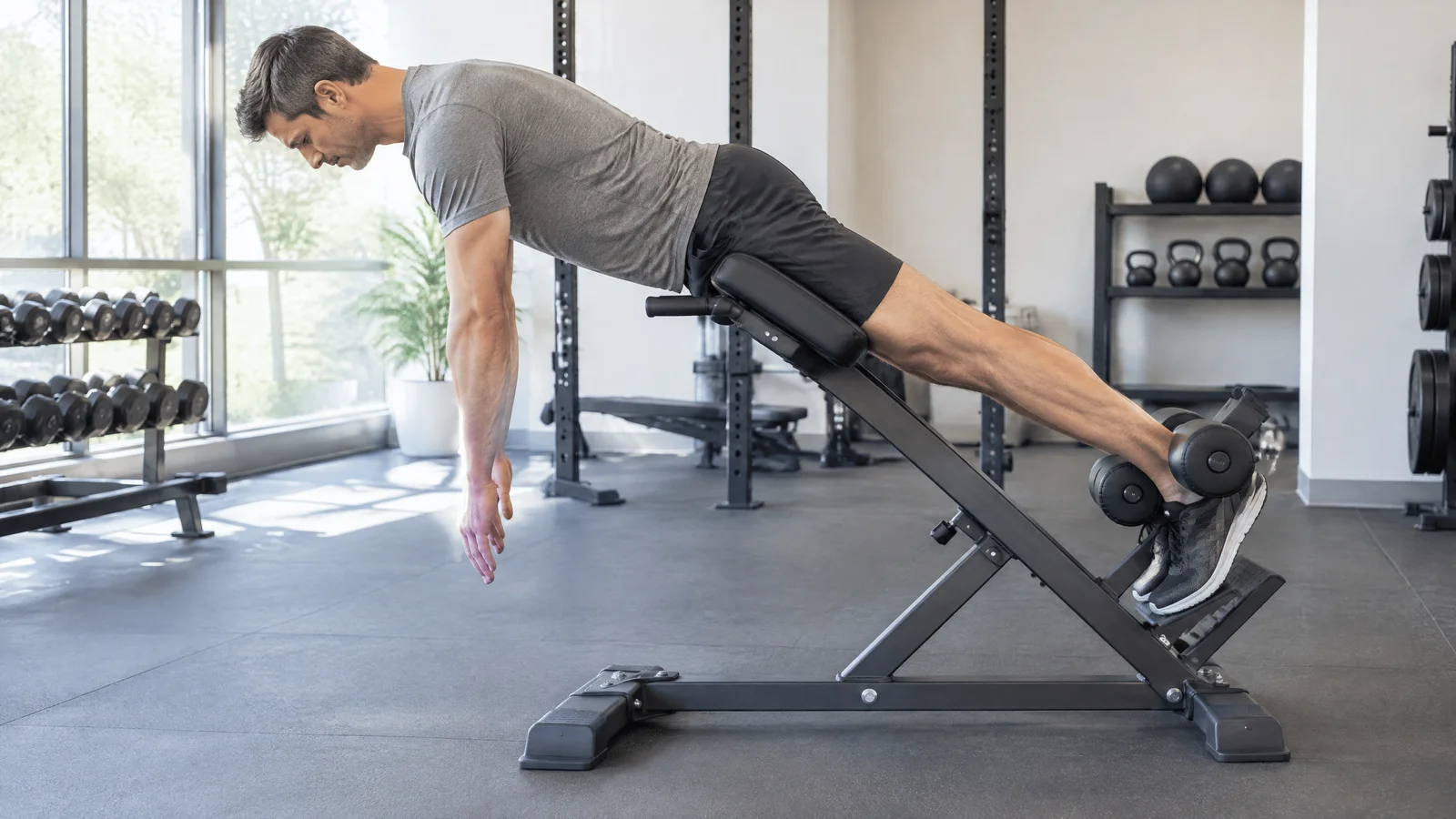
Back extensions, also called hyperextensions, commonly use a purpose-built bench. The torso returns from a forward-bent position. The name is not an instruction to bend backwards as far as possible. Adjusting the equipment and learning the intended movement belong in an introduction to the particular bench you are using. 18
Leg raises and knee raises: moving the legs while controlling the trunk
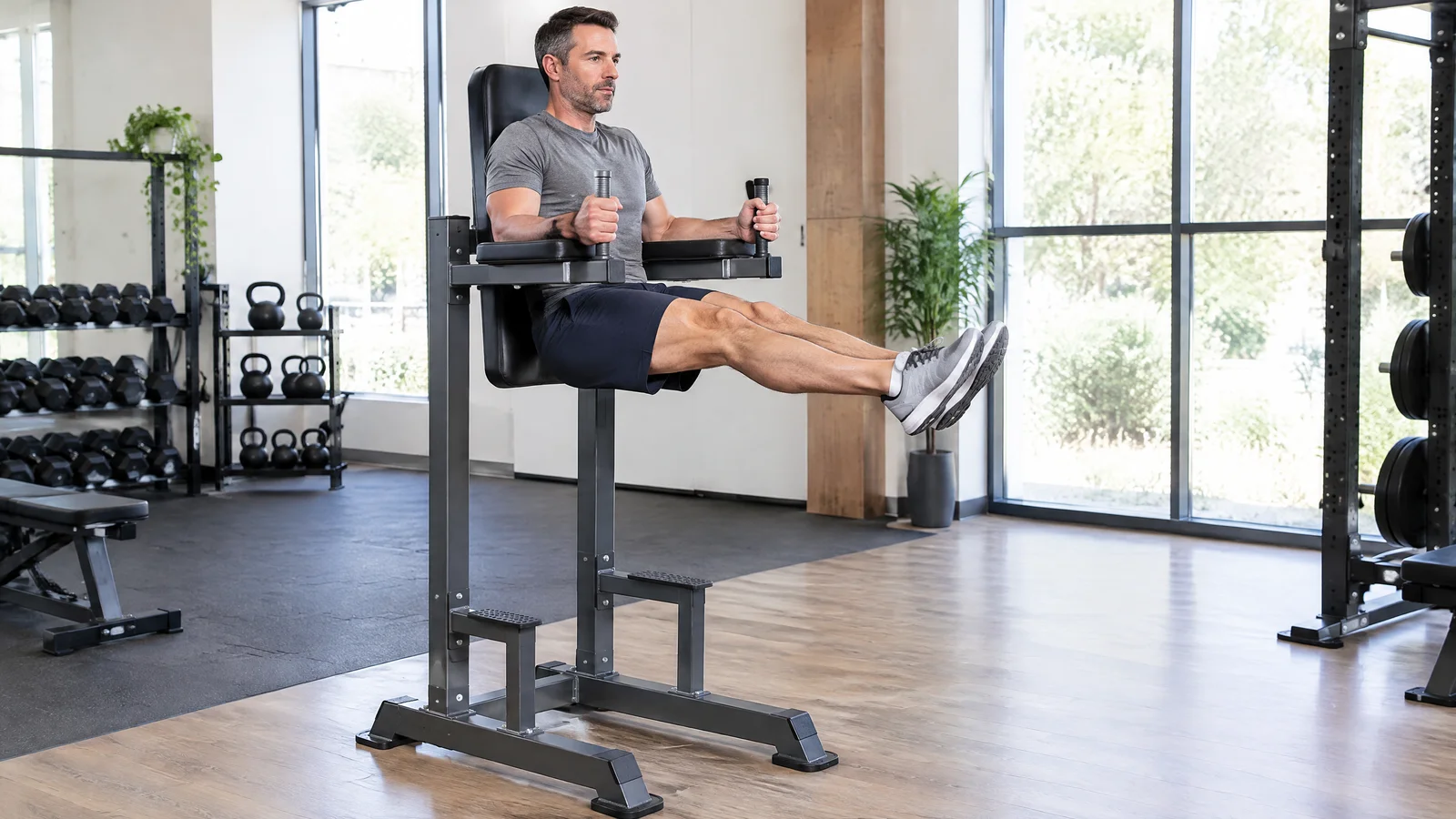
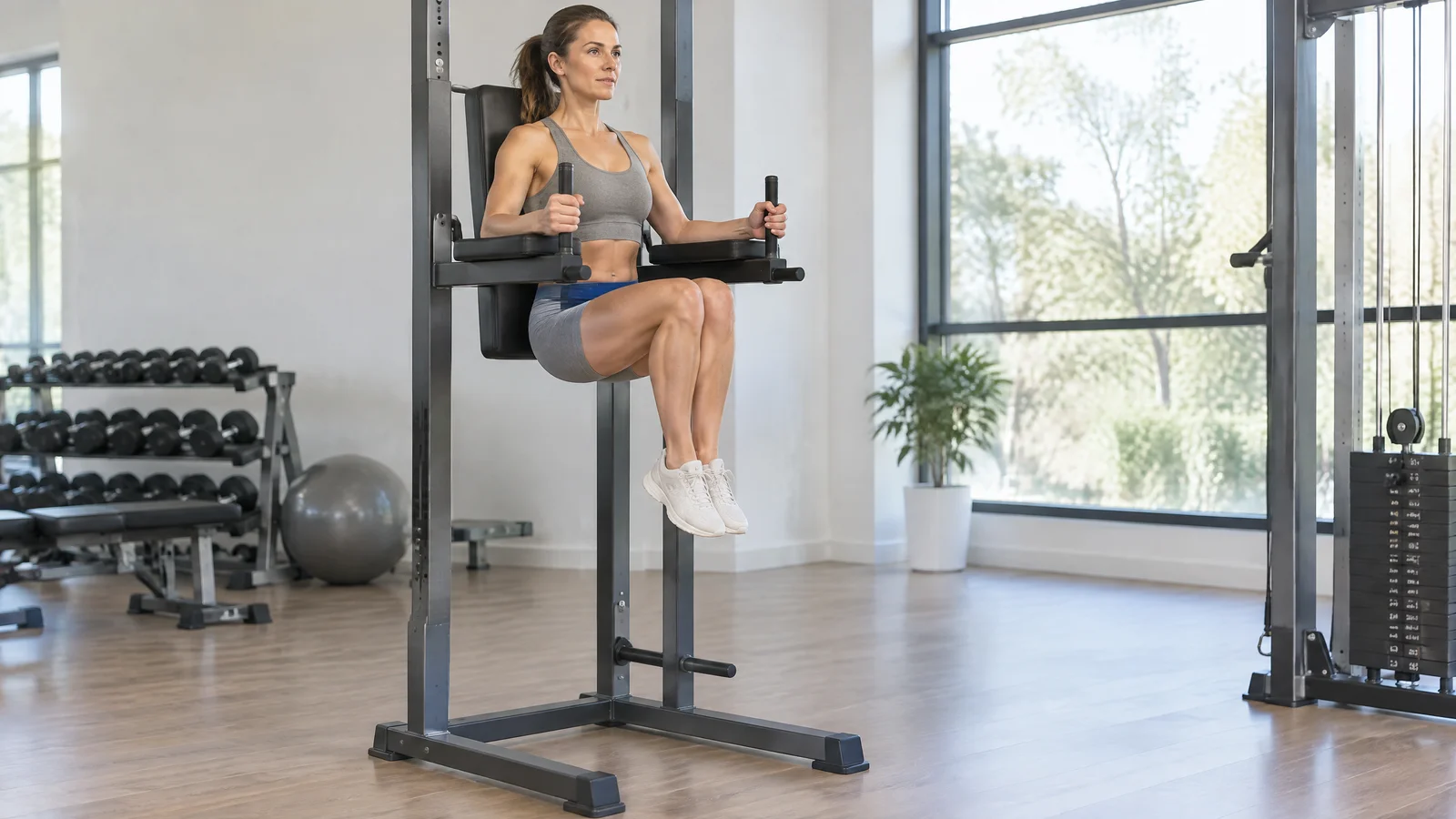
Leg raises involve hip flexion while the trunk helps control body position. The variation described here starts with bent knees on a purpose-built forearm-support station, often called a captain’s chair. This is exercise equipment, not an ordinary chair. Raise your knees slowly towards your torso, then lower them under control. Do not let them drop or use momentum. 19
Bent knees shorten the lever in a knee raise. Keeping the legs straight makes the task more demanding. Hanging freely from a bar adds grip and shoulder-support demands, so that starting position needs its own preparation. Lying leg raises are a different variation and are not taught here. The ACE guide advises against these unsupported-leg variations for people with diagnosed lower-back pain. In that situation, choose a different core exercise with appropriate professional guidance. 19
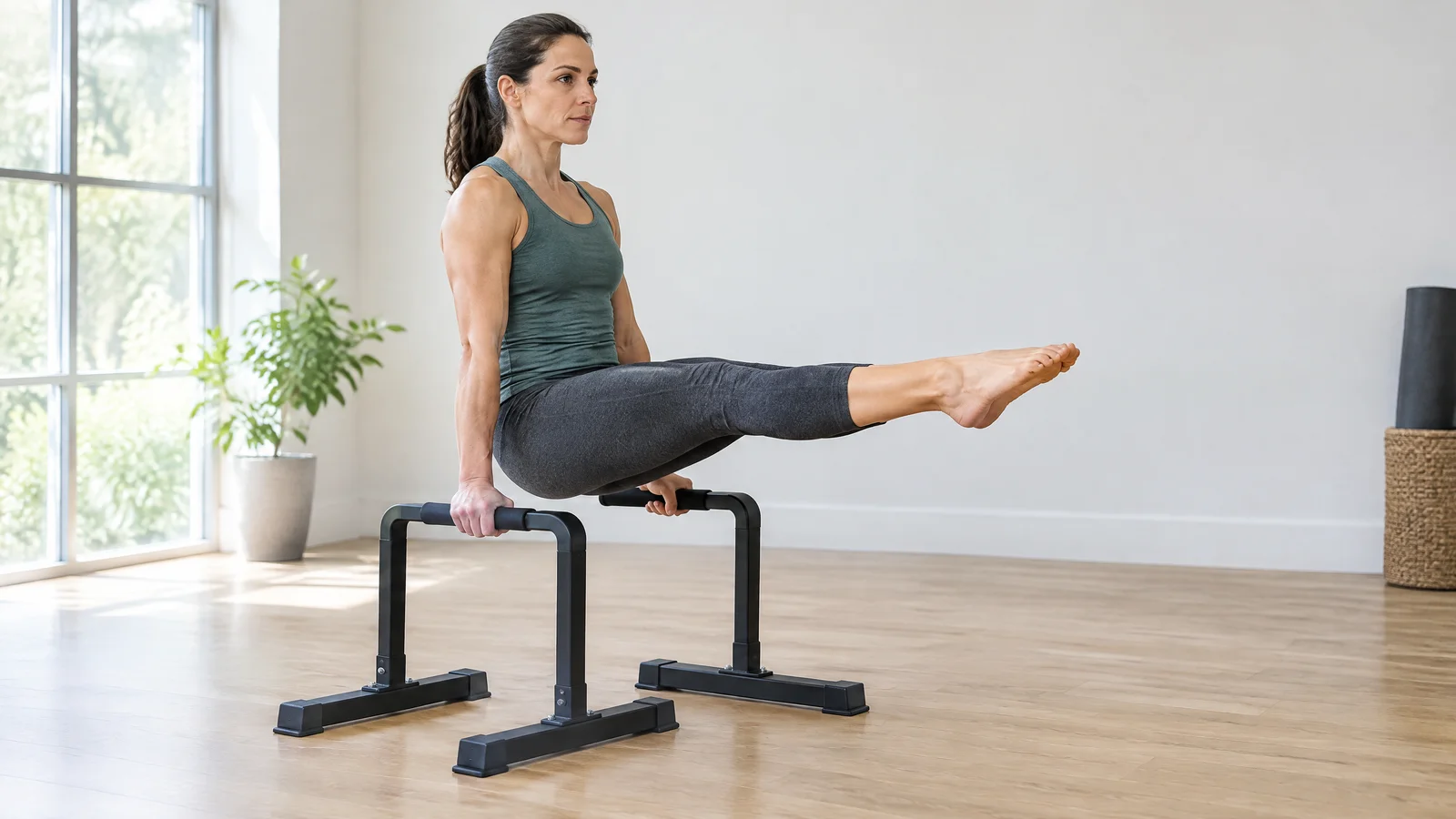
L-sits: a demanding support hold with raised legs
In an L-sit, your arms support your body while your legs extend in front. Seen from the side, the position forms the L that gives the exercise its name. The hold combines weight-bearing through the arms with control of the legs. That makes the L-sit an advanced learning goal rather than a simple abdominal exercise for every beginner. 7
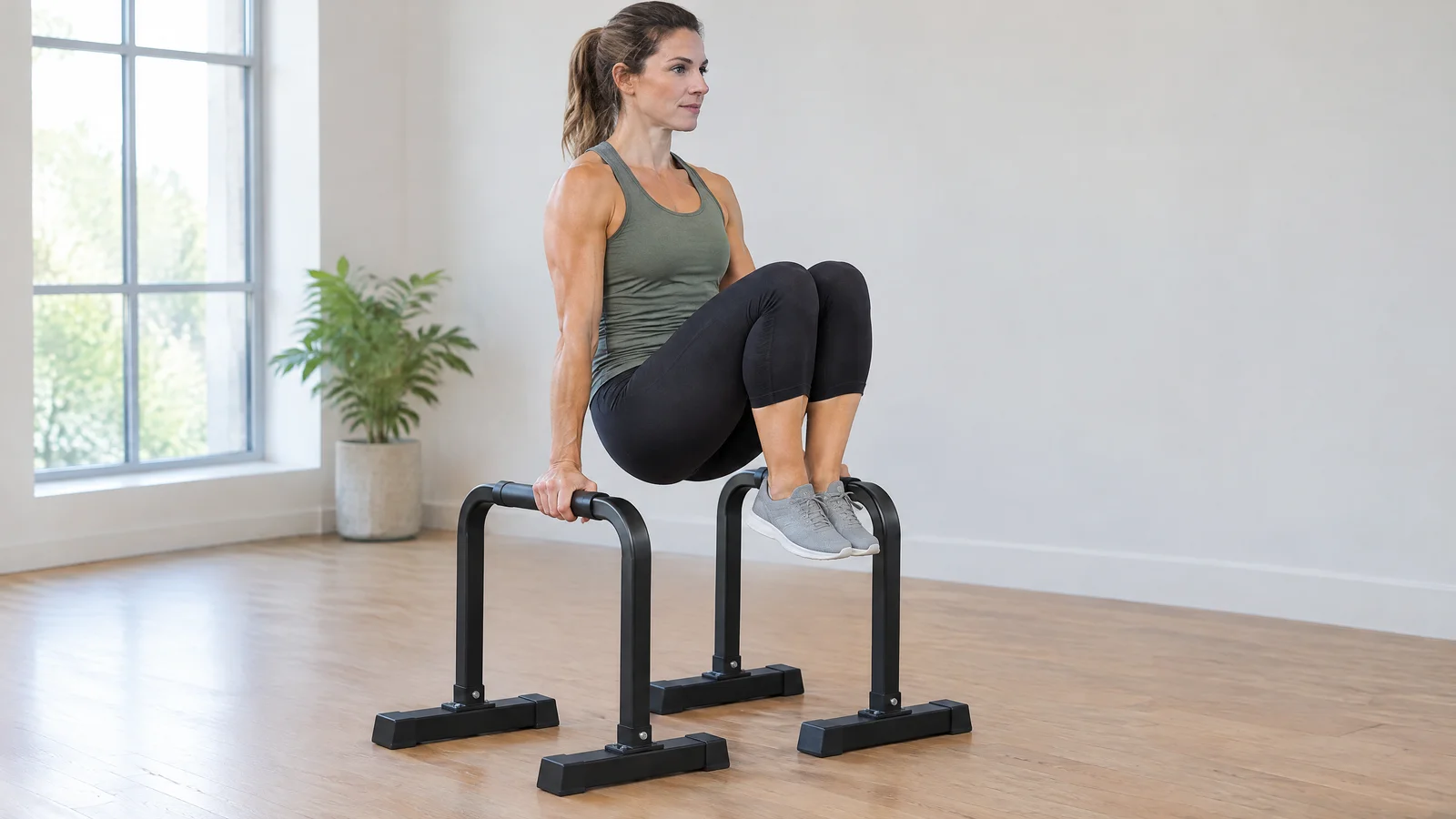
A tuck variation keeps the knees drawn in, shortening the leg lever. This L-sit preparation still requires a dependable arm-support position. Choose it with qualified coaching suited to your abilities and equipment.
Hollow body holds: maintaining a shape
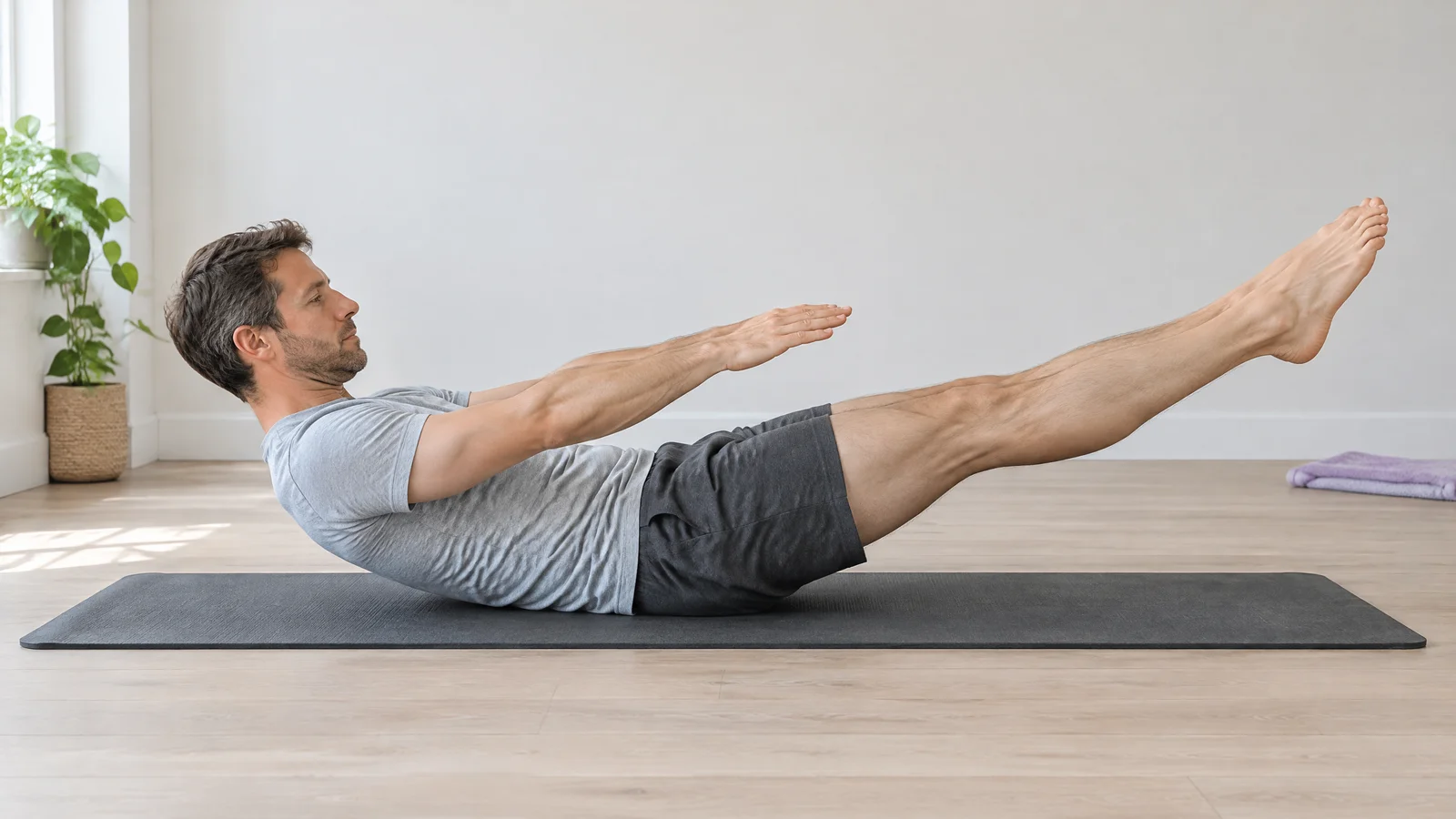
A hollow body hold starts on your back in a slightly curled position. Keep your lower back against the floor while your arms and legs are raised. Reaching your hands towards your knees gives you a shorter arm lever than extending them overhead. Lowering the legs further increases the demand. Choose a position that lets you maintain lower-back contact. 20
Choose a position you can control rather than aiming immediately for the longest, most extended shape in a photograph. Hollow holds, knee raises and L-sits differ in their starting position, support and movement.
How often should you train?
Two separate full-body sessions make an easy-to-follow starting structure, perhaps Monday and Thursday. Leave room between them for recovery and other movement. Kettlebell training belongs in the same weekly workload. A demanding swing session is not a strength-training rest day simply because it contains no pull-ups.
WHO guidance recommends muscle-strengthening activity at moderate or greater intensity, involving all major muscle groups, on at least two days a week for adults, including older adults. It also recommends 150 to 300 minutes of moderate-intensity or 75 to 150 minutes of vigorous-intensity aerobic activity each week, or an equivalent combination. The whole duration of a strength session, including rest periods, does not automatically count towards that aerobic total. Starting small and gradually increasing activity is part of the guidance too. 5
Other days can include brisk walking, cycling or swimming. Yoga and mobility work offer additional movement tasks but do not automatically replace strength or aerobic activity. From age 65, WHO also recommends varied multicomponent activity emphasising functional balance and strength at moderate or greater intensity on at least three days a week. That does not mean three extra heavy lifting days. For example, standing on one leg near a fixed support lets you practise balance directly. 521
Sets and repetitions
A set is a group of repetitions performed before resting. For a simple planning example, two sets of eight to twelve controlled repetitions can organise the dynamic basic exercises. Start with one set if that is more manageable. These numbers are a working structure, not biological boundaries separating strength, muscle growth and muscular endurance.
Choose a version that does not require momentum or compensating movements from the first repetition. Finish the set while you can still control the movement. Training to complete muscular failure is not an entry requirement. With an unfamiliar exercise, a few easy practice repetitions may be enough initially.
Holds need a different approach. Choose a duration that lets you maintain the intended position. Staying up longer by losing that position is not the same progression.
Straight sets, circuits and EMOM
Straight sets give you space to learn. Perform a set, rest and repeat the same task. Around two to three minutes can be a starting point for rest between sets. What matters is being ready to begin the next set under control. If repetitions drop sharply, consider the rest period, exercise difficulty and how hard you pushed the first set.
Circuits move from one exercise to another after each set. They can make a workout more compact, but switching exercises does not guarantee full recovery. Push-ups and rows still share demands on the arms and trunk. Keep the rest you need rather than sacrificing movement quality to the clock.
EMOM means “Every Minute on the Minute”. At the start of each minute, perform a small preselected task, then rest for the remainder. Choose few enough repetitions to leave genuine recovery time. If the next minute starts while you are still struggling, the task does not fit the pace. A timer organises training rather than making it automatically more effective. Straight sets are often easier to manage while learning a movement.
Progress without constantly changing exercises
With an elevated push-up, you can keep the same stable support and gradually add repetitions within your chosen range. Once the upper number is repeatedly controlled across all planned sets, try a slightly lower support. Repetitions can then come down again. This is double progression: first increase repetitions within a range, then increase difficulty.
Other adjustments include changing your body angle in a row, reducing assistance in a pull-up or eventually adding weight. Bands can provide help, but need appropriate attachment and do not provide the same assistance throughout the movement. Change one variable at a time where possible, so you can understand the difference.
Leg training does not have to progress towards a pistol squat. That single-leg squat adds substantial balance and range-of-motion demands. Holding a kettlebell near the chest is another way to challenge a two-legged squat through external load. In a goblet squat, keep the load close and choose a depth you can control. 3
A kettlebell also adds resistance to hip extension. Learn a controlled deadlift first, treating the swing as a separate dynamic skill. Its impulse comes from hip extension rather than lifting the bell with the arms. The kettlebell guide covers exercise selection and learning in more detail. 224
A guided kettlebell programme has also been studied in insufficiently active, independently living older adults. Grip strength and some physical function tests improved. The study compared phases within the same group, without a randomised parallel control group. It tested a supported programme with several exercises, not the isolated effect of swings or any home workout. 23
Progress does not require a record at every session. Moving more steadily through a familiar task or maintaining an existing ability can also be a reasonable training goal.
Why rings and kettlebells complement each other
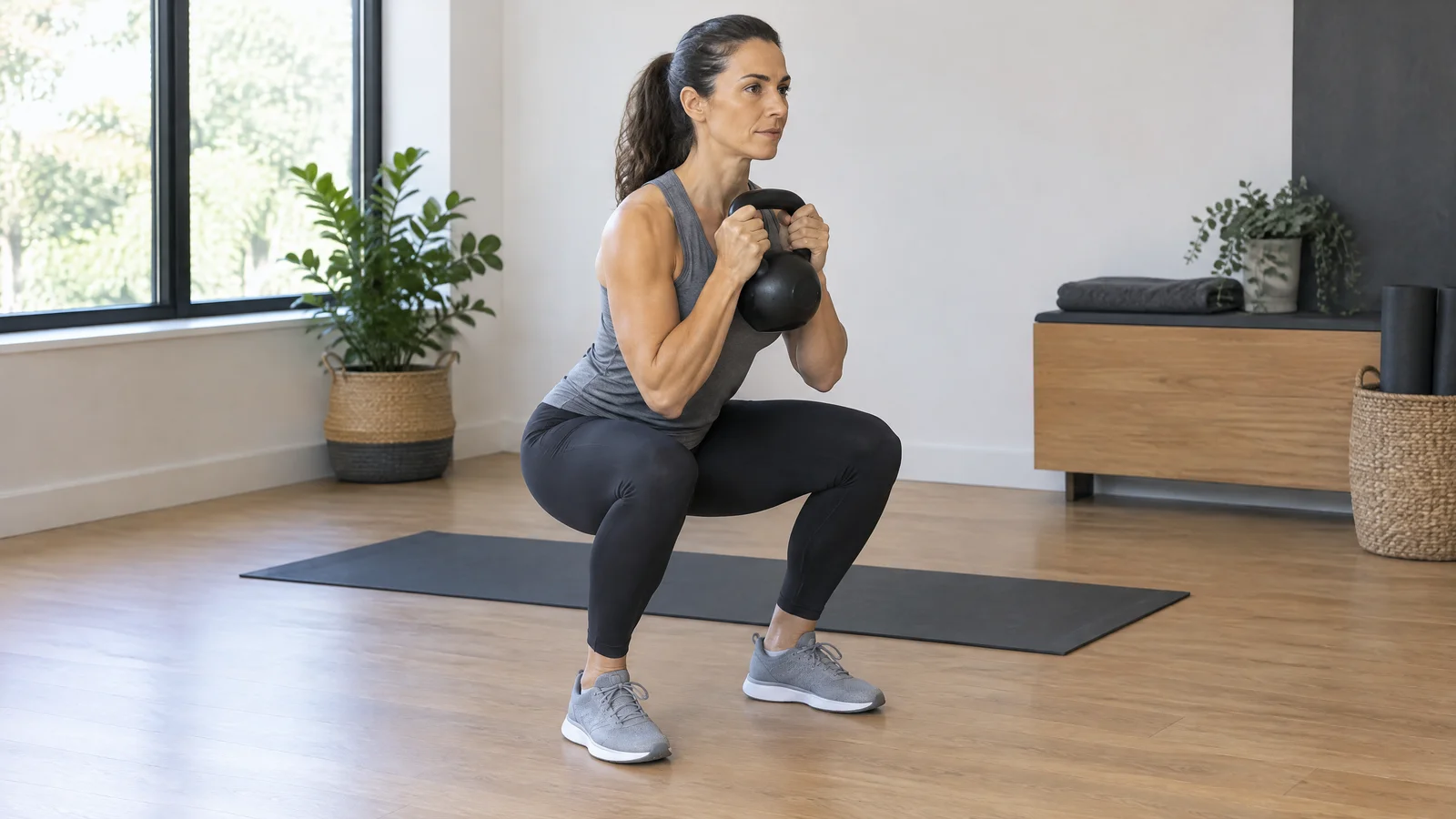
In a ring row, the arms pull while the trunk maintains the body line. Moving handles add a control task. A kettlebell provides an external load: in a goblet squat, the legs and hips move the body while you hold the bell near your chest. A clean and press connects bringing the bell to the shoulder with pressing it overhead. Learn the separate movements before joining them into a continuous sequence. 3224
These multi-joint exercises involve several body regions in a shared task. The main muscular demands and the amount of balance or stabilisation vary between exercises. Functional fitness here means the abilities needed for practical movement tasks: producing force, controlling a load, holding a position and coordinating movement. Standing up, climbing stairs and carrying objects help explain why these abilities also matter when thinking about ageing. 9
What equipment do you need?
Wall push-ups, squats and glute bridges can begin with a suitable clear area and a stable support or chair. Pulling exercises need a load-bearing bar or purpose-designed handles. Avoid improvised table or doorway arrangements.
Rings can be adjusted to different heights but also move under you, increasing the support demands. Ring push-ups and ring dips are not automatically easier options. Parallel bars and parallettes offer other support arrangements. Bands and, later, a suitable weight belt may be useful additions without belonging on your first shopping list.
Check attachment, load limits and clear space against the equipment instructions. Hands and gripping surfaces should be dry. Chalk does not make a wet bar automatically usable. Stop a painful exercise and seek appropriate advice for new or persistent symptoms.
Two alternating full-body sessions
This example arranges already learned movements into two full-body days. Start each session with easy movement and light preparation sets. For familiar dynamic basic exercises, two sets of eight to twelve repetitions can provide a working structure, per side for single-leg movements. Use fewer practice repetitions or one set while learning. Knee raises use the separate approach below, while holds are measured by time in a controlled position. 3
Session A
- Pull upwards: An assisted pull-up or an appropriately adjusted lat pulldown after equipment instruction. A full pull-up is not compulsory.
- Press forwards: Push-ups against a stable raised support or wall, moving to the floor if appropriate later.
- Work the legs in a staggered stance: A split squat using a fixed support and manageable depth.
- Row: An inverted row with suitable attachment and an easier body angle, or a machine row you have been shown how to use.
- Extend the hips: A glute bridge on the floor.
- Control the trunk: After instruction, practise knee raises on a captain’s chair. Start with a few slow knee raises, controlling the lowering phase too, resting before swinging develops. Straight-leg raises are a later variation. If that starting position is not suitable yet, choose a previously learned hollow hold with the shorter arm position. Keep it brief and stop when your lower back loses contact with the floor. 1920
Session B
- Row: A suitable inverted row or a machine row you have been shown how to use.
- Press: Dips are an option for someone who already controls the support position and has received appropriate instruction. Otherwise, an elevated push-up remains an easier pressing alternative.
- Squat: Stand up from a stable chair, use a supported squat or choose a familiar free-standing version. A suitable kettlebell can add load later.
- Pull upwards: An assisted pull-up or a lat pulldown you have been shown how to use.
- Hinge at the hips: A supported single-leg deadlift, if learned. An instructed two-legged deadlift with manageable load provides an alternative with less balance demand.
- Trunk and support: An already learned L-sit or a preparation chosen with a coach is an advanced option. Otherwise, you can use the familiar hollow hold from A. Choose two brief holds with recovery between them, ending each before the position is lost. Record seconds rather than repetitions.
With two weekly sessions, alternate A and B, perhaps Monday A and Thursday B. If three sessions later fit your recovery, continue alternating: A, B, A, followed by B, A, B the next week. A third day is an optional expansion rather than a starting requirement. Record the variation and either repetitions or hold duration so your next adjustment has a clear basis.
Food on training days and the supplement question
An ordinary meal can follow a workout: tofu with rice and vegetables, lentils with bread or potatoes with eggs and salad. Protein-containing foods belong to your whole day’s eating, not just a drink after the last repetition. Daily protein intake and strength training explains amounts, food comparisons and how protein powder fits in.
Calisthenics does not create a special supplement list. Whether an addition is useful depends on diet and the particular situation. Vitamin D, omega-3 products or creatine do not become necessary simply because you choose push-ups over a chest-press machine. Protein powder can be a convenient dietary addition, but it is not a requirement for this training structure. Blanket doses and assumed deficiencies do not answer the individual question.
When work and training leave little cooking time, a prepared portion can make dinner easier. Meal prep for training days offers practical ways to organise that without adding another elaborate plan.
Meals and exercise in your daily overview
The 8 Protocol lets you record foods and meals in a food diary and connect Apple Health if you choose. You can also add exercise manually by entering the activity and duration, then change the estimated calories burned when needed. This lets you document movement alongside your meals. Manual exercise tracking is off by default and can be enabled when needed. The app records food and activity rather than coaching your workout. 24
My alternative to the gym
I combine ring training with kettlebells. Together, they are an alternative to the gym for me. I describe how I organise my training in my personal kettlebell and rings routine.
This is my personal routine, not a recommendation to do the same. Everyone needs to find out what works for them.
A starting point with room to learn
You do not need a human flag to begin calisthenics. A controlled squat, a suitable push-up and an achievable pulling task already give you something concrete to practise. Two scheduled sessions, appropriate variations and small, understandable adjustments make a manageable start. Advanced skills can become separate goals later, while walking, aerobic activity and balance remain part of a varied movement routine.
Sources
Linked technical and product sources checked on 7 November 2026. Technique sources describe exercises rather than establishing that they are injury-free.
ACE: Push-up. Floor push-up and body alignment.
NHS: Strength exercises. Wall press-up, sit-to-stand and supported mini-squat.
Lincoln, Ill and Ibrahim (2023): Progressive Strategies for Teaching Fundamental Resistance Training Movement Patterns. NSCA, Personal Training Quarterly 10.2, pp. 6-16. Movement patterns and individual learning steps. Figures 1 to 5 include kettlebell goblet squats, hip hinges, elevated push-ups, assisted pull-ups and rows.
StrongFirst: The Kur for Your Kettlebell Swing and Clean. Commercial training provider. Technique source for deadlifts, swings and cleans.
Bull et al. (2020): World Health Organization 2020 guidelines on physical activity and sedentary behaviour. Physical activity guidance for adults and older adults.
ACE: Pull-ups. Controlled overhand pull-up, with added load listed as a variation.
Dennis Ratano (02.11.2026): So startest du noch VOR 2027 mit Calisthenics. Training styles and exercise spectrum. Not a medical source or a complete technique guide for advanced skills.
Kikuchi and Nakazato (2017): Low-load bench press and push-up induce similar muscle hypertrophy and strength gain. Small randomised comparison in young men over eight weeks.
Fragala et al. (2019): Resistance Training for Older Adults: Position Statement From the National Strength and Conditioning Association. Public abstract of the position statement.
Liu et al. (2025): Effects of Online Supervised Slow-Movement Bodyweight Resistance Training Followed by Self-Directed Exercise on Physical Function in Older Adults: A Pilot Study. Eight older adults, no control group, chair-rise test and everyday-function questionnaires.
Momma et al. (2022): Muscle-strengthening activities are associated with lower risk and mortality in major non-communicable diseases: a systematic review and meta-analysis of cohort studies. Sixteen observational cohorts. An association does not establish causation or added years of life.
Michigan State University Extension (10.03.2026): Strength Training Basics - Dips. Public text transcript describing a dip station or parallel bars.
ACE: TRX ® Back Row. A suspension-row variation in a split stance. Setup details do not apply to every ring system.
ACE: Forward Lunge. Forward lunge with a controlled return.
University Hospitals Plymouth NHS Trust: Back Rehabilitation Programme, section Split Squat. Issued July 2022, listed review date July 2024. Exercise description from a rehabilitation booklet, not its full training prescription.
ACE: Single-arm, Single-leg Romanian Dead Lift. The original variation uses a dumbbell in the hand opposite the supporting leg.
ACE: Glute Bridge. Supine glute bridge.
Schoenfeld et al. (2017): Roman Chair Back Extension Is/Is Not a Safe and Effective Exercise? Strength and Conditioning Journal 39(3), 42-45. Public abstract discussing the exercise, not instructions for equipment adjustment or range of motion.
ACE: 6 Exercises for a Stronger Core, section Hanging Leg Lowers. Knee raises on a captain’s chair before free hanging, controlled lowering and straight legs as a progression. Not a source for lying leg raises.
USA Gymnastics: Home Conditioning Ideas, Hollow Hold, first PDF page. Gymnastics handout for children and parents. It describes lower-back contact and a shorter arm position. Its durations are not adult training targets.
NHS: Balance exercises. One-leg stand near a fixed support.
ACE: Advanced Kettlebell Workout for Increased Strength and Conditioning. Technique article for advanced double-kettlebell training, not a beginner programme.
Meigh et al. (2022): Effects of supervised high-intensity hardstyle kettlebell training on grip strength and health-related physical fitness in insufficiently active older adults: the BELL pragmatic controlled trial. Phase comparison within one cohort using a guided multi-exercise programme, not a randomised parallel-group trial.
The 8 Protocol: App Store, description and release notes. Public product description, checked 7 November 2026. Optional manual exercise tracking with an editable expenditure estimate.