
Andrew Huberman: What he eats
Meat, chicken or salmon with vegetables at lunch, then more rice or pasta at dinner: Andrew Huberman gives his meals different priorities across the day. That is how he described his diet at the time of an older Huberman Lab episode. Familiar foods fit around the rhythm he wants for work and the evening.1
Huberman describes himself as an omnivore. Meat, fish and eggs sit alongside fruit, vegetables and starchy foods, with the proportions changing from meal to meal.2 His choices offer a way to discuss protein, body fat and longevity without treating his diet as a single named regimen.
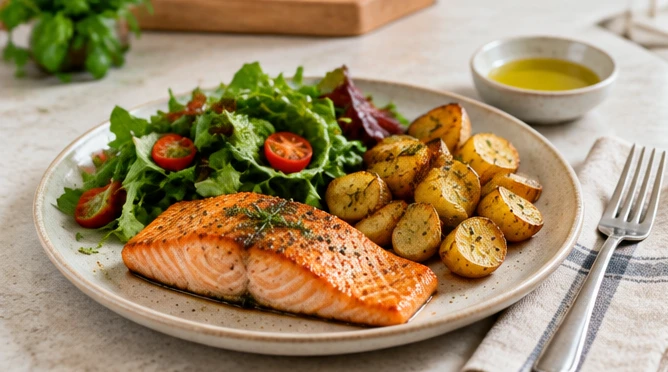
An omnivorous diet: protein, plants and a side
His food choices include animal protein, plant foods and starchy sides. Each plays a different part in the meals he describes:12
- The protein source: Meat, chicken, fish and eggs feature in his accounts. A salmon fillet with vegetables, for example, makes it clear which ingredient fills this part of the meal.
- The plant foods: Salad and vegetables accompany the main meal. Fruit is part of his diet too, with berries among his dessert examples.
- The side: Rice, pasta, bread and oats are among his examples. Their amount and place in the day vary with the meal and in relation to training.
Salmon and vegetables at lunch can fit the same eating pattern as rice and vegetables at dinner. The meals do not need to look alike. Their different proportions are part of how he spreads his food choices across the day.
Lunch: protein and vegetables take the lead
Huberman describes his first meal at around midday, giving examples of meat, chicken or salmon with vegetables. In the context of training, he also mentions bread, rice or oats. He says that he generally keeps the carbohydrate portion smaller at lunch.1
“Carb-free” would miss that distinction. Bread, rice and oats all appear in his account, even though he describes eating less carbohydrate at lunch than at dinner.
Dinner: more room for rice, pasta and vegetables
For the roles of time awake and daily timing in sleep, see Sleep pressure and your body clock: why sleepiness changes.
For the evening, he describes meals with more carbohydrate: rice or pasta with vegetables, sometimes accompanied by fish, chicken or eggs. He connects this distribution with the rhythm of his day. His personal aim is to stay alert for work and settle down more easily in the evening.1
Dinner therefore complements the protein-focused lunch. Rice or pasta takes a larger role, with fish, chicken or eggs included in some meals.
Fermented foods: where the gut microbiome comes in
Alongside protein and meal timing, Huberman discusses fermented foods. His examples include sauerkraut, plain yogurt, kimchi and kefir. His focus is the gut microbiome, the community of microorganisms in the gut. When discussing food choices, he distinguishes refrigerated products with live cultures from heat-treated, shelf-stable versions. Fermented does not automatically mean that live cultures remain when the food is eaten. These examples broaden his discussion of nutrition rather than forming a fixed list of his daily meals.3
Sauerkraut alongside a main meal or plain yogurt with fruit can fit with the other foods described here. These combinations show how fermented ingredients can feature alongside a protein source. Taste and personal preferences also shape which ones you choose.
Fats and fish: looking at what each ingredient provides
Salmon provides both protein and fat. Olive oil adds fat to a dish without taking the place of its protein source. The fatty acids differ too: oily fish supplies omega-3s, while olive oil has a high proportion of monounsaturated fatty acids.4
Labels such as “low fat” or “high protein” describe only part of a meal. Look at which foods are present and how much of each you eat. Daily protein intake and strength training over 40 explains protein sources and how to fit them into your day.
Muscle, body fat and longevity: three different goals
Protein, meal timing and longevity raise different questions. Research on muscle building has tested extra protein alongside longer-term resistance training.5 A trial on body weight and body fat instead examined what an early eating window added to calorie restriction.6 The longevity research considered here measured molecular markers of ageing.7 The findings need to be read in light of those different aims.
If timing is the part that interests you most, our guide to Intermittent fasting: methods, metabolism and autophagy explains the different patterns.
What deserves a closer look?
Huberman’s public accounts of his meals are snapshots rather than a fixed menu for every day. The lunch and dinner routine described here leaves exact daily portions open. Above all, a personal food choice is not evidence of how the same meals would affect other people.12
For protein, a review of randomised trials in healthy adults found, on average, additional increases in fat-free mass and certain strength measures when protein was supplemented alongside longer-term resistance training. People under energy restriction were excluded, and fat-free mass includes more than muscle tissue. The authors disclosed connections to the supplement and dairy industries.5
For meal timing, a twelve-month trial in adults with obesity found no statistically significant additional difference in body weight when an early eating window was added to calorie restriction. The body fat findings were consistent with that pattern. Its early window differed from the schedule Huberman describes.6
For longevity, a secondary analysis of the two-year CALERIE trial compared molecular measures of ageing in healthy adults without obesity under supported calorie restriction and in a control group. DunedinPACE differed between groups, while PhenoAge and GrimAge did not show significant differences. The analysis did not demonstrate extra years of life. Two authors were named as inventors of the commercially licensed DunedinPACE method.7
Huberman’s meals mainly show how familiar foods can take different roles across the day. Research on individual elements addresses narrower questions than the effects of his eating pattern as a whole.
From his example to your own meals
For your own meals, start with the protein source: what do you regularly eat with it, how much room does the side take up, and what changes on training days? Those questions keep the focus on what you actually eat rather than copying his lunch and dinner.
If you want to keep track, The 8 Protocol lets you record foods and the amounts you eat. That gives you a view of your own meals alongside the broader nutrition idea. Explore The 8 Protocol for iPhone.
This article describes someone else’s eating approach and puts selected research in context. It is not individual nutritional or medical advice, or a recommendation to copy Huberman’s routine.
Sources
- Huberman Lab: Maximizing Productivity, Physical & Mental Health with Daily Tools. His own account of lunch and dinner in the transcript. Sources checked 5 November 2026.
- Huberman Lab: How Different Diets Impact Your Health. Huberman’s own description of his omnivorous diet and foods in the conversation. Sources checked 5 November 2026.
- Huberman Lab (2022): 6 Key Tools to Improve Your Gut Microbiome Health. Fermented food examples; sponsored newsletter, not evidence of a fixed personal routine. Sources checked 5 November 2026.
- German Nutrition Society: Food-based dietary guidelines and Plant-based oils. Nutritional context for fish and fat sources, not an account of Huberman’s personal practices. Sources checked 5 November 2026.
- Morton et al. (2018): Protein supplementation and resistance training, systematic review of randomized trials; conflict-of-interest correction (2020). Sources checked 5 November 2026.
- Liu et al. (2022): Calorie Restriction with or without Time-Restricted Eating in Weight Loss. Original abstract. Sources checked 5 November 2026.
- Waziry et al. (2023): Effect of long-term caloric restriction on DNA methylation measures of biological aging in healthy adults from the CALERIE trial, with author-affiliation correction. Sources checked 5 November 2026.